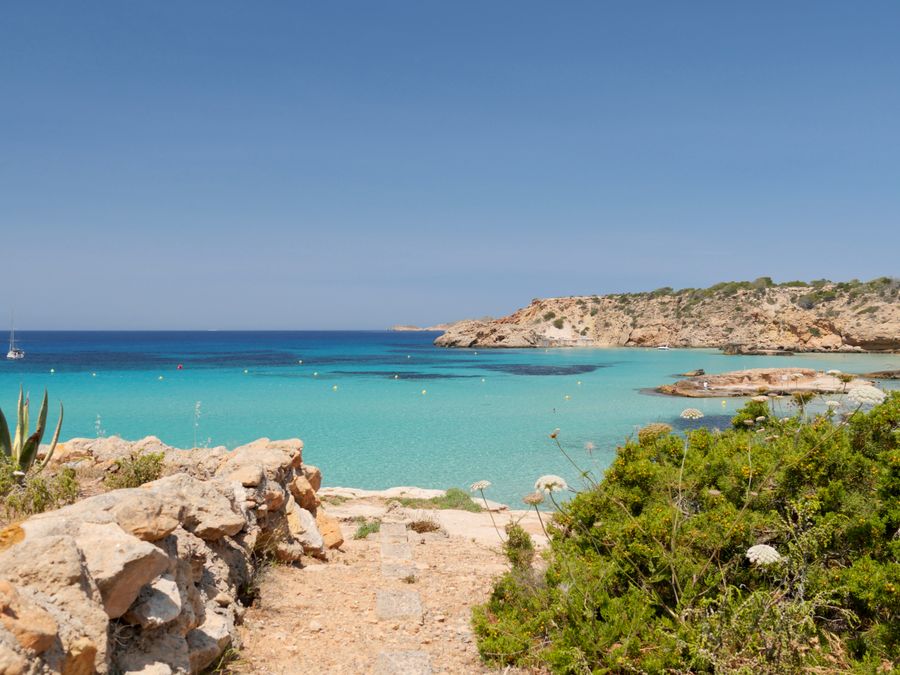
Sant Josep de sa Talaia holds Ibiza's west and south coast: salt flats, pine coves, Es Vedrà and the villages inland from them. This is how the municipality works, and when to come.
248stays in the IMPT hotel database
4area guides
Ibizaisland
Sant Josep de sa Talaia is one of the five municipalities of Ibiza, and the largest by area. It runs from the salt flats south of Ibiza Town round the whole western side of the island to the cliffs above Es Vedrà. Most visitors know it for its coves; residents know it for its villages and quiet winters.
01
A municipality of the west
Sant Josep de sa Talaia is the rural half of Ibiza's map. Apart from the long strip at Playa d'en Bossa, the municipality has no large resort: it is villages, dry-stone walls, almond and olive terraces, pine woods and a coast of small coves. People who want the island's beaches without its nightlife tend to end up here. Winters are genuinely slow, even in the villages that stay open all year round.
The municipality runs across the whole south-west of Ibiza, from the salt flats just south of Ibiza Town (Eivissa) round to the cliffs of Cap Llentrisca and the water below Es Vedrà. Inland, Sa Talaia rises to about 475 m, the highest point on the island, and the lanes below it link one small village to the next. Distances look short on a map and take longer on the road, especially in summer.
02
Villages and small towns
The administrative centre is the village of Sant Josep de sa Talaia itself, set inland under Sa Talaia with a whitewashed church, a small square and the municipal offices. Sant Agustí des Vedrà sits on the Sant Antoni side of the municipality, and Sant Jordi de ses Salines lies close to the airport road. None of them is a resort: they are places where people live, shop and go to school all year round.
On the coast the settlements are smaller and more seasonal. Es Cubells stands on high cliffs above the water, Cala Vedella wraps around its own cove, and Port des Torrent has a short beach and a handful of streets behind it. The little church of Sant Francesc de s'Estany sits near the salt flats. Many businesses in these places close from November to April, and the parking fills early in August.
Sant JosepThe inland administrative centre, with the church, the square and the year-round services.
Sant AgustíA village on the Sant Antoni side of the municipality, with a church and a small square.
Sant JordiThe village closest to the airport, useful for a late arrival or an early flight.
Es CubellsA hamlet on high cliffs above the west coast, with a church and long views.
Cala VedellaA cove settlement that fills in summer and slows to almost nothing in winter.
The village centre and church of Sant Josep de sa Talaia, Ibiza03
Coves and long beaches
The coves are why most people come, and Sant Josep holds a long stretch of Ibiza's coastline. Es Cavallet, Cala Tarida, Cala Molí, Cala Carbó, Cala Vedella, Port des Torrent and Sa Caleta all lie within it, with sand, pebbles or a mixture of both. Some are signed from the main road, others from a turning with no sign at all. Four areas have their own guides on this site and are covered further down this page.
Facilities vary. Some coves have a car park, a bus stop and a seasonal bar; others are reached on foot down a track and have nothing at all. In July and August the car parks fill by mid-morning, so an early start or a late afternoon is easier. Behind several beaches are dunes and salt-tolerant plants rather than more sand, and the rules that protect the posidonia meadows apply in every bay.
Cala TaridaA broad sandy bay on the west coast, one of the larger beaches here.
Cala VedellaA cove with a small settlement behind it, busy in summer and quiet in winter.
Cala CarbóA small pebble inlet on the west coast, with room for few people.
Port des TorrentA shallow sandy bay with a village behind it and sunset views.
Sa CaletaA small beach beside the Phoenician site, reached by a side road.
04
Nature and protected land
Ses Salines Natural Park, declared in 2001 and listed as a Ramsar wetland, covers the south of Ibiza, the sea between the island and Formentera, and the north of Formentera itself. Salt is still harvested here, and the pans change colour with the season. The park protects dunes, salt pans and the shallow meadows of Posidonia oceanica, the seagrass that filters the water, holds the sand and is the reason the sea looks as clear as it does.
The rest of the protected land is on the west. Es Vedrà, Es Vedranell and the western islets have been a nature reserve since 2002, and there is no landing on them. Cap Llentrisca and the slopes of Sa Talaia make up the surrounding park. The small Pitiusan wall lizard lives on the islets and the rocks. Water is scarce here, and the dry-stone walls and terraces are part of how the land was farmed.
Protect itNever anchor over the posidonia meadows, and use the summer buoys where they are installed. Rules change, so check the Balearic decree and the natural park office.
05
Phoenicians, towers and churches
The municipality holds part of the UNESCO World Heritage Site listed in 1999 as Ibiza, Biodiversity and Culture. The Phoenician settlement of Sa Caleta, on a low headland near the airport, is one of its four parts, and the posidonia meadows are another. The walls of Dalt Vila and the necropolis of Puig des Molins, the remaining two, are in Ibiza Town, a short drive east. Sa Caleta is visited on foot and has almost no shade.
Defence left more marks than the Phoenicians did. Watchtowers along the coast, including the Torre des Savinar above Es Vedrà, were built in the centuries when raids from the sea were a real risk, and the churches in the villages doubled as places of refuge. Farming shaped everything else: terraces, cisterns, threshing floors and the dry-stone walls that still divide the fields. Much of that fabric is now maintained by people who farm part-time.
Defence left more marks on this coast than the Phoenicians did.
06
Fish, salt and markets
Fish is the base of the local kitchen: bullit de peix, a fish stew served with rice, and arròs de peix, cooked in a wide pan. Salt from the pans has been an export for centuries. Almonds, olives, figs and hierbas, the aniseed liqueur, come from the inland terraces. Menus follow the season. In summer the coastal kitchens are busy from lunch until late; in winter the cooking moves inland to the villages.
Markets are small and local rather than a day out. Village squares host stalls in season, with produce, cheese, olives and crafts; days change from year to year, so ask at the town hall (Ajuntament de Sant Josep de sa Talaia) or look for the notices in the square. In the villages a few kitchens stay open through the winter for the people who live here; most coastal places shut from November to April.
The fortified church of Sant Jordi de ses Salines, Ibiza07
Four areas, four guides
Four parts of Sant Josep de sa Talaia have their own guides on this site, because they work differently as bases. They are not interchangeable. One is a long beach with buses and a summer bar strip, one lies inside a protected park, and two are small coves at the end of minor roads. Which one suits a stay depends on whether the day ends on foot or in the car.
Staying near Playa d'en Bossa means the shortest transfer and the most going on. Ses Salines suits anyone who wants the park on the doorstep and does not mind a drive for groceries. Cala Comte and Cala d'Hort are for people who will trade convenience for a view and a quieter evening. In all four, August is the month to book early and expect traffic on the coast roads; May, June and September are easier.
Playa d'en BossaA long beach south of Ibiza Town, with the municipality's densest summer base.
Ses SalinesBeaches, dunes and salt pans inside the natural park, close to the airport.
Cala ComteWest-facing coves with shallow water and a sunset over the islets.
Cala d'HortA cove facing Es Vedrà, reached by a small road with limited parking.
08
Getting there and around
Ibiza Airport (IBZ) sits in the south-west of the municipality, about 7 km from Ibiza Town. The straight-line distance from the airport to Sant Josep de sa Talaia village is worked out on this page; road distances and times are longer and vary with traffic, so plan on the map rather than the number. Buses link the airport with Ibiza Town, Sant Antoni, Santa Eulària and the south beaches, with more lines in summer.
A car makes the coves and the inland villages much easier, and parking is the constraint at every beach in high season. Scooters and bicycles work for short hops on quiet lanes, less so on the main coast road in August. Walking is realistic between neighbouring coves on some stretches of coast, but not around the whole municipality. Check the island bus operator for current lines, and note that services thin out from November to April.
09
Where to stay, and when
There are 249 stays in the IMPT hotel database for Sant Josep de sa Talaia, from village houses and inland fincas to apartments near the beach. Anyone with a car who wants coves, walking and quiet evenings will find the municipality suits them, and Ibiza Town stays within reach without the need to sleep in it. Guests who want everything on foot should look at Playa d'en Bossa or the town itself.
The season runs from May to October, and June and September are the easiest months: warm sea, open businesses, fewer people than in August. The water is around 18 °C in May, around 26 °C at the height of summer, and still above 23 °C in September. Spring is greener and windier, with the terraces at their best. October swims well and empties out once the school holidays end.
Out of season much of the coast closes. Many beach bars, boat trips, seasonal buses and restaurants shut roughly from November to April, while Sant Josep village, Sant Jordi and the roads stay open. Flights and ferries are fewer. The tourist tax is charged per person per night by the accommodation, at rates that depend on category and season; check the Govern de les Illes Balears for the current rules before booking.
Check before you goWinter timetables, seasonal bus lines and the tourist tax all change from year to year. Check the Govern de les Illes Balears and the island bus operator before booking.
Stays in Sant Josep: the first 9 of 248 stays in the IMPT hotel database in or close to Sant Josep de sa Talaia, five-star first, then four-star, then by guest score. Each button opens live prices for your dates in the IMPT app.
Is Sant Josep de sa Talaia a good base for an Ibiza holiday?
Yes, if you have a car and want coves rather than a resort. The municipality covers Ibiza's west and south-west coast, with villages inland and Ibiza Town a short drive east. Beaches, walking and sunsets are close; nightlife and shops on foot are not, apart from Playa d'en Bossa.
Which beaches are in Sant Josep de sa Talaia?
Playa d'en Bossa, Ses Salines, Es Cavallet, Cala Comte, Cala d'Hort, Cala Tarida, Cala Molí, Cala Carbó, Cala Vedella, Port des Torrent and Sa Caleta, among smaller inlets. Some sit inside the Ses Salines Natural Park, others are reached down minor roads. Facilities vary from a seasonal bar and a bus stop to nothing at all, so take water.
How far is Sant Josep de sa Talaia from Ibiza Airport?
The airport lies inside the municipality, about 7 km south-west of Ibiza Town. The straight-line distance from the airport to the village of Sant Josep de sa Talaia is worked out on this page. Road distances are longer than the straight line and depend on the route and the traffic, so allow more time in summer.
Do you need a car in Sant Josep de sa Talaia?
It helps. Buses connect the airport with Ibiza Town, Sant Antoni, Santa Eulària and the south beaches, with more lines in summer, but the smaller coves and inland villages are awkward without a vehicle. Parking at the beaches fills early in high season. Check the island bus operator if the plan is to rely on public transport.
What is there to see in Sant Josep de sa Talaia besides the beaches?
The Phoenician settlement of Sa Caleta, part of the UNESCO listing, the watchtowers along the coast including the Torre des Savinar, the churches at Sant Josep and Sant Agustí des Vedrà, and the salt pans at Ses Salines. Inland there are terraces, dry-stone walls and the climb to Sa Talaia, the island's highest point.
Is Sant Josep de sa Talaia quiet in winter?
Much of the coast is. Many beach bars, boat trips, seasonal buses and restaurants close roughly from November to April, and the coves empty. Sant Josep village, Sant Jordi and the main roads stay open, with fewer flights and ferries. The weather is cooler and wetter, and walking is easier without the summer heat.
Where can you watch the sunset in Sant Josep de sa Talaia?
The west coast faces the sunset. Cala Comte and the coves near it are the obvious places, and the cliff paths above Es Vedrà look west as well. Arrive early in summer, since parking is limited and the roads are narrow. Take a torch for the walk back and leave nothing behind.
What is the tourist tax in Sant Josep de sa Talaia?
The Balearic sustainable tourism tax is charged per person per night by the accommodation, whatever the municipality. The rate depends on the type and category of the accommodation and the season, it is reduced in low season and for longer stays, and children under 16 are exempt. Rates change, so check the Govern de les Illes Balears.
Which villages are in Sant Josep de sa Talaia?
The municipality includes Sant Josep de sa Talaia itself, Sant Agustí des Vedrà, Sant Jordi de ses Salines, Es Cubells and the small settlements around Cala Vedella and Port des Torrent. Sant Francesc de s'Estany stands near the salt flats. These are working villages rather than resorts, and several businesses close from November to April.