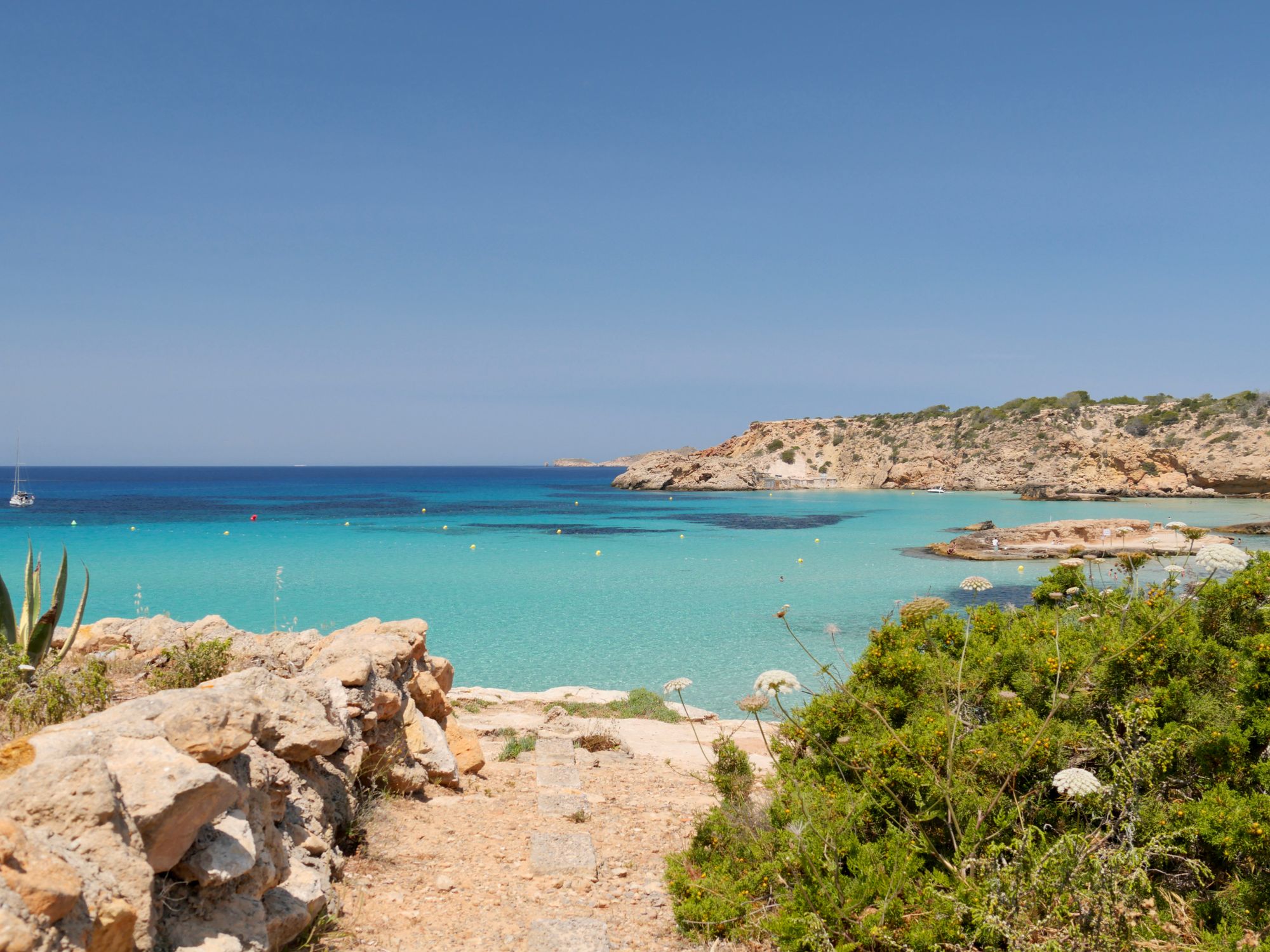
Ibiza is small enough that no coast is far from the next, yet each has its own water, its own evening and its own reasons to stay. Where the bed is shapes the whole trip.
7 minread
Planningtopic
Ibizaisland
The coast chosen decides more than the view from the window. The west is for sunsets, the south for late nights and the airport, the east for shallow water and families, the north for pines and quiet. Sant Antoni de Portmany works as a base for the west and south, with the north a longer drive.
01
Start with the island
Ibiza covers about 572 km² and runs roughly 40 km from end to end, which makes the map easy to hold in mind. Five municipalities share the island: Eivissa in the south-east around the port, Sant Josep de sa Talaia in the south-west, Sant Antoni de Portmany in the west, Santa Eulària in the east and Sant Joan de Labritja in the north. Each has its own water, its own evening and its own reasons to be there.
The main roads radiate from Ibiza Town and from Sant Antoni de Portmany, so most journeys are a spoke rather than a loop. Distances look short on the map, and outside July and August they usually are. In high summer the traffic on the approaches to the beaches makes any estimate unreliable, so it pays to think in half-days: one coast in the morning, another for the evening, with the middle of the day spent where you already are.
02
The west, for sunsets
The west coast faces the open sea and takes the sunset for much of the year, which is why Sant Antoni de Portmany fills in the evening and why the terraces and rocks south of the town are busy at that hour. The coastline here is low and rocky, with small coves rather than long strands, and the water deepens quickly. Wind arrives in the afternoon on many summer days, so morning is calmer for swimming.
South of Sant Antoni the road runs to Cala Comte and Cala d'Hort, both west-facing, with Es Vedrà standing offshore from the second. Cala d'Hort looks across to the islet and the cliffs of Cap Llentrisca; the beach is small and the car park fills early in summer. Bring supplies, as the nearest shops are back in the villages. The sunset at Cala Comte is the reason many people choose this side of the island at all, and the day is best planned around it.
Sant AntoniThe town is the natural base for the west, with buses and a centre that stays open year-round.
Cala ComteLow rocks and shallow shelves make it a sunset spot more than a swimming beach.
Cala d'HortFaces Es Vedrà and is best reached early, before the parking fills.
Es VedràA limestone islet about 380 m high, a nature reserve since 2002, with no landing.
Yachts off Ibiza's coastline from the air03
The south, for late nights
The south holds Ibiza Town, the port and Dalt Vila, the walled upper town on its hill. This is the busiest part of the island and the most urban: ferries leave for Formentera from the harbour, the old town forms part of a UNESCO World Heritage Site, and the streets below the walls stay alive well past midnight in summer. The airport is about 7 km south-west of Ibiza Town, which makes the south the easiest arrival and the loudest.
Playa d'en Bossa runs south from Ibiza Town along a long sandy bay, with the airport a short ride inland. It is the place to be if the evening matters more than the morning: the season is long, the bay is wide, and the road into town is short. Further south, the salt pans and dunes of Ses Salines begin. Buses link the bay with Ibiza Town and the airport, and summer services run later; check the island bus operator for the current timetable.
04
The east, for shallow water
Santa Eulària sits at the mouth of a river on the east coast, with a promenade, a marina and a centre that stays open outside the season. The coast around it is gentler than the west: wider beaches, shallower shelves and water that is sheltered from the swell. Families tend to settle here for the flat walks, the easy entry into the sea and the fact that the town keeps going in winter.
South of Santa Eulària the coast runs through Cala Llonga and on towards Ibiza Town; north of it the road climbs to Es Canar and the Punta Arabí market, held on Wednesdays in season. Cala Sant Vicent lies further north again, a long sweep of sand at the end of a valley, in Sant Joan de Labritja. Parking at the smaller coves fills by mid-morning in July and August, and the roads in are narrow.
Santa EulàriaA working town with a promenade, a marina and buses, open through the winter.
Cala LlongaA sheltered bay south of town with shallow water and a bus link.
Es CanarBase for the Punta Arabí market, held on Wednesdays in season.
05
The north, for pines and quiet
The north is the quietest of the four coasts and the least built up. Sant Joan de Labritja is a scatter of villages, almond terraces and pine, and the roads are narrow and shaded. Portinatx sits at the end of one of them, in a group of small bays with notably clear water; the coast between here and Cala Sant Vicent is good for kayaking when the sea is calm.
This is walking and swimming country rather than nightlife, and the evenings are early. It suits a slow week: a different cove each morning, lunch where you land, and a drive back through the pines. The trade-off is distance. Portinatx and Sant Joan are a long way from Ibiza Town and further from the airport, so the north works best as a stay, not a day trip. Buses reach the main villages, but a car makes the coves practical.
Pines above turquoise water on the Ibiza coast06
What the season changes
Much of the tourism business on Ibiza closes roughly from November to April: many hotels, beach bars, boat trips and seasonal buses stop, and some restaurants shut with them. The main towns, Eivissa, Santa Eulària and Sant Antoni de Portmany among them, stay open year-round, and so do the ferries to Formentera, though with fewer sailings. Flights are fewer too, and the island feels like a place where people live rather than a place that hosts.
Water temperature decides how the coast is used. It sits at about 14-15 °C in February and March, about 18-19 °C in May, 22-23 °C in June, roughly 25-26 °C in August and 23-25 °C in September. Outside the summer months the beaches are for walking, and the swimming is for people who do not mind the cold. In May and October the island is quiet and the light is long, which suits walking and cycling more than lying on sand.
In August the island is full and in February the same road is empty, and both versions are worth seeing.
Check before you goClosures, timetables, the tourist tax and anchoring rules all change. Check the Govern de les Illes Balears and the island bus operator before booking.
07
Moving between the coasts
Bus routes fan out from Ibiza Town to Sant Antoni de Portmany, Santa Eulària, the airport and the main beaches, with more lines in summer than in winter. A car gives access to the small coves and the north, where services thin out. Bikes and scooters work on the quieter lanes but not on the main roads in August. Parking near the popular beaches is limited and fills early; the cars on the verges are not a model to copy.
The base decides how much of the island is within reach. Staying in the south puts the airport, the old town and the salt pans within a short drive, but every trip west or north is a crossing. Staying in Sant Antoni de Portmany puts the west coast and the south close and makes the north a longer, deliberate day out. A base in Santa Eulària or the north trades convenience for quiet.
08
The seagrass under it all
Posidonia oceanica is a flowering seagrass found only in the Mediterranean, and the meadows between Ibiza and Formentera are part of why UNESCO listed the island in 1999 as Ibiza, Biodiversity and Culture. The meadows grow from the shallows to about 30-40 m deep, shelter young fish and hold the sand in place, which is why the water looks the way it does. They also store carbon and protect the coast from swell, which is a lot to ask of a plant that most visitors never see.
Anchoring over the meadows is regulated by a Balearic decree, and mooring buoys are installed in some bays in summer. If you are on a boat, use a buoy where one exists and ask the boat operator where anchoring is allowed. From the beach, the same plant shows up as dark patches under the surface and as loose fibre on the sand. Ses Salines Natural Park, declared in 2001, covers the south of Ibiza, the north of Formentera and the sea between, and salt is still harvested there.
Protect itAnchor over sand, not seagrass. Use a marked buoy where one is provided, and check the current rules with the natural park office before mooring.
09
Choosing for the trip
Match the coast to the trip. For sunsets and a base that reaches most of the island, the west and Sant Antoni de Portmany make sense. For late nights, the port and the old town, the south is the obvious choice. For shallow water and early evenings, the east. For pines, walking and empty coves, the north. Splitting a week between two coasts is common, and it cuts the driving.
Whichever coast suits, the island rewards early starts. The light is best before ten, the car parks are empty and the water is calm. In high summer, plan the day around the coast at hand rather than crossing the island for a beach read about in advance. The best swim is usually the nearest one at the right hour. Book a base with a short walk to a cove and the rest becomes optional.
Sunset firstBase in the west, around Sant Antoni de Portmany, for the evening light.
Nightlife firstBase in the south, near Ibiza Town or Playa d'en Bossa, and walk home.
FamiliesBase in the east around Santa Eulària for shallow water and a working town.
Quiet firstBase in the north around Sant Joan de Labritja and Portinatx.
FAQ
Questions people ask.
How does choosing your coast on Ibiza change a trip?
It decides how much driving the week involves and what the evenings look like. A west base puts sunsets and the quieter coves close, a south base puts the port, the old town and the airport close, and the east and north trade access for space. Distances are short, but summer traffic makes repetition costly.
Which coast of Ibiza suits a first visit?
The south and the west between them cover most first trips: Ibiza Town and Dalt Vila, Playa d'en Bossa if the nights matter, and the sunset coast around Sant Antoni de Portmany and Cala d'Hort. The east and north are easy day trips from either, and a week allows one change of base.
Is Sant Antoni de Portmany a good base for choosing your coast on Ibiza?
It works well for the west and the south. The town stays open year-round, buses run to Ibiza Town and the airport, and the sunset coves are close. The north, Portinatx and Sant Joan de Labritja, is a longer drive, so treat it as a day out rather than a routine.
Which coast of Ibiza is best for families?
The east around Santa Eulària, with Cala Llonga and Es Canar nearby. The shelves are shallow, the town has a promenade and a marina, and it stays open outside the season. The south is busier and the west is rockier underfoot, though Cala Comte and Cala d'Hort suit older children who swim well.
Where on Ibiza is best for sunsets?
The west coast, from Sant Antoni de Portmany south to Cala Comte and Cala d'Hort. The sun drops into the sea there for much of the year, and Es Vedrà stands offshore from Cala d'Hort. Arrive early in summer, as parking is limited and the best spots on the rocks go first.
How easy is it to travel between the coasts of Ibiza?
Easy in distance, slower in practice in July and August. Main roads link Ibiza Town with Sant Antoni de Portmany and Santa Eulària, and buses serve the main beaches, with more lines in summer. The north is the exception: narrow roads and fewer services make a car useful. Check the island bus operator.
Does choosing your coast on Ibiza matter out of season?
Yes, more than in summer. From roughly November to April many hotels, beach bars and seasonal buses close, so the towns that stay open, Eivissa, Santa Eulària and Sant Antoni de Portmany among them, matter more than the beach on the doorstep. Winter is for walking, and the water is cold.
Which coast of Ibiza is quietest in high summer?
The north, around Sant Joan de Labritja and Portinatx, where the roads are narrow, the coves are small and the evenings end early. It is not empty in August, but it feels nothing like the south. Book ahead, as the number of places to stay is limited and many close in winter.
Can one base cover the whole island of Ibiza?
One base can reach everywhere, but not comfortably every day. Sant Antoni de Portmany covers the west and south well and the north with a longer drive; a south base covers the town and the airport. Splitting a week between two coasts is common and cuts the time spent in the car.