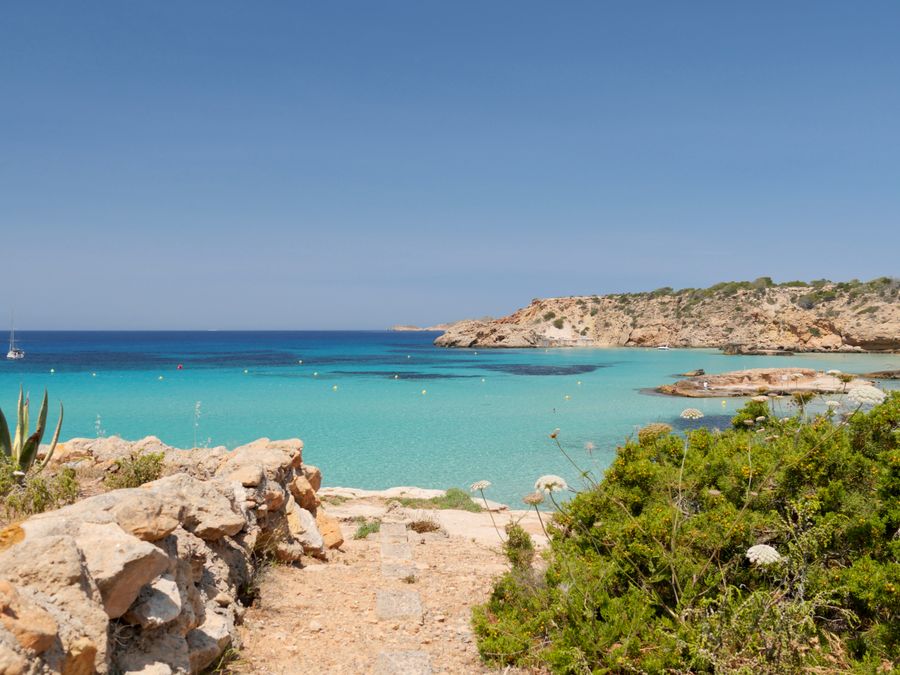
A west-coast bay of shallow water and low islets, with sunsets that draw a crowd and quiet mornings that do not. It makes a practical base for the south-west of Ibiza.
16.3 kmfrom IBZ, straight line
11stays in the IMPT hotel database
Westcoast
Cala Comte is a cluster of small sandy inlets on the west coast of Ibiza, about 16.3 km from the airport in a straight line, with shallow clear water and low islets offshore. It works well as a base for the south-west: quiet mornings, strong sunsets, and Cala d'Hort, Sa Talaia and the watchtowers within a short drive.
01
What Cala Comte is like
Cala Comte sits on the far west coast of Ibiza, in the municipality of Sant Josep de sa Talaia, where the land drops to a shallow shelf of sand and flat rock. Several small inlets make up the place rather than one long beach, and low islets lie just offshore, softening the swell. The water is clear and stays shallow a long way out, which is why families and weak swimmers tend to arrive early, before the afternoon wind picks up.
Behind the coves the coast road climbs through pine and scrub, with views back over the water towards Es Vedrà and the islets. Building is low-rise and spread out, and the area feels less developed than the bays closer to Ibiza Town. In high summer the parking fills early and the tracks down to the water carry a steady stream of people, so the place reads busy at midday and much quieter at either end of the day, especially in the evening after sunset.
02
Beaches and sights nearby
The inlets of Cala Comte are the main draw: sand in the middle, flat rock at the edges, and shallow water that suits children. Offshore, the islets and the rocky bottom make a natural place to snorkel, and the posidonia meadows that keep the water clear lie further out. A short drive south the coast turns wilder at Cala d'Hort, where the view opens to Es Vedrà and the cliffs below the tower. Bring a mask and you will see fish within a few metres of the rock.
There is more within easy reach to fill a day. Sa Talaia, the highest point on Ibiza at about 475 m, gives a wide view over the whole south-west and the sea on both sides. The watchtower of Torre des Savinar stands above the cliffs facing Es Vedrà, reached on foot along a rough track. Further east, the salt pans and dunes of Ses Salines Natural Park and the walled old town of Eivissa make a longer outing by car.
The covesSand in the middle, flat rock at the edges, shallow water and calm mornings.
Cala d'HortA stony cove to the south with a direct view of Es Vedrà.
Sa TalaiaThe highest point on Ibiza, about 475 m, with a wide view south-west.
Torre des SavinarA coastal watchtower above the cliffs, reached on foot.
Es VedràA limestone islet about 380 m high, a nature reserve with no landing.
Clear shallow water at Cala Comte, Ibiza03
Who it suits
Cala Comte suits people who want to swim, eat and watch the light change without moving far. Families do well here because the water is shallow and the flat rock gives older children somewhere to explore. Couples and groups of friends come for the sunsets, which face straight out to sea with nothing in the way. Walkers and cyclists use the coast road and the inland lanes as a base for the south-west.
It suits less well if you want a town on the doorstep or something to do after dark beyond a meal and the sunset. There is no real village here, no promenade and no nightlife strip, and the road back is unlit. Anyone without a car will find the evenings long and the buses thin. Those who want shops, pharmacies and year-round restaurants within walking distance should look at Sant Antoni de Portmany or Sant Josep de sa Talaia instead.
04
Evenings and food
The evening here has one event, and it is the sunset. People arrive towards the end of the afternoon with blankets and drinks and settle on the rock ledges facing west, and the show lasts until the light goes. After that the area empties quickly. Food is simple and seasonal: small beach bars and restaurants above the coves serve fish, rice and grilled meat through the summer months, with a few tables and a short menu.
Booking matters in July and August, when the few tables near the water go early. Out of season most of these places close, some for the whole winter, so the nearest dependable year-round eating is in Sant Josep de sa Talaia or Sant Antoni de Portmany, a short drive inland or up the coast. Check what is open before counting on dinner beside the water, and carry a torch for the walk back up the track.
05
Getting there from the airport
Ibiza Airport lies about 16.3 km away in a straight line, though the road route is longer because it bends inland around the hills. By car the natural line is towards Sant Josep de sa Talaia and then west on the coast road, following signs for the coves. Taxis work too, but in high summer the return leg needs planning, as demand outstrips supply when the sunset crowd leaves at the same moment.
Buses run in summer and connect the area with the nearest towns, though services thin out in spring and autumn and mostly stop in winter. Schedules change with the season, so check the island bus operator before relying on one. Wherever you stay, the last stretch to the water is on foot, down tracks and steps, so allow time, wear shoes that grip on hot rock and carry what you need for the day.
Straight lineAbout 16.3 km from Ibiza Airport, though the road route is longer.
By carThe simplest way, following signs for the coves from Sant Josep de sa Talaia.
By busSummer services link the area with nearby towns; check the island bus operator.
By taxiBook the return in high season, when demand outruns supply after sunset.
Sailing boats off the rocks at Cala Comte, Ibiza06
Getting around the area
The coves of Cala Comte are close together on foot, linked by paths, steps and short tracks, and walking between them is the easiest way to find a quiet corner. A car or a scooter makes the wider area practical, including Cala d'Hort, the watchtower and the summit of Sa Talaia, none of which is served well by public transport. Fuel and supplies are in the nearest towns, so fill up before you come out for the evening.
Parking is the constraint. The signed areas near the coves are small and fill early in summer, and parking on the scrub beside the road damages the ground and is often prohibited. Rules on access tracks, one-way sections and vehicle numbers change with the season, and the Consell d'Eivissa enforces them. Read the signs when you arrive rather than following the car in front, and leave room for cyclists on the bends.
Check before you goParking, access tracks and one-way sections around Cala Comte change with the season. Check current rules with the Consell d'Eivissa before driving down to the coves.
07
When to go and what closes
Late spring and early autumn are the best of it. In May the sea is around 18-19 °C and the coves are half empty; September holds water at about 23-25 °C with softer light and thinner crowds. June is warm at 22-23 °C and still manageable. August brings about 25-26 °C and the most people, with parking gone by mid-morning and little quiet left on the rock.
The sea itself is coldest in February and March, around 14-15 °C, which suits walkers more than swimmers. Much of the tourist business around Cala Comte closes roughly from November to April: beach bars, boat trips, seasonal buses and many restaurants. The main towns stay open year-round, but flights and ferries are fewer in winter. Between those dates the coves are quiet and often empty, provided you bring what you need and do not count on a lift back.
May and JuneSea around 18-19 °C in May, 22-23 °C in June, with fewer people.
SeptemberWater still about 23-25 °C, softer light and thinner crowds.
AugustThe busiest month, sea about 25-26 °C, parking gone by mid-morning.
WinterMost beach business closes roughly November to April; the coves are empty.
08
How to visit lightly
The clear water is a working system, not a setting. Posidonia oceanica, a flowering seagrass found only in the Mediterranean, grows on the seabed offshore and holds the sand in place and the water clean. Anchoring over the meadows is regulated by a Balearic decree and mooring buoys are installed in some bays in summer. If you arrive by boat, take a buoy or anchor over sand, never over the dark patches.
On land, the small things add up. Take your litter back to the bins in town, since bins near the coves are limited and the wind carries what is left. Do not take sand, pebbles or plants, keep to the marked paths through the scrub, and carry drinking water, because there is little shade and no reliable tap. On a dry island the water you bring matters more than the weight of it.
The clear water is not an accident: the meadows offshore keep it that way.
Protect itThe posidonia meadows offshore are protected by a Balearic decree. Anchor only over sand or on an installed buoy, and never over the dark seagrass patches.
Where to wake up
Stays in Cala Comte
Stays in Cala Comte: 11 stays in the IMPT hotel database in or close to Cala Comte, five-star first, then four-star, then by guest score. Each button opens live prices for your dates in the IMPT app.
Cala Comte is about 16.3 km from Ibiza Airport in a straight line. The road route is longer because it winds inland around the hills, and the last stretch to the water is on foot. Allow more time than the distance suggests in summer, when traffic on the coast road slows and the parking near the coves fills.
Can you swim at Cala Comte?
Yes. The coves are shallow over sand and flat rock, and the water stays clear a long way out, so swimming is easy for most people. The rocky edges are better for snorkelling than for jumping in. Watch children near the islets and where boats pass, and swim early when the water is calmest.
Is Cala Comte a good place to watch the sunset?
Yes. The coast here faces west and the sunsets over the islets are the reason many people come. Arrive in the late afternoon, since the rock ledges fill in summer, and bring something to sit on. The light fades quickly once the sun goes, and the track back to the road is unlit.
Do you need a car to stay at Cala Comte?
A car or a scooter makes the area much easier, because the coves, Cala d'Hort, the watchtower and Sa Talaia are spread out and poorly served by public transport. Buses run in summer and thin out in spring and autumn. Without a vehicle, plan around the nearest towns and check the island bus operator's current timetable.
Are there restaurants and bars at Cala Comte?
Small beach bars and restaurants above the coves serve simple food through the summer months, usually fish, rice and grilled meat. Tables are few and booking helps in July and August. Most shut roughly from November to April; out of season the nearest year-round eating is in Sant Josep de sa Talaia or Sant Antoni de Portmany.
Is Cala Comte busy in August?
Yes. August is the busiest month at Cala Comte, with parking gone by mid-morning and little space on the rock ledges. The sea is at its warmest, around 25-26 °C, which brings everyone at once. Come at the start of the day for quiet water, or accept the crowd and walk a few minutes to a smaller inlet.
What closes at Cala Comte outside the summer season?
Most of the seasonal business closes roughly from November to April: beach bars, boat trips, seasonal buses and many restaurants. The coves themselves stay open and are often empty, and the main towns keep their shops and services through the winter. Flights and ferries are fewer, so check timetables before planning a winter stay.
Can you walk from Cala Comte to Cala d'Hort?
It is a walk on roads and rough tracks rather than a coastal path, and the distance is short by car but longer on foot around the inlets and hills. There is little shade and no water on the way. Walkers should check the route locally, carry water and avoid the middle of the day in summer.
Is Cala Comte suitable for children?
Yes. The water is shallow and calm in the inlets, and the flat rock gives children room to move about. Supervision is needed throughout: the rock is hot underfoot in August, shade is scarce and the edge shelves away in places. Bring water, hats and shoes, and keep children away from the outer rocks where boat traffic passes.