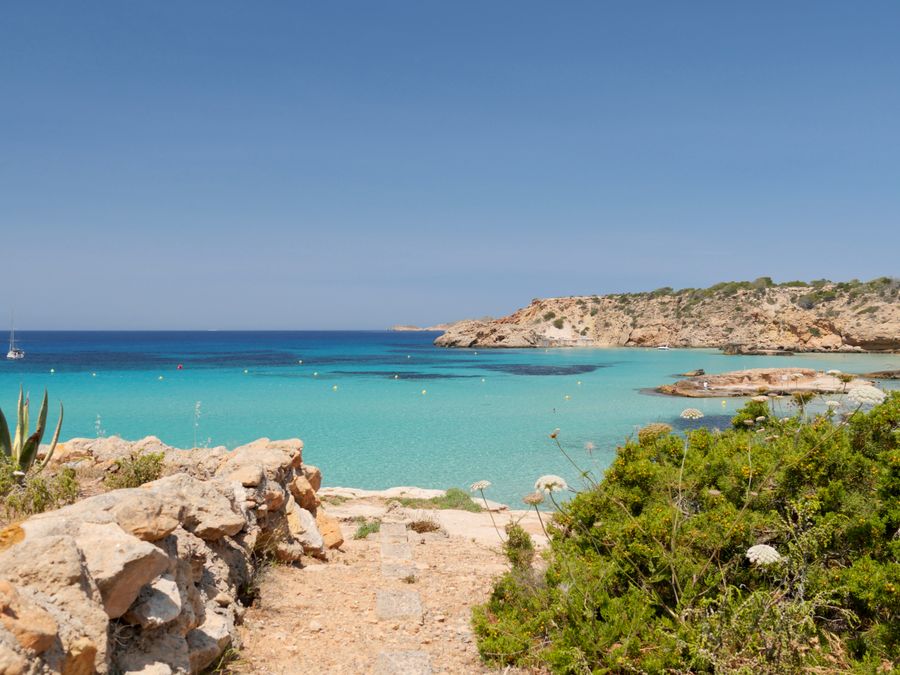
A small cove on Ibiza's south-west coast, with Es Vedrà filling the horizon. Quiet, protected, and best reached early or late.
13.1 kmfrom IBZ, straight line
18stays in the IMPT hotel database
Westcoast
Cala d'Hort is a small sandy cove on the south-west coast of Ibiza, in Sant Josep de sa Talaia, looking straight at Es Vedrà. It sits inside a protected natural park, the lane down ends at the beach, and there is little behind it but dry hills. This page covers what the area is like, what is near it, and how to base yourself there.
01
A cove under Es Vedrà
Cala d'Hort is a short sandy cove on the south-west coast of Ibiza, in the municipality of Sant Josep de sa Talaia. The lane down to it ends at the beach, and behind the sand there is little more than dry hills of pine and scrub. The water is clear and shelves gently at first. The cove faces west, so the afternoon and evening light comes straight in across the water, and the sun sets behind the island opposite.
Es Vedrà is the reason the cove is known. The islet is limestone, about 380 m high, and it lies a short way offshore, close enough to fill the view from most of the beach. It has been a nature reserve since 2002, together with Es Vedranell and the western islets, and landing on it is not permitted. The land around Cala d'Hort, Cap Llentrisca and Sa Talaia is protected as a natural park.
Es Vedrà is a limestone islet about 380 m high, and the reserve allows no landing.
02
A protected coast
Ses Salines Natural Park is the protected area that shapes this coast. It was declared in 2001 and takes in the south of Ibiza, the north of Formentera and the sea between them, including the meadows of posidonia that keep the water clear. It is also a Ramsar-listed wetland, and salt is still harvested from the salt pans. UNESCO listed the meadows, Dalt Vila, Sa Caleta and the Puig des Molins necropolis as one World Heritage Site in 1999.
Posidonia oceanica is a flowering seagrass found only in the Mediterranean. The meadows here grow from the shallows down to about 30 to 40 m, and they hold the sand in place and keep the water unusually clear. Anchoring over them is regulated by a Balearic decree, and mooring buoys are installed in some bays in summer. Take a buoy where one is there, and do not drop an anchor on the dark patches. The meadows are also why the water off Cala d'Hort looks as it does.
Waves on the shore at Cala d'Hort, Ibiza
Protect itThe posidonia meadows are protected and anchoring over them is regulated. Use a mooring buoy where one is installed and leave the seagrass undisturbed.
03
Beaches and coves nearby
The cove itself is the first beach. It is short, sandy and shallow at the edges, and it fills early in July and August. Shade is scarce on the sand, so most people arrive in the morning or come back for the last hours of light. The seabed slopes away further out, and small boats come and go, so keep an eye on children. The view does the work: Es Vedrà sits straight ahead and the sun goes down behind it.
A short drive north along the same coast brings several other coves. Cala Carbó is smaller and quieter. Cala Vedella is a deeper bay with a longer beach and more around it. Past the headland, Cala Comte opens to the west and is known for the sunset. Inland, Sa Talaia is the highest point on Ibiza, about 475 m, with a road to the summit area and a view over the whole island and the sea on both sides.
Cala d'HortThe cove itself: short sand, clear water and Es Vedrà straight ahead.
Cala CarbóA small cove just north with less space and fewer people.
Cala VedellaA wider bay further north with a longer beach and more services.
Cala ComteAround the headland, several small beaches and a west-facing sunset.
Sa TalaiaThe highest point on Ibiza, about 475 m, with wide views.
04
Who Cala d'Hort suits
The area suits people who want quiet evenings and a view more than a resort. Couples, walkers and anyone with a car do well here, because the coast road makes the rest of the island easy and the cove itself asks nothing of you. It is also a workable base for a first visit to Ibiza, since the airport is close and Dalt Vila is a short drive east. The nearest village with year-round life is Sant Josep de sa Talaia.
It does not suit everyone. There is no town at Cala d'Hort, no promenade and very little nightlife, and evenings end early once the sunset is over. Families with small children will find the first metres of water gentle, but the beach is small and can be busy. Anyone without a car should think carefully about walking and limited buses. For nightlife, Playa d'en Bossa and Sant Antoni de Portmany are where people go, and both mean a drive back.
05
Evenings and food
Evenings here are built around the sunset. A handful of places sit close to the cove, most of them seasonal, and they fill as the light drops, so book ahead in July and August or eat earlier. Expect rice dishes, grilled fish and the local fish stew, bullit de peix, rather than anything elaborate. The west-facing view does most of the work. In September the crowd thins and the light softens.
For a wider choice, Sant Josep de sa Talaia is a short drive inland and stays open through the winter, and Sant Antoni de Portmany has more in every category. Supplies are easiest to pick up in the village on the way rather than at the cove. The village also has the pharmacy, the bank and the small shops. Late nights mean driving, because there is nothing at Cala d'Hort beyond a meal and the walk back to the car.
SunsetThe beach faces west and the light is the main event.
Book aheadPlaces near the cove are few and fill in high summer.
Local dishesRice, grilled fish and bullit de peix are the things to order.
VillageSant Josep de sa Talaia has year-round places to eat and shop.
Flowers on the slope above Cala d'Hort, Es Vedrà beyond, Ibiza06
Getting there from the airport
Ibiza Airport (IBZ) sits in Sant Josep, about 7 km south-west of Ibiza Town. Cala d'Hort is roughly 13.1 km from it in a straight line, though the road is longer: it runs through Sant Josep de sa Talaia and then down a narrow lane to the coast. The last stretch is slow, and in summer it carries cars, cyclists and people walking down to the water. Distances look small on a map and take longer on the ground.
A car is the simplest option, whether hired at the airport or in town, and it makes the whole west coast easy. Seasonal buses run on the island, with more in summer, though times change; check the island bus operator before relying on one. Taxis wait at the airport. Car hire is in heaviest demand in July and August, so booking ahead is sensible, and the smallest cars are easier on the lane down to the cove.
Check before you goParking at the cove is limited and fills early in summer, and the lane down is narrow. Check current access and bus times with the island bus operator before setting out.
07
Getting around
Distances on this coast are short but the roads are slow. A car gives the most freedom: the west coast is a chain of coves and viewpoints linked by lanes, and the main road runs inland through Sant Josep de sa Talaia. Parking at the smaller coves is limited, so arrive early or be ready to walk the last part. The lane to Cala d'Hort is narrow enough that meeting another car takes care.
Walking is good if you keep to the cooler hours, since the hills are dry and shade is thin. Cycling works for fit riders, but the gradients are real and the summer heat is not. Seasonal buses link the main villages and some beaches, and times change with the season, so check the island bus operator. Taxis are easy to find in Sant Josep and Sant Antoni de Portmany. Carry water on any walk; the nearest shop is in the village.
By carThe easiest way to link the coves, with early arrival for parking.
On footShort walks between coves are good; carry water and start early.
By busSeasonal services run; check current routes with the island operator.
By taxiAvailable in the villages, useful for a sunset visit without driving.
08
When to go and what closes
May, June, September and early October are the best months: warm water, open places and room to park. July and August are hot and busy, and the cove fills early. The sea is about 18-19 °C in May, 22-23 °C in June, 25-26 °C in August and 23-25 °C in September. Spring and autumn light is gentler and the hills greener after rain. The sea is at its warmest in August and stays swimmable into October.
Much of the tourism business on this coast closes roughly from November to April: many beach bars, boat trips and seasonal restaurants shut, and some small hotels too. The main towns stay open year round, flights and ferries are fewer, and the cove is left to walkers and local traffic. Visiting lightly matters here, because the park and the meadows are the reason the water looks as it does. Take litter away, keep to paths and do not take sand or stones home.
Where to wake up
Stays in Cala d'Hort
Stays in Cala d'Hort: the first 12 of 18 stays in the IMPT hotel database in or close to Cala d'Hort, five-star first, then four-star, then by guest score. Each button opens live prices for your dates in the IMPT app.
Cala d'Hort is on the south-west coast of Ibiza, in the municipality of Sant Josep de sa Talaia. The cove faces west towards Es Vedrà and sits inside a protected natural park. Sant Josep de sa Talaia is the nearest village, Ibiza Town is a short drive east, and the airport is roughly 13.1 km away in a straight line.
How far is Cala d'Hort from Ibiza Airport?
About 13.1 km in a straight line. The road is longer, since it runs through Sant Josep de sa Talaia before turning down the lane to the coast. The distance is short but the last stretch is slow. In summer, allow extra time for traffic on the coast road and for limited parking at the cove.
Can you swim at Cala d'Hort?
Yes. The water is clear and shelves gently at the edge, which makes entry easy. Further out the seabed drops away, and small boats come and go, so stay close to the shore with children. There is no river or current to worry about, but take the usual care on a west-facing beach when the wind picks up.
Can you land on Es Vedrà from Cala d'Hort?
No. Es Vedrà has been a nature reserve since 2002, together with Es Vedranell and the western islets, and landing on it is not permitted. The islet is seen from the shore at Cala d'Hort or from a boat that stays offshore. Where a trip is offered, check the conditions with the operator before booking.
Is there parking at Cala d'Hort?
Parking near the cove is limited and fills early in summer. The lane down is narrow, with few places to turn. Arriving before mid-morning or late in the day helps. Rules and access can change with the season, so check with the Consell d'Eivissa before setting out, especially in July and August.
Where can you eat near Cala d'Hort?
A handful of places sit near the cove, most of them seasonal and busy around sunset. Booking ahead helps in July and August. Sant Josep de sa Talaia, a short drive inland, has more choice and stays open through the winter. Expect rice dishes, grilled fish and bullit de peix rather than anything formal.
Do buses run to Cala d'Hort?
Seasonal bus services cover parts of the west coast, with more in summer than in winter, but routes and times change. Check the island bus operator for current services before planning a day without a car. A taxi from Sant Josep de sa Talaia or Sant Antoni de Portmany is the simpler alternative for an evening visit.
When is the best time to visit Cala d'Hort?
May, June, September and early October give warm water and space on the beach. The sea is about 18-19 °C in May and 23-25 °C in September. July and August are hot and busy, and parking fills early. Sunset is the busiest hour at any time of year, so arrive well before it if the cove matters to the plan.
What closes at Cala d'Hort out of season?
Much of the seasonal business closes roughly from November to April: beach bars, boat trips and some restaurants. The cove itself stays open, as do the main towns, but flights and ferries are fewer. Check opening times before travelling outside the main season rather than assuming a place will be open.
Photo credits: Philip Larson from McLean, VA, US, CC BY-SA 2.0, via Wikimedia Commons; Gerda Arendt, CC0, via Wikimedia Commons; Itelchan, CC BY-SA 4.0, via Wikimedia Commons.
Watch
Ibiza
Half a minute of Ibiza, from the old town of Dalt Vila to the coves and headlands of the coast.
Captions are built in; the transcript is on the Ibiza page.
Video: JUAN CARLOS NAVALON SANCHEZ, Steven HAuse, Haseeb Ahmad, Josh Tavernier, Boris Ivas, Luca Musella on Pexels