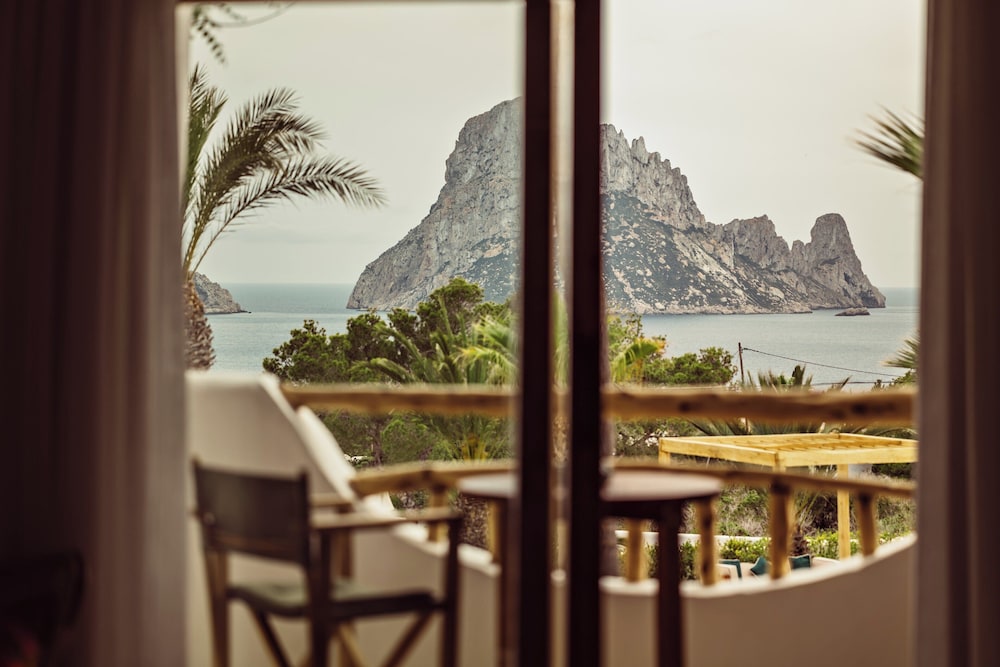
A rock islet rising about 380 metres out of the sea off the south-west coast. It is a nature reserve: you can circle it or watch it, but not land.
~380 mrock above the sea
2002reserve declared
No landingboats circle only
Es Vedrà is the island's most recognisable landmark. The best way to see it depends on the light you want and how much time you have: a short cliff walk for sunset, or a boat on a calm morning.
01
What Es Vedrà is
Es Vedrà and its smaller neighbour Es Vedranell sit just off the south-west coast. Together with nearby islets they form a nature reserve, next to the Cala d'Hort, Cap Llentrisca and Sa Talaia natural park.
The islets are a refuge for seabirds and endemic lizards. Landing, climbing and disturbing the wildlife are not allowed.
Es Vedrà has attracted stories for centuries, from sirens to strange lights. The reality is quieter and more interesting: a steep limestone rock that has stayed largely undisturbed because it is so hard to reach.
02
Seeing it from the shore
Cala d'Hort beach faces the islet directly. The road above it has viewpoints, and a path leads up to Torre des Savinar, a stone watchtower on the cliff.
The walk to the tower is short but steep and stony. Wear proper shoes and bring water.
In summer, the viewpoints are busy around sunset and the roads are narrow. Arriving an hour early, or coming in the morning when the light is softer and the crowds absent, makes for a better visit.
The cliffs above Cala d'Hort are the classic viewpoint.
Most people see Es Vedrà for the first time from a cliff at sunset, and come back to see it again.
03
Going by boat
Boat trips leave from Sant Antoni, Ibiza Town and the south-west coast, and some combine Es Vedrà with nearby coves. Calm days give the best views and the most comfortable crossings.
Choose operators who anchor on sand or use buoys, so the posidonia below stays intact.
Most trips last a few hours and include a swim stop. Ask how many people are on board, where the boat will stop and whether it uses buoys; smaller groups and calm days give the best experience for you and the sea.
A boat passing the rock formations off Es Vedrà.
Protect itKeep a respectful distance from the cliffs and seabird nests, and take all rubbish back to shore.
04
Rules in the reserve
Landing on the islets is not allowed. Fishing and anchoring are restricted in parts of the reserve.
Drone flights are restricted in protected areas, and the cliffs host nesting birds in spring.
Check before you goReserve rules can change. Ask your boat operator or check with the Balearic environment department.
05
When to go
Sunset is the busiest time at the viewpoints, especially in summer. Arrive early for parking and a spot on the cliff.
For a boat trip, mornings are often calmer, and spring and autumn are quieter than high summer.
06
The walk to Torre des Savinar
The tower stands on the cliffs south of Cala d'Hort, looking straight across to Es Vedrà. It was one of a chain of watchtowers built to warn of raiders approaching from the sea.
The path starts from a small parking area off the road and climbs over loose stone. It is short but steep; allow time, wear proper shoes and take water. At the top, keep back from the cliff edge, which is unfenced.
Es Vedrà at sunset from the south-west coast.
Protect itStay on the existing path and don't build stone stacks; they disturb the plants and the soil on the cliff.
07
What lives on the islets
The islets are home to nesting seabirds and to the Ibiza wall lizard, a species found only on the Pitiusas. Populations on small islets can differ in colour and pattern from those on the main island.
Because there is no landing, the wildlife is largely left alone. Watching from a distance, with binoculars from the boat or the cliff, is the best way to see it.
08
Nearby, on the same day
Cala d'Hort is a small beach with a few restaurants, a good place to swim before or after the walk. Further along the coast, Cala Vedella and Cala Carbó are sheltered coves.
The interior of the south-west is rural, with terraces, pine and small roads. If you are driving, go slowly; cyclists and walkers use the same lanes.
SwimCala d'Hort, Cala Carbó, Cala Vedella.
WalkTorre des Savinar, the coast path above Cala d'Hort.
EatBeach restaurants at Cala d'Hort, in season.
09
Access to Cala d'Hort
The road to Cala d'Hort leaves the Sant Josep de sa Talaia side and narrows through fields and pine. In high season the small car park and the roadside spaces fill early, and parking arrangements can change. Check the current position with the Consell d'Eivissa before setting out. A seasonal bus may serve the beach; confirm times with the island bus operator. The final stretch is narrow and not suited to large vehicles. Allow extra time in summer.
The last approach to the beach is on foot in places, so allow time and park only where signs permit. The beach is small, with clear water and little natural shade. Facilities are seasonal and may be closed outside the main months. Carry water and food if needed. The cliff paths begin nearby; keep to marked routes and respect private gates and fences. Do not enter land beyond gates, even if the view is open.
If the car park is full, do not block the road, field entrances or bus stops. Turn back and return later, or choose another beach on the south-west coast. Sunset draws a crowd to the viewpoints; late afternoon is the busiest time. A morning visit is calmer and leaves more room for the cliff walk. Check sea conditions before any boat trip, as the wind can rise quickly. The road has no wide verges.
10
The islet as a seamark
Es Vedrà is a fixed point on the skyline for anyone sailing the water between Eivissa and Formentera. Its steep limestone sides rise straight from deep water, and there is no landing. Sailors use the profile to read position along the south-west coast. In poor visibility the islet disappears, and the crossing becomes a matter of instruments and experience. Small craft should keep a safe distance. The islet gives no shelter.
The reserve that covers Es Vedrà, Es Vedranell and the western islets was declared in 2002. Protection is not only for the rock: it includes the seabed and the species that depend on it. Boundaries and no-entry zones are set by the Balearic government, and notices at the coast and on charts explain them. Do not assume a quiet cove is open to landing. Check current rules before leaving the shore.
From the cliff the islet can look close, but the water between is deep and exposed. Swimming toward Es Vedrà is not a sensible plan: the distance is greater than it appears, currents run, and boat traffic adds risk. Watch from the shore or join a boat trip with a licensed operator. Carry binoculars if wildlife is the interest, and keep voices low near the cliffs. The crossing should be left to those with local knowledge.
11
A lighter visit in practice
Plan the day around sun and wind. The south-west coast is exposed, and shade is scarce on the cliff paths. Carry water, a hat and a layer for the wind. Wear shoes with grip: the limestone is sharp and loose in places. Avoid the middle of the day in summer, when the heat and the glare are strongest. A morning or late afternoon visit is easier on the body and the landscape.
Stay on established paths. The cliff scrub is fragile, and off-route walking damages plants and can disturb birds. Do not remove rocks, plants or marine life. Take litter away, including food waste, which attracts animals and looks worse than it sounds. Keep gates as they are found. Dogs should be kept under control and away from wildlife. These habits matter more here than in a town park. Leave the coast as found.
On the water, use mooring buoys where they are provided and do not anchor over posidonia meadows. Anchoring is regulated by a Balearic decree, and the rules can change. Check current advice with the Balearic government before a boat day. Keep speed low near the shore and give swimmers and divers space. In high season, choose early or late outings to avoid the busiest hours and the most crowded viewpoints.
Where to wake up
Stays near Es Vedrà, from the cliff and the water
Stays near Es Vedrà, from the cliff and the water: the first 6 of 18 stays in the IMPT hotel database in or close to Cala d'Hort, the nearest area to Es Vedrà, from the cliff and the water, five-star first, then four-star, then by guest score. Each button opens live prices for your dates in the IMPT app.
Can I land on Es Vedrà (Es Vedrà, from the cliff and the water)?
No. It is a nature reserve, and landing is not allowed.
How tall is it?
About 380 metres above the sea.
Where is the best viewpoint?
The cliffs above Cala d'Hort and Torre des Savinar.
How long is the walk to the tower?
Short but steep and stony. Allow time and wear proper shoes.
Can I swim near it?
Some boat trips stop to swim nearby. Follow the operator's guidance and the reserve rules.
What are the islets beside Es Vedrà?
Es Vedranell is the main islet beside Es Vedrà, with smaller western islets around it. They form part of the same nature reserve, designated in 2002. From the cliffs near Cala d'Hort they appear as a rocky chain offshore. For current reserve boundaries and access rules, check the Consell d'Eivissa or the natural park office.
How can boat users protect the posidonia around Es Vedrà?
Posidonia meadows grow around the Pitiusas and anchoring over them is regulated by a Balearic decree. Mooring buoys are installed in some bays in summer. Boat users should use marked buoys where available and check current anchoring rules with the Govern de les Illes Balears or the port authority before setting out. Avoiding the meadows helps protect the habitat.
Do boat trips to Es Vedrà run in winter?
Boat trips along the south-west coast are seasonal. Many run from spring to autumn, and much of the tourism business closes roughly from November to April. Services and routes change with demand and weather. Check current sailings with local operators before planning a winter visit, and allow for cancellations when the sea is rough.
How do you reach the cliffs opposite Es Vedrà by road?
The cliffs opposite Es Vedrà are reached by road through Sant Josep de sa Talaia, with Cala d'Hort as the nearest beach area. The islet sits offshore from this south-west coast. Parking and access rules can change, especially in summer. Check the Consell d'Eivissa before driving, and expect busy periods when the light is good.