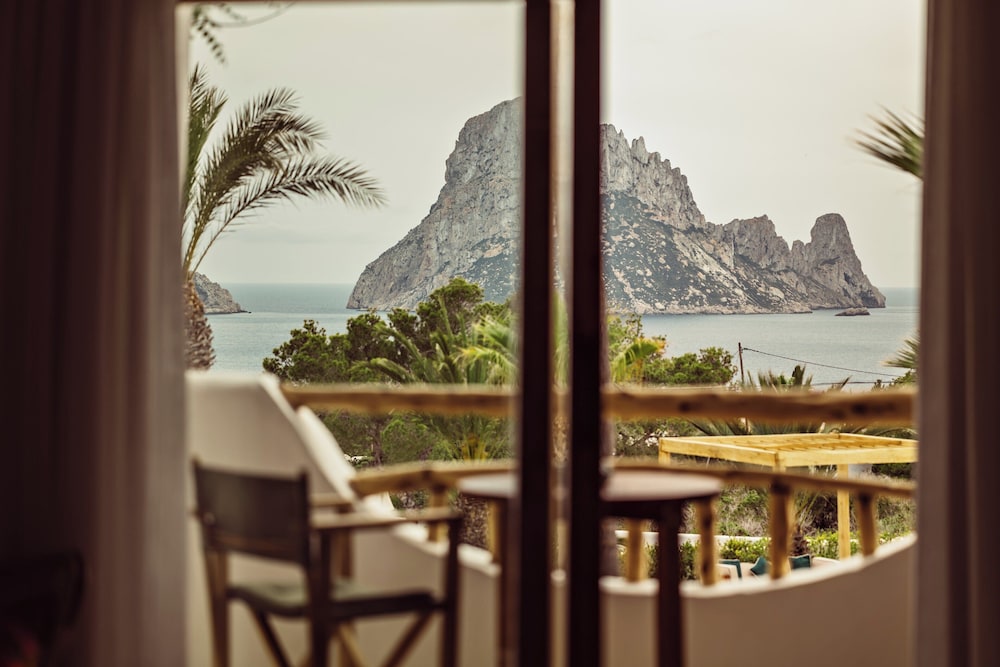
A short climb above Cala d'Hort leads to a stone watchtower on the cliff edge, with Es Vedrà and the open sea in front of it. Go in the afternoon, on foot, and leave the car below.
Afternoonbest time
Cala d'Hortnearest area to stay
14.4 kmfrom IBZ, straight line
The Torre des Savinar is a short climb from the plateau above Cala d'Hort to a watchtower on the cliff edge, with Es Vedrà directly in front. There is no ticket, no gate and no facilities, just a rough limestone path and a view that has not changed since the tower was built. Go in the afternoon and stay back from the edge.
01
A watchtower above the cliffs
The Torre des Savinar is a small stone watchtower standing on the cliff edge above Cala d'Hort, in the municipality of Sant Josep de sa Talaia. It belongs to the chain of coastal towers built to keep watch on shipping and to give warning of raids from the sea. The tower is squat and solid, open to the sky, and it faces the islet of Es Vedrà across a narrow stretch of water. Locally it is often called the pirate's tower.
Es Vedrà rises about 380 m out of the sea and has been a nature reserve, with Es Vedranell and the western islets, since 2002. Landing on it is not allowed. The tower stands inside the Cala d'Hort, Cap Llentrisca and Sa Talaia natural park, which protects the cliffs, the dry fields and the seabed below, where posidonia meadows grow. Nothing here is landscaped or fenced for visitors, and the ground is as rough as the view is open.
02
Getting there
The tower sits at the end of the country lanes signed to Cala d'Hort, in the far south-west of Ibiza. The road narrows past Sant Josep de sa Talaia and ends in informal parking areas on the plateau above the cove. In high season these fill through the afternoon, and cars end up along the lane, which adds walking. Arriving early in the afternoon usually leaves more room and a shorter walk to the path.
Public transport is limited. Seasonal buses reach Cala d'Hort in summer, with few or no services in winter, so confirm days and times with the island bus operator before relying on them. A taxi from Sant Josep or from Eivissa is another option, though the return needs planning because the lane is quiet in the evening. Cycling the lanes is possible, with steady climbs and little shade.
By carFollow the signs to Cala d'Hort and park on the plateau, not in the turning space.
By busSummer services run to Cala d'Hort; confirm days and times with the island bus operator.
On footFrom the cove, a path climbs to the plateau; the tower path starts near the parking.
Torre des Savinar with Es Vedrà behind it in the haze, Ibiza03
The best time to walk
Afternoon suits this walk. The sun comes round to the west and lights Es Vedrà from the side, and the cliffs lose the flat glare of midday. Sunset is the obvious hour and also the busiest: the parking fills, the path carries a crowd and the light goes quickly once the sun is down. Going an hour or two earlier gives the same view with room to move. Wind can arrive with the evening and make the cliff feel colder than the day did.
Summer afternoons are hot and the path has almost no shade, so a late start or a morning visit is kinder in July and August. In spring and autumn the light is softer and the wind can be strong on the cliff. Winter afternoons are quiet, though most businesses around Cala d'Hort close roughly from November to April. The path itself is open ground and does not close with them.
04
The climb to the tower
The path leaves the plateau near the parking and climbs over bare limestone towards the tower. It is short, but it is not smooth: the rock is worn, loose in places, and the route is marked by use rather than by signs. Closed shoes help. The path forks more than once, and the wrong fork leads towards the cliff edge rather than the tower, so keep the tower in sight as you climb.
At the top the ground opens out and the tower stands clear against the sea. Es Vedrà and Es Vedranell sit directly in front, with the coast running north towards Cap Llentrisca and south to the cove of Cala d'Hort. Beyond the tower the ground falls away with no railing and no fence. Keep back from the edge, especially when the wind is up or the rock is wet.
FootwearClosed shoes with grip are better than sandals on the worn limestone.
RouteKeep the tower in sight; the forks towards the cliff do not lead to it.
EdgeStay back from the cliff lip, particularly in wind or after rain.
From the last rise, nothing stands between the path and Es Vedrà.
05
Rules on the cliff
The tower and the cliffs around it sit inside the Cala d'Hort, Cap Llentrisca and Sa Talaia natural park. Paths here are informal and sometimes braided, and widening them damages the low vegetation that holds the thin soil. Camping, fires and litter are out. Rules on drones, parking and access change, so confirm current conditions with the natural park office or the Consell d'Eivissa before planning around them.
Es Vedrà is a nature reserve and landing on it is not permitted; boats pass, they do not stop. Anchoring over posidonia meadows is regulated by a Balearic decree, and mooring buoys are installed in some bays in summer. Arriving by sea, use a buoy where one exists rather than dropping an anchor on the dark patches of meadow, and check the current rules with the Consell d'Eivissa.
Cliffs and pine seen from Torre des Savinar, south-west Ibiza
Check before you goParking, drone rules and any seasonal restrictions around Cala d'Hort can change. Confirm current conditions with the Consell d'Eivissa or the natural park office.
06
Doing it lightly
The water below the tower is part of the UNESCO World Heritage listing Ibiza, Biodiversity and Culture, inscribed in 1999 for the posidonia meadows and coastal ecosystems between Ibiza and Formentera. The meadows are a flowering seagrass found only in the Mediterranean, and they clear the water and hold the sand in place. From the cliff the sea looks empty; it is not. The meadows grow from the shallows to about 30 to 40 m deep.
Walk on the path, not beside it. Do not move stones, build cairns or pick plants; the soil is thin and slow to recover, and a scar on these cliffs stays visible for years. Everything carried up should come back down, including fruit peel. Swimming from the cliffs is dangerous, with no easy way out of the water, so swim at Cala d'Hort instead, where the cove shelves more gently.
Protect itStay on the worn path, carry your litter out and leave the stones where they lie. The meadows and the cliffs take decades to recover.
07
What to bring
Bring water. The cliffs are dry, there is no tap or kiosk at the tower, and the nearest supplies around Cala d'Hort are seasonal. A wind layer is worth carrying even on a warm day, because the top of the cliff catches the breeze that the cove below does not. Sun protection matters more than the short walk suggests: the path is completely open.
A torch or a phone light helps if the plan runs to sunset, since the path back over the limestone is uneven and nothing is lit. Leave the drone behind unless the current rules have been checked. There is nothing to buy at the tower, so the only weight worth carrying is water, a layer, a hat and a small first aid kit for rough rock.
WaterCarry more than the short climb suggests; there is no supply at the tower.
ShoesClosed shoes with grip for the worn limestone and loose stones.
Wind layerA light jacket for the cliff top, even on a warm afternoon.
LightA torch or phone light for the path back after sunset.
08
Nearby and practical notes
Cala d'Hort is the nearest cove, a pebbly beach below the plateau with clear water and a view straight to Es Vedrà. Businesses there are seasonal and many close roughly from November to April. Inland, Sant Josep de sa Talaia has shops and services all year. The salt pans and dunes of Ses Salines lie further east, and Sa Talaia, the highest point on Ibiza at about 475 m, is a separate walk.
There are no facilities at the tower: no toilets, no bins, no shade and no lighting. Phone signal can be weak on the plateau. In an emergency call 112. Anyone walking back after dark should tell someone where they are going, and valuables are better left out of sight in a parked car. Cala d'Hort and the Sant Josep coast make the easiest base for an afternoon here.
Where to wake up
Stays near Torre des Savinar walk
Stays near Torre des Savinar walk: the first 6 of 18 stays in the IMPT hotel database in or close to Cala d'Hort, the nearest area to Torre des Savinar walk, five-star first, then four-star, then by guest score. Each button opens live prices for your dates in the IMPT app.
The climb from the parking above Cala d'Hort to the tower is short, but the ground is rough and the path is unmarked in places, so it takes longer than the distance suggests. Most of the time goes on parking, stops and the light. Set aside an afternoon rather than a quick stop.
Can you drive right up to Torre des Savinar?
No. The lanes end in informal parking on the plateau above Cala d'Hort, and the last stretch is on foot over limestone. In summer the parking fills and cars line the lane, which adds walking. Arriving earlier in the afternoon is easier than arriving at sunset, when everyone comes at once.
Is the Torre des Savinar walk suitable for children?
It can be, with close attention. The climb is short but the rock is uneven, and the cliff beyond the tower has no railing, so younger children need to stay within reach the whole way. Closed shoes and water help. If the group wants an easy afternoon, the cove at Cala d'Hort is the gentler option.
When is the best time of day for Torre des Savinar?
Afternoon, when the sun comes round to the west and lights Es Vedrà from the side. Sunset is the most popular hour and the most crowded. An hour or two earlier gives the same view with space on the path and less pressure on the parking above Cala d'Hort.
Can you land on Es Vedrà from Torre des Savinar?
No. Es Vedrà is a nature reserve, with Es Vedranell and the western islets, and landing is not permitted. Boats pass the islet but do not stop. The tower gives the closest land view of it, and the cliffs of the Cala d'Hort, Cap Llentrisca and Sa Talaia natural park frame the water in between.
Is Torre des Savinar inside a protected area?
Yes. The tower stands within the Cala d'Hort, Cap Llentrisca and Sa Talaia natural park, which covers the cliffs, the dry fields and the seabed. Stay on the worn paths, take litter out and leave stones and plants alone. Current rules on access and drones are best confirmed with the natural park office or the Consell d'Eivissa.
Are there facilities at Torre des Savinar?
None at the tower: no toilets, bins, shade or water. Supplies around Cala d'Hort are seasonal and many businesses close roughly from November to April. Carry what is needed, including water and a bag for litter, and treat the cove below as the nearest place to sit and eat.
What should you wear for the Torre des Savinar walk?
Closed shoes with grip, because the limestone is worn and loose in places. Add a wind layer for the cliff top, sun protection for the open path, and a torch or phone light if staying for sunset. Water is the one thing not to leave in the car.
Is the Torre des Savinar walk possible in winter?
The path is open ground with no gate, so winter afternoons are quiet and the light is clear. Most businesses around Cala d'Hort close roughly from November to April, so bring what is needed. Days are short, and anyone planning to stay for sunset should check access and conditions with the Consell d'Eivissa beforehand.
Photo credits: LetoIbz, CC BY-SA 4.0, via Wikimedia Commons; Alejandro Vallejo Ortega, CC BY-SA 4.0, via Wikimedia Commons; Gerda Arendt, CC0, via Wikimedia Commons.
Watch
Ibiza
Half a minute of Ibiza, from the old town of Dalt Vila to the coves and headlands of the coast.
Captions are built in; the transcript is on the Ibiza page.
Video: JUAN CARLOS NAVALON SANCHEZ, Steven HAuse, Haseeb Ahmad, Josh Tavernier, Boris Ivas, Luca Musella on Pexels