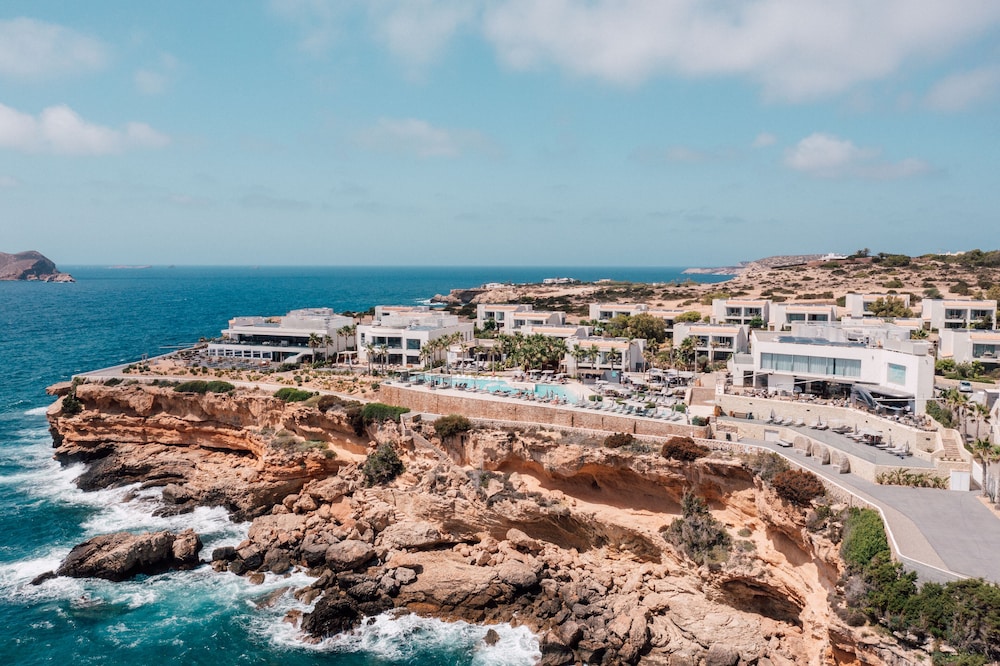
Cala Comte faces west across shallow water and a line of low islets, which is why the island's sunset crowd comes here. Arrive early, swim first, and stay for the afterglow.
Eveningsbest time
Cala Comtenearest area to stay
16.3 kmfrom IBZ, straight line
Cala Comte is the west-facing bay at the end of a lane in Sant Josep de sa Talaia. The sun goes down over open water beyond a line of low islets, and the water is shallow enough to stand in while it happens. This guide covers when to arrive, how to get there, the rules in the water and on the rocks, and what to bring.
01
A bay that faces west
Cala Comte sits on the far west coast of Ibiza, in the municipality of Sant Josep de sa Talaia, and it is not one beach but a handful of small coves linked by low rock. The water is shallow a long way out, the sand is pale, and a line of low islets breaks the horizon. Because the coast turns west here, the sun goes down into open sea rather than behind a headland.
That combination explains the evening crowd. You can stand waist-deep while the light changes, or sit on the flat rock shelves above the water and watch the sun drop beside the islets. In July and August the bay is busy from mid-afternoon, and the last hour before sunset is the busiest of all. Outside those weeks it is calmer, and on a weekday in June you may share it with a dozen people.
02
Getting to Cala Comte
The bay lies at the end of a signed lane off the road between Sant Antoni de Portmany and Sant Josep de sa Talaia, near the village of Sant Agustí des Vedrà. Parking at the end of the lane is limited and fills well before sunset in high summer. Park only where it is marked, and never on the verges or across gates, because access for residents and emergency vehicles has to stay clear. Summer restrictions on vehicles change, so check with the Consell d'Eivissa.
Seasonal buses run to the bay in summer from the nearest towns, which is the simplest way to avoid the parking problem altogether. Services are more frequent in July and August than in June or September, and the last return usually leaves after sunset but not late. Confirm the current timetable and the last departure with the island bus operator before setting out, because the walk back along the lane is long and unlit. A bicycle avoids both problems, but the approach roads are hilly and partly unlit.
By carThe turn is signed from the main road; arrive early and park only in marked spaces.
By busSummer services run from the nearby towns; check the last return before you commit to it.
By bikeThe approach is hilly and partly unlit; bring lights and a lock for the evening.
On footThere is no coast path from the neighbouring coves, so walk in along the lane.
A paddler crossing the sunset at Cala Comte, Ibiza03
When to arrive
In midsummer the sun sets late, so the wait on the rocks is long. Arriving an hour or more before sunset gives time for a swim, a walk to the outer rocks and a choice of place to sit. In May, June, September and October the sun goes earlier, the bay is quieter, and the light is often clearer because the summer haze has gone. A weekday evening is calmer than a Saturday in any month.
Wind decides the quality of the evening more than anything else. A westerly or south-westerly breeze pushes swell into the bay and can make the water cloudy and the rocks wet. A calm evening or a light offshore wind gives the flat, reflective sea that people come for. Check the marine forecast on the day, and remember that the wind often gets up after the sun has gone. A cloudy horizon can still give colour; a clear one gives a clean, quick exit.
The sun goes down into open water here, not behind a headland, and the whole bay faces it.
04
How the evening runs
Most people swim first, while the water still holds the heat of the day and the beach begins to empty. Then they move to the flat rocks at the outer end of the bay, where the view west is clear, and sit with the water below. The sun goes and the afterglow lasts longer than the sunset itself, which is the part worth staying for. Bring something to sit on if the rock has been in the sun all day.
Small seasonal beach bars serve the bay in summer and close outside the season, so food and drink after September should not be assumed. Bring what you need with you. When the light has gone, the lane and the parking area are unlit and the rocks between the coves are uneven, so a torch and a little patience on the way out make the end of the evening easier.
Swim firstThe water is shallow and warm at the end of the day; swim before the light pulls people to the rocks.
Take the outer rocksThe view west is clearest at the far end of the bay, away from the parked cars.
Stay for the afterglowThe colour comes after the sun has gone; most people leave too early to see it.
Leave slowlyThe car park empties at once; waiting a few minutes avoids the queue on the lane.
05
Rules in the water and on the rocks
Anchoring over posidonia is regulated by a Balearic decree, and mooring buoys are installed in some bays in summer. The dark patches in the water are seagrass meadows, not rock, and a scar from an anchor takes decades to close. Use a buoy where one is provided, anchor only over sand, and check the current rules with the Consell d'Eivissa or the natural park office before bringing a boat. Small boats are common off the bay in August.
On land the rules are the ordinary ones that keep a small bay usable: no fires, no camping, no cooking on the rocks and nothing left behind. Do not take sand, stones or the dried seagrass that washes up, because all of it belongs to the beach. Keep to the worn paths on the low cliffs, where the plants are thin and slow to recover, and keep music low enough for the next cove.
People waiting for sunset at a beach bar on Cala Comte, Ibiza
Check before you goAnchoring rules, summer vehicle restrictions on the lane and seasonal bus times all change. Confirm the current position with the Consell d'Eivissa before you set out.
06
Watching a sunset lightly
The bay is small and heavily visited, and the seagrass offshore is part of why the water is clear enough to see the bottom. Posidonia oceanica grows from the shallows to about 30 or 40 metres and holds the sand in place through the winter storms. Swimming over the meadows is harmless. Standing on them, dragging an anchor through them or taking a piece away is not. A handful of sand taken home is a small thing multiplied by a million visitors.
Take everything home, including cigarette ends and anything that might blow away, and use the bins in the villages rather than leaving a bag beside a full one. Carry water in a refillable bottle. If you come by car, share it, and consider the shoulder weeks: the same sunset, a fraction of the people, and far less pressure on a small bay with one lane in and out. Small choices repeated by many people are what keep a place worth visiting.
Protect itThe dark patches offshore are meadows of posidonia, not rocks. Anchor in sand or on a buoy, and leave the seagrass, the sand and the shoreline as you found them.
07
What to bring
Water first: an evening on warm rock with no shade is thirstier than it looks, and there is nothing to buy outside the summer season. A light layer matters too, because the temperature drops quickly once the sun has gone and the wind comes up across the bay. Everything else is small and easy to carry in one bag. A sunset here involves sitting still for an hour, which is colder and drier work than a walk.
Footwear makes the difference between a comfortable evening and a slow one. The rock shelves are uneven and polished where people climb out of the water, and the way back to the car crosses stone and dust. A torch, a dry bag for a phone and a bag for your own litter cover the rest. Glass is best left at home. So is anything that might blow out of a hand and into the sea.
WaterCarry more than seems necessary; the rocks give no shade and there is nowhere to refill.
A light layerThe wind arrives with the dark and the temperature falls quickly after sunset.
Sturdy shoesThe shelves are uneven and slippery where people walk up from the water.
A torchThe lane and the parking area are unlit, and phone batteries run down.
A litter bagTake away everything you bring, including items that could blow into the sea.
08
What is nearby
The nearest neighbours are Cala Bassa and Cala Tarida to the north, and Cala d'Hort to the south, where Es Vedrà stands offshore and the natural park of Cala d'Hort, Cap Llentrisca and Sa Talaia begins. Inland, the village of Sant Agustí des Vedrà and the town of Sant Josep de sa Talaia are the closest places for a meal or a bed, and both are small enough to walk across in a few minutes.
Sant Antoni de Portmany, a short drive north, has the island's long sunset tradition and stays open through the winter. Much of the tourism business, including many hotels, beach bars, boat trips and seasonal buses, closes roughly from November to April, so an out-of-season sunset at Cala Comte can mean an empty bay and an empty lane, with fewer places open afterwards. Plan the evening around that.
Where to wake up
Stays near Sunset at Cala Comte
Stays near Sunset at Cala Comte: the first 6 of 11 stays in the IMPT hotel database in or close to Cala Comte, the nearest area to Sunset at Cala Comte, five-star first, then four-star, then by guest score. Each button opens live prices for your dates in the IMPT app.
Cala Comte is on the west coast of Ibiza, in the municipality of Sant Josep de sa Talaia, at the end of a signed lane off the road between Sant Antoni de Portmany and Sant Josep. The coves face west into open sea, with low islets offshore, which is why the sun sets in full view.
Is Cala Comte a good place to watch the sunset on Ibiza?
Yes, for the simple reason that the coast turns west and nothing blocks the horizon except a line of low islets. The water is shallow enough to stand in while the light goes. It is popular, so the trade-off is company: in July and August the rocks fill up well before sunset.
How early should you get to Cala Comte before sunset?
An hour or more in high summer, which gives time for a swim, a place on the flat rocks and no rush over parking. In May, June, September and October, half that is usually enough, and the bay is quieter. Midsummer sunsets come late, so the wait is longer than in spring.
Can you park at Cala Comte in high summer?
Parking at the end of the lane is limited and fills well before sunset in July and August. Park only in marked spaces, never on verges or across gates, and expect summer vehicle restrictions to change: confirm the current position with the Consell d'Eivissa. Seasonal buses avoid the problem entirely.
How do you reach Cala Comte without a car?
Seasonal buses run to the bay from the nearest towns in summer, with more frequent services in July and August. Check the current timetable and the last return with the island bus operator before setting out, because the lane is unlit and the walk back is long. A bicycle works too, though the approach roads are hilly.
Can you swim at Cala Comte while the sun goes down?
Many people do: the water is shallow a long way out and still warm at the end of the day. Swim before the light fades rather than after, keep an eye on anyone swimming alone, and remember there is no lighting on the rocks. The shelves are uneven where people climb out.
Is Cala Comte crowded in July and August?
The bay is busy from mid-afternoon in the peak weeks, and the hour before sunset is the busiest of all. Outside July and August it eases, and between November and April it can be empty. A weekday is calmer than a weekend in any month.
Can boats anchor at Cala Comte?
Anchoring over posidonia is regulated by a Balearic decree, and buoys are installed in some bays in summer. The dark patches in the water are seagrass, not rock, so anchor over sand or use a buoy. Check the current rules with the Consell d'Eivissa or the natural park office before bringing a boat.
What is open at Cala Comte outside the season?
Very little. Small beach bars serve the bay in summer and close outside it, and many hotels, boat trips and seasonal buses in the area shut roughly from November to April. The villages of Sant Agustí des Vedrà and Sant Josep de sa Talaia stay open, so plan on eating there. Check before relying on anything.