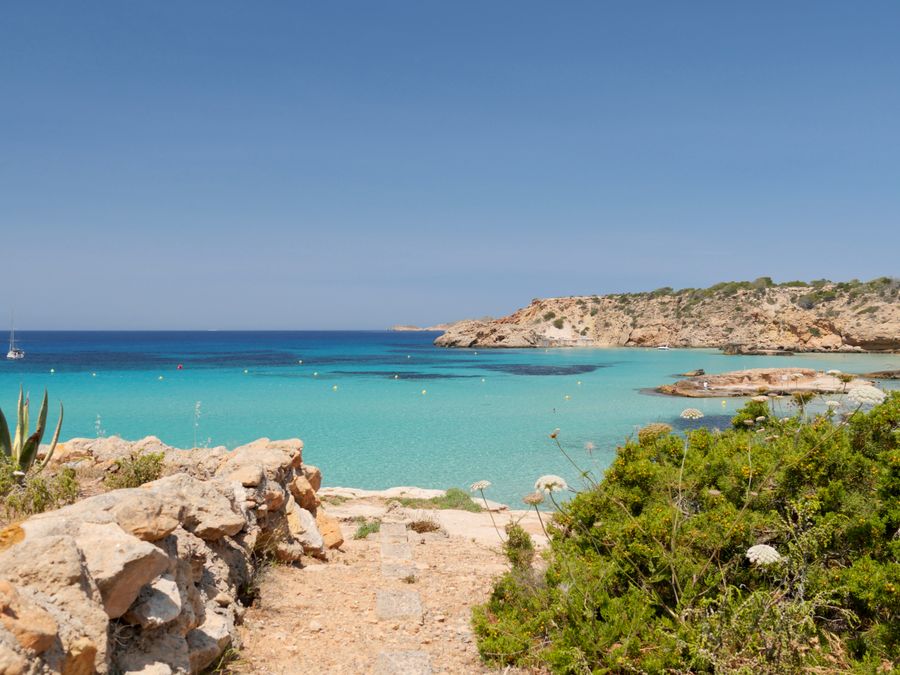
Three small bays at Ibiza's northern tip, backed by pine and stone terraces. Portinatx is a base for slow days: swimming in shallow water, walking the north coast, eating near the sand.
29.2 kmfrom IBZ, straight line
18stays in the IMPT hotel database
Northcoast
Portinatx works as a base if the north is what you want: a sheltered, pine-ringed corner with three swimmable bays and enough everyday there to keep a week easy. It is not a town and it is not open all year. The trade-off is distance from the south and from the airport.
01
A corner, not a town
Portinatx sits at the northern tip of Ibiza, in the municipality of Sant Joan de Labritja, where the coast stops running south and turns back on itself into small coves. The settlement is low and scattered: a few lanes, houses behind the beaches, pine running down to the rock. There is no old town and no grid to learn. What there is, is water in three directions and hills behind. The road from the south ends here rather than passing through.
The name covers a small area rather than a single beach. Cala Portinatx is the main bay, with s'Arenal Petit beside it and Cala Xuclar a short way west along the coast road. Each is small enough to cross in a few minutes, and each faces a slightly different angle, so when one bay is choppy another is often calm. Add the fact that the north coast begins here, and the whole place becomes a base for walking as much as for swimming.
02
Three bays and shallow water
The water in the bays is shallow for a long way out, sand underfoot and rock at the edges, which makes for easy swimming with children and for anyone who prefers to see the bottom. Posidonia oceanica grows offshore, not in the swimming zone, and the seagrass is the reason the sand is pale and the bays stay as clear as they do. Shelter matters more than size here: the coves are narrow enough to cut the swell when the wind comes from the north.
Snorkelling is the obvious thing to do and needs no plan: mask, rock at the sides of each bay, fish in the shadows. Beyond the sand the seagrass is a habitat, not decoration, so do not stand on it, do not anchor on it and keep inside the marked swimming areas where they exist. Kayaks can be hired in season from the bays; ask locally about conditions before setting out. Groups heading further out should take a guide; the north wind arrives without much warning.
Cala PortinatxThe main bay, with the most room on the sand and the easiest access from the lanes behind.
s'Arenal PetitThe smaller neighbour, quieter in the morning and sheltered when the wind comes from the east.
Cala XuclarA narrow inlet a short way west, still water, rock and pine, and a small crowd at most.
BenirràsFurther down the north coast, a wide beach known for drumming at sunset on some summer evenings.
Fishermen's boat shelters on the shore at Portinatx, Ibiza03
Walks and the north coast
Behind the bays the land rises into terraced hills, almond and olive, dry stone and pines, crossed by lanes that carry more goats than cars for much of the year. Walking here is informal: farm tracks, old connecting paths and the cliff tops, with gates that should be left as they are found. It is worth asking locally before following a track through a field, and carrying water, because shade is not continuous.
Inland, Sant Joan de Labritja is the small municipal centre, with its church and a cluster of houses, and Sant Carles a little south, where the Saturday market draws people from across the north in season. The coast road east leads to Cala Sant Vicenç and Sant Vicent de sa Cala; west, the lane climbs to Cala Xarraca. None of these is far. All are easier with a car. Market days are worth checking, since they move with the season and the weather.
04
Who it suits
Portinatx suits families with young children, swimmers who like calm water, walkers and anyone who wants the north as a base rather than a day trip. It does not suit people who came for nightlife, for a town with street life after dark, or for a car-free week outside the summer months, when the lanes empty and the buses thin out. Groups of friends looking for late bars will be in the wrong corner of the island.
The trade is distance. Ibiza Town, Dalt Vila, the airport and the southern beaches all lie at the far end of the island, and the road between is slow in summer. In exchange there are mornings that begin with a swim from the sand and evenings without traffic. For a week of small days, that is usually the right exchange, and for anything more energetic, two full days out will cover it.
In exchange there are mornings that begin with a swim from the sand and evenings without traffic.
05
Evenings and food
Eating here is seasonal and small-scale: kitchens behind the bays, terraces with simple tables, fish, rice, grilled vegetables and a menu that follows what comes off the boats. Several places close in the afternoon and reopen at night; many shut entirely from November to April. In July and August, booking ahead matters more than choosing carefully, because the choice is limited. Outside those months, walk in and see what is open.
Evenings are quiet by design. There is no club strip and no promenade of bars; the pleasure is a late swim, a slow dinner and dark skies over the pines. Sunset faces west across the water at Cala Xuclar, and the point north of the main bay holds the last light. Anything louder means driving south, and driving back late on unlit roads. The rice dishes take time to cook and are worth ordering at the start of the evening.
A turquoise cove ringed by pine at Portinatx, Ibiza06
Getting there from the airport
Ibiza Airport lies about 29.2 km from Portinatx in a straight line, at the other end of the island. The road route is longer and slow in summer, when the way through the centre queues behind coaches and campers. By car the simplest line is north through the middle of the island, then east to the coast; allow more time than the distance suggests. In daylight the drive is straightforward; after dark the last stretch is unlit.
Public transport is thin. Buses link the north with Ibiza Town and with Sant Joan de Labritja, more often in summer than in winter, and some services stop altogether outside the season. A taxi from the airport is straightforward; the return from the bays needs arranging in advance. Check the island bus operator before building a plan around a connection, and expect to change in Ibiza Town. Allow a buffer for the change and for the walk from the stop to the bays.
Hired carThe most practical way north; collect at the airport and drive in daylight where possible.
BusSeasonal lines link the north with Ibiza Town; times change, so check with the island operator.
TaxiSimple from the airport; arrange the return from the bays in advance, especially late at night.
Check before you goBus lines and opening months change with the season. Check the island bus operator and the Consell d'Eivissa before relying on a connection, and confirm that accommodation is open outside summer.
07
Getting around, and the season
A car makes the north work: the coves along the coast road, the inland villages, the Saturday market at Sant Carles, the beaches past Sant Vicent de sa Cala. Roads are narrow and bend often, and parking at the bays fills early in August. Bikes are a good compromise for short trips; the lanes are steep in places, so plan a route that suits the day rather than the map. On summer evenings the coast road is pleasant rather than busy, and the light lasts.
The season shapes everything. Most tourism businesses close roughly from November to April, and Portinatx in January is a handful of houses and a great deal of weather. May, June, September and early October are the most comfortable months: warm sea, open kitchens, room on the sand. The sea is typically around 18-19 °C in May and 23-25 °C in September, and the north wind can cool any month. Out of season the villages inland are the places that stay awake.
08
Visiting lightly
The clarity of the water is not an accident. Posidonia oceanica, the Mediterranean seagrass, filters the water and holds the sand in place, and the meadows between Ibiza and Formentera form part of the UNESCO World Heritage listing of 1999. Anchoring over them is regulated by a Balearic decree, and mooring buoys are installed in some bays in summer. Use a buoy, or anchor on sand. The park rules and the buoy fields are there to keep the meadows alive, not to complicate a swim.
On land the pressures are water and fire. The north is dry, the pines burn easily and the wells are finite. Keep to tracks, take litter away, refill bottles rather than buying new ones, and treat water as something borrowed. The coves stay pleasant because they are awkward to reach and lightly built on. Small is the point of the north, and it is easier to keep small than to make it large again.
Anchor on sandSeagrass is protected, so use a buoy where one exists and never anchor over the meadows.
Carry waterRefill a bottle rather than buying new ones; the north is dry and the wells are finite.
Keep to pathsFarm tracks cross private land; leave gates as found and avoid cutting through terraces.
No firesThe pines burn easily in summer; cigarettes and stoves belong nowhere near the trees.
Protect itPosidonia meadows are protected by a Balearic decree. Anchor on sand or on an installed buoy, never over the seagrass, and check the current rules before mooring in any cove.
Where to wake up
Stays in Portinatx
Stays in Portinatx: the first 12 of 18 stays in the IMPT hotel database in or close to Portinatx, five-star first, then four-star, then by guest score. Each button opens live prices for your dates in the IMPT app.
Portinatx works well for a week if the plan is swimming, walking and short trips rather than nightlife. Three small bays, a handful of seasonal restaurants and the north coast on the doorstep cover most days. The compromise is distance: Ibiza Town and the southern beaches sit at the far end of the island, so allow time for the drive.
How far is Portinatx from Ibiza Airport?
About 29.2 km in a straight line, measured from the airport in the south-west to the northern tip of the island. The road route is longer than that figure suggests, and in summer the drive can take considerably more time than the map implies. Hire a car or arrange a transfer rather than relying on a tight connection.
Do you need a car in Portinatx?
A car makes a northern base much easier. Buses serve the north more often in summer and less so in winter, and the coves along the coast road are awkward without wheels. For a short stay built around the bays and short walks, a car is optional; for exploring Sant Joan, Sant Carles and the east coast, it is close to essential.
Are the beaches at Portinatx good for children?
The main bay and s'Arenal Petit are shallow for a long way out, with sand underfoot and rock at the edges, which suits young swimmers. The coves are small, so children stay in view. Bring shade and water, since the sand gets hot by midday, and check conditions when the north wind is up, as the bays can turn choppy.
What is there to do in Portinatx in the evening?
Not much, and that is the point. Evenings are a late swim, a slow dinner on a terrace and dark skies over the pines. There is no club strip and no long promenade of bars. For anything louder, plan a drive south and arrange a way back, because the roads north are unlit and slow after dark.
Is Portinatx open in winter?
Largely not. Most of the tourism business, including many restaurants and seasonal buses, closes roughly from November to April, and the settlement becomes a small residential corner of Sant Joan de Labritja. The villages inland stay open year-round. If you travel in winter, confirm that your accommodation is actually open before booking, and expect fewer flights and ferries.
Can you snorkel at Portinatx?
Yes, and it is the simplest activity here. The rock at the sides of each bay holds fish, and the seagrass beyond the sand is worth seeing without touching. Take a mask and stay inside the marked areas. Do not stand on the meadows or anchor over them, and ask locally about conditions before going out by kayak.
How does Portinatx compare with the south of Ibiza?
The south is louder, sandier over longer stretches and closer to the airport, Ibiza Town and the salt flats. Portinatx is smaller, greener and quieter, with coves rather than long beaches and a shorter season. Choose the north for walking and calm water, the south for convenience and nightlife. The drive between them is the price of either.
Where can you walk from Portinatx?
Short walks follow the coast road to Cala Xuclar and the lanes behind the bays, with terraced hills, almond trees and sea views. Inland tracks reach Sant Joan de Labritja and Sant Carles. Paths are informal and some cross private land, so ask before following a track and carry water. Long cliff sections are exposed; avoid them when the north wind is strong.