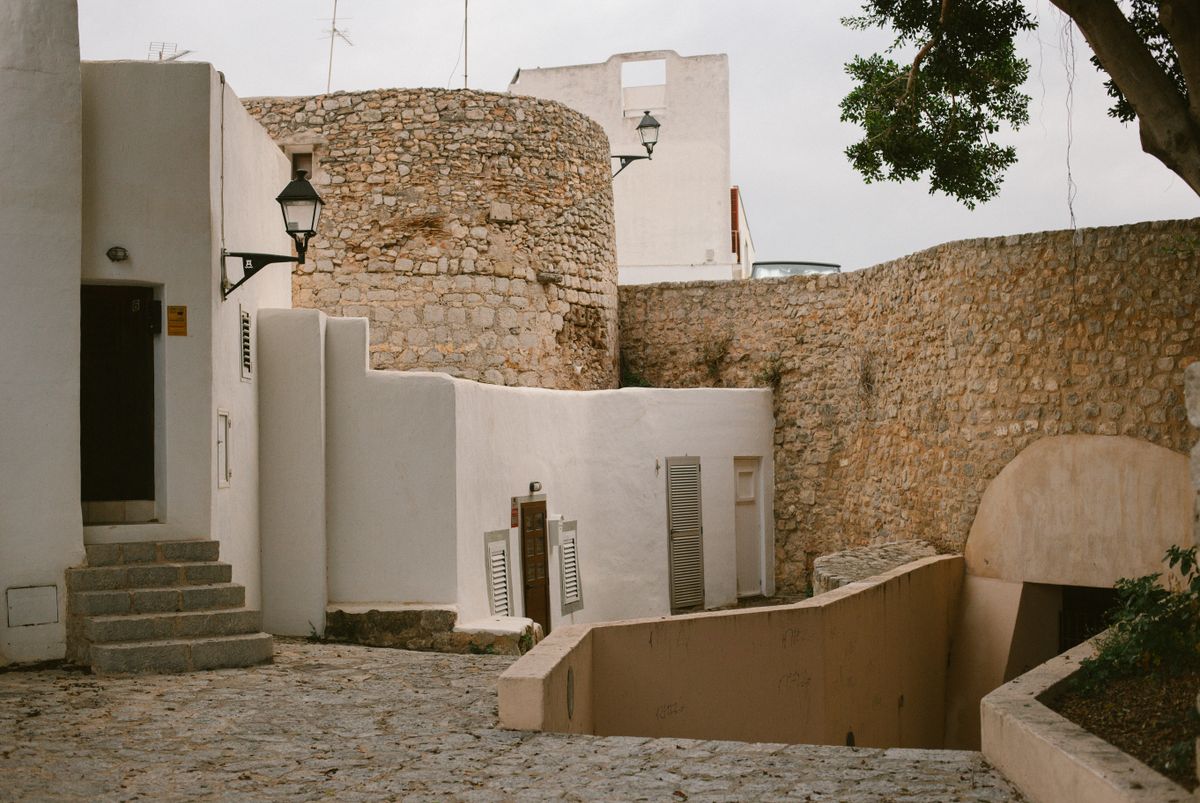
The municipality that covers Ibiza's northern tip: hill villages, pine coves and farmland, with no large resort at its centre and a season that ends in autumn.
76stays in the IMPT hotel database
2area guides
Ibizaisland
Sant Joan de Labritja is the northernmost and least built-up of Ibiza's five municipalities. It runs from the hills above Sant Miquel to the island's northern cape, taking in small villages, pine-backed coves and a lot of farmland. There is no town of any size: the administrative centre is the village of Sant Joan, and the coast is a string of small resorts and quiet calas.
01
The shape of the municipality
Sant Joan de Labritja is one of the five municipalities of Ibiza and holds the island's northern end. Its land runs from the hills behind Sant Miquel de Balansat across to the north-east coast, taking in Sant Carles de Peralta and the farmland between them. Of the five, it has the smallest population and the least built-up coastline, with no town at its centre, only villages and a scatter of farms.
The character follows from that. This is the greenest part of Ibiza: pine woods on the slopes, almond and olive terraces, carob and figs, dry stone walls holding the soil, and lanes between walled fields. The villages are small, the coast is a series of coves rather than a strip, and several roads end at a beach with nothing behind it but pines and juniper. Nightlife is not the point here. Quiet is.
02
Villages and hamlets
The administrative village of Sant Joan de Labritja sits on a low hill in the middle of the municipality, with its parish church, a small square and a handful of bars and shops around it. It is where a rural stay goes for basic errands, and it stays inhabited all year, unlike much of the coast. From the village the roads run north to Portinatx and east towards Cala Sant Vicent.
Sant Carles de Peralta, to the south-east, is the other centre: a crossroads village with a church, a cluster of houses and the Saturday market that draws people from across the island. Sant Miquel de Balansat lies to the west, on the road towards Sant Antoni, its church standing above the village. Sant Llorenç de Balàfia and Sant Vicent de sa Cala are smaller again, one in the farmed interior, the other at the beach.
Sant JoanThe administrative centre, with the parish church, a square and the errands a rural stay needs.
Sant CarlesCrossroads village in the south-east, known for its Saturday market and its church.
Sant MiquelWestern village on the road towards Sant Antoni, with its church on the rise above it.
Sant LlorençA hamlet of stone houses in the farmed interior, away from the coast.
Sa CalaThe houses at Cala Sant Vicent, at the end of the northern road.
The white church of Sant Miquel de Balansat, Ibiza03
Beaches and coves
The coast of Sant Joan is short on long sand and long on small coves. Benirràs, on the western side, is the best known: a shelving beach under pines, a rock islet offshore and, in summer, drums at sunset. Cala Xarraca and Cala Xuclar, further north, are smaller and quieter, with shallow water over sand and pebbles. Es Portitxol and Cala d'en Serra are smaller again, reached by track or on foot.
Portinatx holds the largest concentration of beds and three beaches within walking distance of each other. Cala Sant Vicent, in the north-east corner, is a long sweep of sand with a village behind it. Cala Mastella, on the east side, is a small, shallow inlet that suits families with young children. Access matters: the roads to the smaller coves are narrow, parking is limited, and in August the sensible approach is to arrive early.
BenirràsSandy cove under pines, with a rock islet offshore and drums at sunset in summer.
Cala XarracaShallow, pebbly and quiet, on the north coast road beyond Portinatx.
Cala MastellaA small east-coast inlet with shallow water, suited to families with young children.
Es PortitxolA tiny north-coast cove reached by track or on foot; take water and shade.
04
Cala Sant Vicent and Portinatx
Two parts of the municipality have their own guides on this site. Cala Sant Vicent, in the far north-east, is a long beach with a small village behind it and walking country on both sides. Portinatx, on the north-west coast, is the municipality's main holiday base, with three beaches and most of its beds. Each guide covers the beaches, the walking and the practicalities in detail, including what closes in winter.
Between and around them the municipality works at two speeds. Portinatx is the busier of the two, with seasonal hotels and a small centre that fills in July and August. Cala Sant Vicent is quieter and more residential in feel, and better placed for walking the north coast. Neither is a town. Both empty out substantially from November, and both reward a car, because buses along the north coast are few.
05
Land, coast and sea
Sant Joan holds no natural park; the island's protected areas lie mostly in the south and south-west. What the north has instead is farmland in use: terraced slopes, almond and olive trees, carob and figs, dry stone walls holding the soil, and tracks between walled fields. That working landscape is why the north looks the way it does, and why the roads between the villages feel like country lanes rather than resort access.
Offshore, the meadows of Posidonia oceanica that run along Ibiza's coast are part of why the water reads so clear. Posidonia is a flowering seagrass found only in the Mediterranean, and the meadows grow from the shallows to about 30 to 40 metres down. Anchoring over them is regulated by a Balearic decree; mooring buoys are installed in some bays in summer. The rules change, so check the current position for the bay before anchoring.
Protect itPosidonia meadows grow slowly and scar easily. Use a designated buoy where one is installed, and check the current anchoring rules for the bay before dropping anchor.
06
Culture and history
The north was farmed long before it was visited, and the shape of the municipality still shows it: scattered houses rather than a single village, churches placed where people could reach them on foot, and roads that followed the fields. The parish churches are the monuments here, solid and plain, several built with thick walls and a tower that served as a refuge when the coast was raided from the sea.
Some of that history is in the details of the farms: the wells and cisterns that made a house viable, the threshing floors, the old tracks linking hamlet to hamlet. Walkers notice it more than drivers do. The paths between the villages, some of them old cart tracks, remain the best way to read the landscape, and the interior in late winter, with the almond trees in flower, is why many people come back.
The lighthouse at Punta Grossa above Cala Sant Vicent, Ibiza
The parish churches are the monuments here: thick walls, small windows and a tower built to be watched from.
07
Food and markets
Eating in Sant Joan is mostly village-level: bars and small restaurants around the churches, a few places at the coves in season, and menus that lean on what grows nearby. Almonds, olives, figs, carob, tomatoes and greens come from small plots; fish comes from the island's coasts. The Ibizan classics turn up on most menus: sofrit pagès, a mixed meat and potato dish, bullit de peix, fish stewed with potato and served with rice, and almond cake to finish.
Markets matter more than shops here. The Saturday market at Sant Carles is the one people plan a week around, a mix of produce, clothes, crafts and food stalls spread through the village. Check current days before building a trip around it: the winter programme is shorter, and days and seasons can shift. Other markets run elsewhere on the island on other days. Village shops are small and few, and the nearest full supermarkets are down the coast.
Sant Carles marketThe Saturday market at Sant Carles is the main one here; check current days.
Village barsSimple menus and a table in the square, mostly in the villages rather than at the coves.
Cove eatingA handful of places open at the main coves in summer, with little outside the season.
Check before you goMarket days, winter opening and cove restaurants change from year to year. Check current days with the Consell d'Eivissa or the market's own listings before building a day around one.
08
Getting there and around
Ibiza Airport (IBZ) sits about seven kilometres south-west of Ibiza Town, in the municipality of Sant Josep. Sant Joan is at the other end of the island, so the transfer crosses the whole of it. The straight-line distance from the airport to the village of Sant Joan is computed on this page; the road distance is longer, because every route bends through the centre or along the coast.
By car, the usual approaches run through the middle of the island, by Sant Miquel from the west or through Santa Eulària from the east. Both are slow roads with villages, cyclists and farm traffic. Buses link Sant Joan and Sant Carles with Ibiza Town and Santa Eulària, with more services in summer than in winter. Check current timetables with the island bus operator before relying on one.
Once here, a car or a bike makes the difference. The coves are spread around the northern coast, the roads to the smaller ones are narrow, and parking at Benirràs, Cala Xarraca and Cala Sant Vicent fills early in high season. Bikes work well on the quieter lanes. The paths along the north coast link several coves on foot, and kayak routes run out of the northern bays in season.
09
Who it suits, and when
The site lists 76 stays in the Sant Joan area, and they set the tone: restored fincas and farmhouses inland, small hotels and apartments around Portinatx and Cala Sant Vicent, and a handful of places near Sant Carles and Sant Miquel. Nothing here is on the scale of the island's large resort areas. Anyone who wants a base for nightlife, a big pool scene or a town on the doorstep should look at Sant Antoni de Portmany or Playa d'en Bossa instead.
This suits walkers, cyclists, families with young children who want shallow water and short drives, and anyone after a rural base within reach of the coast. It does not suit people who want to step out of a hotel and choose between ten restaurants. At the coves the choice is small, and outside the season it is smaller still. A car helps, and so does a taste for quiet evenings.
The season here is the usual Ibizan one. July and August are full, hot and busy at the main coves; June and September are better for walking and for space on the sand; May and October are quiet, with some places shut. Much of the tourism business closes roughly from November to April: many hotels, beach bars, boat trips and seasonal buses stop. The villages stay inhabited, but check before travelling. The sustainable tourism tax is charged per person per night by the accommodation; rates change, so check the Govern de les Illes Balears site.
Stays in Sant Joan: the first 9 of 76 stays in the IMPT hotel database in or close to Sant Joan de Labritja, five-star first, then four-star, then by guest score. Each button opens live prices for your dates in the IMPT app.
The municipality takes in Sant Joan de Labritja itself, Sant Carles de Peralta, Sant Miquel de Balansat, Sant Llorenç de Balàfia and Sant Vicent de sa Cala, plus the two coastal areas of Portinatx and Cala Sant Vicent. It covers Ibiza's northern end and is the least built-up of the island's five municipalities.
Are the beaches of Sant Joan de Labritja good for swimming?
Yes, though they are coves rather than long sands. Cala Sant Vicent, Portinatx and Benirràs have the most space; Cala Mastella and Cala Xuclar are shallow and calm, which suits children. The water is clear because of the posidonia offshore. In August arrive early, since parking at the main coves fills, and follow any flag or buoy instructions.
How far is Sant Joan de Labritja from Ibiza Airport?
The straight-line distance from Ibiza Airport (IBZ) to the village of Sant Joan de Labritja is computed on this page. The road distance is longer: the airport sits in Sant Josep, in the south-west, and any route crosses the middle or the east of the island. Allow for slow roads, and check current bus timetables with the island operator.
Do you need a car in Sant Joan de Labritja?
It helps. The coves are spread around the northern coast, buses are few and thinner in winter, and the smaller roads are narrow with limited parking. A car makes the villages and beaches easy, a bike covers the quieter lanes well, and walking links several coves on the north coast. Many travellers combine a car with days on foot.
When is the market at Sant Carles in Sant Joan de Labritja?
The market at Sant Carles de Peralta runs on Saturdays, and it is the main market in the municipality. Days and the winter programme can change, so check current days before planning a day around it. Other markets on Ibiza run on other days of the week, some of them outside the municipality.
What closes in Sant Joan de Labritja out of season?
Much of the tourism business closes roughly from November to April, as elsewhere on Ibiza: many hotels, beach bars, boat trips, seasonal buses and some restaurants. The villages of Sant Joan and Sant Carles and the hamlets stay inhabited, and a few places serve through the winter. Days and opening vary, so confirm before travelling, especially at the coves.
Where can you stay in Sant Joan de Labritja?
The site lists 76 stays in the area. They run from restored fincas and farmhouses in the interior to small hotels and apartments around Portinatx and Cala Sant Vicent, with a handful of places near Sant Carles and Sant Miquel. Nothing is on the scale of the island's larger resort areas, and quiet is the common feature.
Is Sant Joan de Labritja good for walking and cycling?
Yes. The lanes between the villages carry little traffic, the north coast path links several coves, and the interior tracks pass walls, cisterns and old farm buildings. Cyclists find the gradients testing in places, since the north is hilly throughout. Carry water: shade is patchy on the inland routes and refill points are few.
Is the tourist tax charged in Sant Joan de Labritja?
Yes. The Balearic sustainable tourism tax, often called the ecotasa, is charged per person per night by the accommodation, and applies across the island, Sant Joan de Labritja included. The rate depends on the type and category of accommodation and the season, and children under 16 are exempt. Rates change, so check the Govern de les Illes Balears site.
Photo credits: I, the copyright holder of this work, hereby publish it under the following license:, CC BY 3.0, via Wikimedia Commons; Chixoy, CC BY-SA 4.0, via Wikimedia Commons; Joan Gené, CC0, via Wikimedia Commons.
Watch
Ibiza
Half a minute of Ibiza, from the old town of Dalt Vila to the coves and headlands of the coast.
Captions are built in; the transcript is on the Ibiza page.
Video: JUAN CARLOS NAVALON SANCHEZ, Steven HAuse, Haseeb Ahmad, Josh Tavernier, Boris Ivas, Luca Musella on Pexels