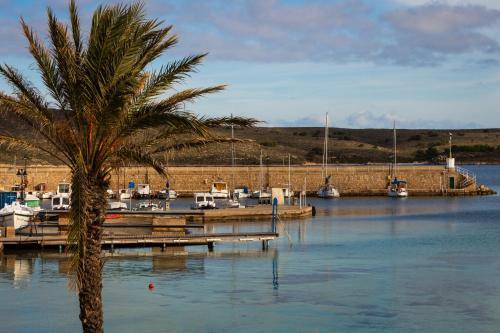
Dark rock, caves and quiet coves on Menorca's north coast, best paddled from Fornells on a calm day, with the rules and what to bring.
Calm daysbest time
Fornellsnearest area to stay
23.2 kmfrom MAH, straight line
The north coast of Menorca is the island's Tramuntana shore: older rock, higher cliffs, reddish sand and a wind that decides the day. Kayaking it is the simplest way to see the caves, arches and coves that have no road or path to them. Fornells, at the head of a long sheltered bay, is where most paddlers start.
01
A coast of dark rock
The north coast of Menorca runs from the mouth of Maó harbour west to Cap de Cavalleria, and it looks nothing like the south. Here the rock is older and darker, the cliffs are higher, and the beaches, where they exist, are small and reddish rather than white. The tramuntana, the north wind, shapes the whole shore: it prunes the pines, keeps the water cool and decides whether a day on the water is possible at all.
From a kayak the same coast reads differently. The cliffs open into caves and low arches, slabs of rock slide into the sea, and coves that take an hour on foot appear within a few minutes of paddling. Much of this shoreline has no path to it at all. The water is clear enough to see the bottom in the shallows, and on a calm morning the only noise is the swell against the rock. Seabirds work the cliff faces, and a kayak passes below them without clearing the ledge.
02
Getting to the north coast
Fornells is the obvious base: a village at the head of a long, sheltered bay on the north coast, in the municipality of Es Mercadal. The bay itself is calm water, which makes it a sensible place to start a paddle or to hire a kayak. The village works to the season, and much of it closes roughly from November to April. Outside July and August it is quiet, and the water is the main reason to be there.
By road, Fornells is reached from Maó or from Es Mercadal, both a short drive away. Buses run, more often in summer and less or not at all in winter; check the island bus operator for current times. In high season the parking at the bay fills early in the morning, and the tracks to the smaller north coast car parks are narrow and unsurfaced. Arriving early makes a difference, and so does asking locally whether a track is passable after rain.
Two practical points for the day. Phone signal comes and goes under the cliffs, so a waterproof case and a planned meeting point matter more than a full battery. Food and water are limited outside the main season, and the nearest supplies are in Es Mercadal or at Fornells in summer. The emergency number is 112. Tell someone where the plan goes and when the boats are expected back, and keep the group together on the return leg into the wind.
Cala del Pilar on the wild north coast of Menorca03
When to paddle
The north coast is a calm-day coast. The tramuntana arrives without much warning and builds short, steep seas against the cliffs, so the forecast matters more here than in the sheltered south. Mornings are usually the quietest window, and the breeze tends to fill in through the afternoon. Late spring and early summer give long days, cool water and few other craft. September is often the best of all: warm sea, empty coves and a softer wind. The bay of Fornells stays workable on many windy days.
Sea temperature runs about 18-19 °C in May, 22-23 °C in June, 25-26 °C in August and 23-25 °C in September. A wetsuit makes sense outside high summer, and a light one is enough in June. Check the marine forecast the evening before and again in the morning. If the wind is up, the north coast is the wrong coast, and the bay of Fornells or the south is the better answer. Wind against tide is worse than wind alone.
If the wind is up, the north coast is the wrong coast.
04
How to do it
Kayaks can be hired in Fornells in season, and guided trips run along the coast from the bay. A guide is the simpler option on a first visit: local knowledge covers where the swell stays manageable, which caves are safe to enter and where landing is allowed. Independent paddlers need real experience of rock landings, cold water and a building wind. Hire boats usually come with a buoyancy aid and a brief, but ask what else is included before paddling out.
Two shapes of day work well. A half day stays inside or just outside the bay, following low cliffs and small coves, with time to swim and land. A full day heads west towards Cap de Cavalleria, where the cliffs are higher, the coast emptier and the caves more serious. Plan the return leg first, because the wind usually helps on the way out and hinders on the way back. Boats that stay together cross the exposed stretches faster than a scattered group.
Half dayStay inside or just outside the bay of Fornells, with shelter from most winds and easy landing.
Full dayHead west towards Cap de Cavalleria for higher cliffs, more caves and almost no other craft.
GuidedThe simplest first visit: local knowledge of swell, caves and landing places, with boats provided.
IndependentOnly with experience of rock landings, cold water and a north wind that builds by midday.
05
The rules on the water
Part of the north coast is protected, and the rules are not the same everywhere. Anchoring over Posidonia oceanica meadows is regulated by a Balearic decree, and mooring buoys are installed in some bays in summer. Zoning and seasonal restrictions apply in the marine reserve, and catching fish from a kayak is controlled. Some caves and islets are closed to landing at certain times of year. Confirm the current rules with the Consell Insular de Menorca or the natural park office before launching.
Kayaks are not exempt from any of this. Keep a distance from caves where seabirds nest, do not land on the small islets, and give marine life room: dolphins, turtles and birds resting on the cliffs all react badly to a boat that comes close. If a warden or a buoy line asks for a change of course, change it. The rules protect one of the least built-up shorelines in the Balearics, and they keep the water clear enough to see the bottom, which is the point of paddling here.
The bay of Algaiarens on Menorca's north coast
Check before you goMarine reserve zoning, anchoring rules and seasonal landing restrictions change. Confirm the current position with the Consell Insular de Menorca or the natural park office before launching.
06
Doing it lightly
The appeal of this coast is that it is still largely unbuilt. That survives only if paddlers behave the way walkers on the Camí de Cavalls are asked to: stay on the path, or here, keep to the water where the shore is fragile. Land on rock or sand rather than on vegetated slopes, and never drag a kayak across the low rock platforms, where plants and lichens grow very slowly. The rock is colonised by plants that take decades to return after a single dragging hull.
Everything carried ashore goes back in the boat, including picnic waste, sunscreen bottles and the small things that fall out of a pocket. Use reef-safe sunscreen and apply it before getting in, so less of it ends up in the water. Avoid the shallowest seagrass, where a paddle blade does real damage, and keep voices low below cliffs where birds are nesting. A plastic bag in the cockpit collects what would otherwise go over the side.
Protect itPosidonia meadows and nesting cliffs recover slowly. Land on rock or sand, keep the paddle out of the shallow seagrass and take everything back to the shore.
07
What to bring
The north coast is not a place to paddle under-equipped. The water is cool even in August, the cliffs cut off easy exits, and the wind can arrive mid-crossing. A buoyancy aid is not optional, and a spray deck, a towline and a pump belong in the boat rather than in the car. Hire boats usually come with the basics, so check what is included. Decide before leaving the shore what stays behind, because there is no locker at the water's edge.
For a half day, a dry bag with water, food, a hat, sunglasses on a cord and a warm layer for the return is enough. Add a rash vest or a light wetsuit in spring and autumn, and shoes that can get wet for rock landings. A phone in a waterproof case, a small first aid kit and a whistle cover the rest. Leave the drone and the speaker at home. A hat and sunglasses on a cord matter more on the water than they sound.
Buoyancy aidWorn for the whole time on the water, whatever the sea state looks like from the beach.
Wet shoesRock landings on this coast are slippery, and a pair of shoes makes the difference.
Water and foodMore than seems necessary, because there is nothing to buy under the cliffs.
Warm layerThe wind off the water is cool even in August, and the return leg is the coldest.
Waterproof phoneFor the forecast in the morning and for the call nobody wants to make.
08
What is nearby
The rest of the day fits around the paddle. Favàritx lighthouse and the S'Albufera des Grau natural park lie to the east, with the lagoon, dunes and birdlife that make the park the core of the Biosphere Reserve. Inland, Es Mercadal sits under Monte Toro, the highest point on the island, with a sanctuary at the top and a road all the way up. Both are worth an afternoon, and neither needs a booking.
West of Fornells the coast empties towards Cap de Cavalleria and its lighthouse, with beaches such as Binimel·là and Cala Pregonda reached on foot or by a rough track. The Camí de Cavalls crosses this country and gives a walking alternative when the wind rules out the water. The lighthouse roads and the park car parks are small, and access can be closed in summer; the natural park office can confirm current arrangements. Fornells sits between Maó and Ciutadella, so either town works as a base.
FavàritxLighthouse and the eastern end of the north coast, with the S'Albufera park behind it.
S'Albufera des GrauLagoon, dunes and birds, the core zone of the Biosphere Reserve.
Monte ToroThe highest point on the island, above Es Mercadal, with a sanctuary and a road to the top.
Camí de CavallsThe coast path, useful on a day when the wind rules out the water.
Es MercadalThe nearest town for supplies, at the centre of the island under Monte Toro.
Where to wake up
Stays near the north coast
Stays near the north coast: the first 6 of 19 stays in the IMPT hotel database in or close to Fornells, the nearest area to Kayak the north coast, five-star first, then four-star, then by guest score. Each button opens live prices for your dates in the IMPT app.
Where is the best place to start kayaking the north coast of Menorca?
Fornells, at the head of a long sheltered bay in the municipality of Es Mercadal, is the usual start. The bay gives calm water for a first hour, kayaks can be hired there in season, and the open coast begins just outside the entrance. Maó and Es Mercadal are both a short drive away.
Is a guide needed to kayak the north coast of Menorca?
Not required, but useful on a first visit. A guide knows which caves are safe in the day's swell, where landing is allowed and how the return leg will feel once the wind builds. Independent paddlers should already be confident with rock landings, cold water and a small shore break.
When is the best time to kayak the north coast of Menorca?
Late spring and early summer, and again in September. Mornings are calmer than afternoons, and the tramuntana decides everything: if it is blowing, the north coast is the wrong coast that day. Sea temperature runs about 18-19 °C in May and 23-25 °C in September, so a light wetsuit helps outside high summer.
How exposed is the water when kayaking the north coast of Menorca?
Very, in places. Long stretches have no landing, the cliffs reflect swell back at the boat and the wind arrives offshore or straight on the nose. The bay of Fornells is sheltered, and the coast just outside it is manageable on a calm day. Beyond that, the crossings are for paddlers with experience.
Can a kayak reach Cap de Cavalleria from Fornells?
It can be done as a long day by strong paddlers, and it is the classic run on this coast: higher cliffs, more caves and very little other traffic. Most people do it with a guide or in a small group, and turn back before the cape if the wind is building. Check the forecast and the return leg first.
What rules apply to kayaking the north coast of Menorca?
Anchoring over Posidonia meadows is regulated by a Balearic decree, mooring buoys are installed in some bays in summer, and parts of the coast lie inside a marine reserve with seasonal restrictions. Some islets and caves are closed to landing at certain times. Confirm the current rules with the Consell Insular de Menorca or the natural park office.
Can the north coast of Menorca be kayaked out of season?
The water is open all year, but the support is not. Kayak hire and guided trips in Fornells run with the season and mostly close from November to April, so out of season you need your own boat and kit. The weather is less settled, the days are shorter and the sea is cold. Check conditions carefully.
What should be taken on a kayak trip along the north coast of Menorca?
A worn buoyancy aid, a spray deck, a pump and a towline in the boat; water, food, a hat and a warm layer in a dry bag; wet shoes for rock landings; a phone in a waterproof case; a small first aid kit and a whistle. Everything carried goes back to the shore.
What can be seen from a kayak on the north coast of Menorca?
Caves and low arches in the cliffs, slabs of dark rock sliding into the sea, small reddish coves with no path to them and seabirds nesting on the ledges. The water is clear enough to see the bottom in the shallows. Above Fornells, the coast runs west towards Cap de Cavalleria and its lighthouse.