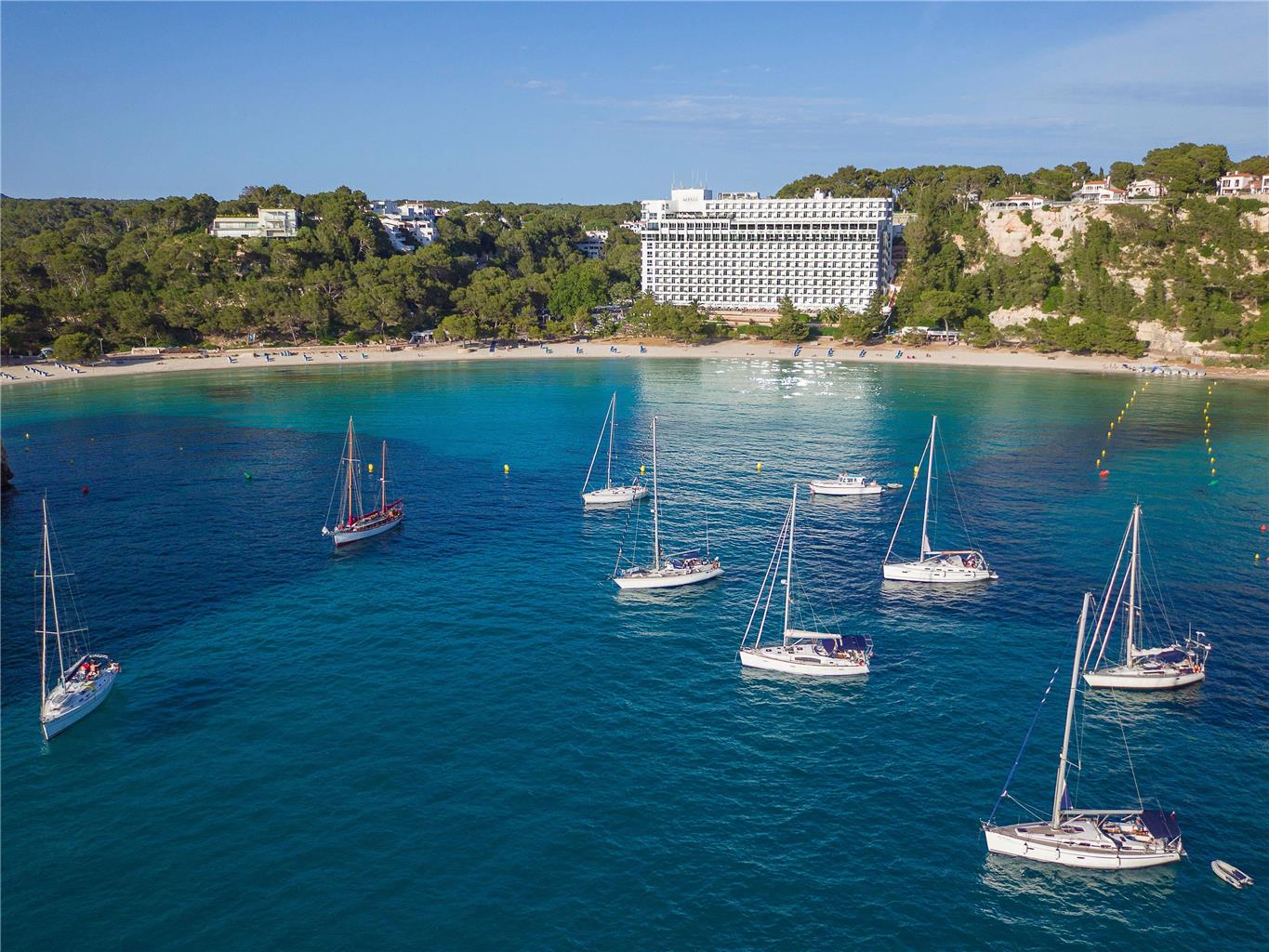
A small south-coast cove of white sand, pines and clear water, reached by a lane from the Ciutadella road. Go early, carry everything you need and leave nothing behind.
Early morningbest time
Cala Galdananearest area to stay
27.4 kmfrom MAH, straight line
Cala Turqueta is one of the south coast's pine-backed coves: white sand, shallow water and a belt of trees that comes down almost to the beach. Nothing is built there, the car park is small and the walk in is short. This guide covers how to reach it, when to come and how to leave it as you found it.
01
A cove under pines
Cala Turqueta is a small cove on the south coast of Menorca, west of Cala Galdana, where the limestone of the Migjorn runs down to the sea. White sand fills the back of the inlet, low cliffs close it on both sides, and a dense stand of pines runs almost to the top of the beach. The rock shelf under the water repeats the same shape, shallow at first and then deeper over sand and seagrass. The cove is small, and on a busy August afternoon it feels smaller still.
There is nothing built at the cove. No bar, no kiosk, no sunbeds and no bins: the beach is as the coast has left it, which is why people drive out here and why it fills early in summer. The pines give shade at the back of the sand through the middle of the day, and the water stays shallow for the first few metres before it deepens over seagrass and rock. Nothing is laid on, and nothing is taken away.
Nothing is built at the cove, and nothing has been laid on for visitors.
02
How to get there
The cove is signposted from the road that runs between Ciutadella and Cala Galdana. A narrow lane leads through the pines to a car park behind the beach, and the last stretch is on foot, a few minutes among the trees. The car park is small, and in July and August it fills in the morning. Arrive at midday in high season and you may wait at the barrier, or turn back and come another day.
In high season the Consell Insular de Menorca has at times closed the lane to visitor cars and run a shuttle from further along the coast, and a seasonal bus links the south-coast coves with Ciutadella. The arrangements change from year to year, so check the Consell's site and the island bus operator before setting out. The Camí de Cavalls is the walking route in, following the cliffs from Cala Galdana and on towards the coves to the west.
By carThe lane leaves the Ciutadella to Cala Galdana road and ends at a small car park.
ParkingSpaces are limited and fill early in July and August; summer access rules can change.
On footThe Camí de Cavalls passes the cove and links it with Cala Galdana and the coves west.
By busSeasonal services from Ciutadella run in summer; check the current timetable with the operator.
The pine-ringed cove of Cala Turqueta, south coast of Menorca
Check before you goSummer access limits, parking and shuttle buses on the south coast change from year to year. Confirm the current rules with the Consell Insular de Menorca before driving out.
03
The best time to come
Early morning is the time to come. The sun comes in low across the water, the pines throw long shade over the sand, and the car park is still half empty. The wind is usually light before it builds in the afternoon, and the cove is at its calmest. By eleven in summer the beach is busy, the light is hard and the shade has gone from the water's edge. An hour earlier makes the difference. In May or early October the same advice holds; in August it is the only way to see the cove empty.
The south coast is sheltered from the tramuntana, the north wind that roughens the northern beaches, so a day when the north is blown out can be calm here. Typical sea temperature is about 18–19 °C in May, 22–23 °C in June and 25–26 °C in August. June and September give you the same water with fewer people on the sand, and September light that lasts longer into the evening. The wind can turn in the afternoon, so check the forecast before committing to a whole day on the south coast.
04
A morning in the water
Swim out over the shallow sand and then over the darker patches of Posidonia oceanica, the seagrass that grows along this coast and gives the water its colour. The meadows are a habitat, not weed. A mask is worth carrying: the rock at the sides of the cove holds small fish, and the morning light is the best of the day for looking down through the water. Keep your feet off the bottom where the grass is dense. It is shallow for a long way out.
The Camí de Cavalls runs along the cliffs above the cove, and a walk in either direction shows you the shape of the coast: the next inlet, the tops of the pines, the limestone shelves at the water. Go before the heat builds or in the late afternoon. Shoes with a grip help, and the path is exposed, with little shade between one cove and the next. A short walk east brings Cala Macarella into view.
05
Seagrass, sand and rules
Posidonia oceanica is a flowering plant rather than an alga, and it grows only in the Mediterranean, from the shallows down to about 30 or 40 metres. The meadows along this coast are protected. Anchoring over them is regulated under a Balearic decree, and mooring buoys are laid in some bays in summer. Swimming above the grass does no harm; an anchor dragged through it does, and so does a foot planted on the rhizomes. Check the current anchoring rules with the Consell Insular de Menorca if you plan to arrive by boat.
On the sand the rules are the ordinary ones, and they matter here because nobody is watching. No fires, no camping, no music carried across the water. Take everything back up the lane with you, including fruit peel and cigarette ends. Keep to the paths through the pines rather than widening new ones, and leave the shells and the sand where the sea put them. A cove with no bins and no staff depends on the people who use it.
The path down through the pines to Cala Turqueta, Menorca
Protect itThe seagrass, the pines and the dune behind the beach are why the cove looks as it does. Anchor only on sand or on a buoy, and carry your rubbish back up the lane.
06
What to bring
There are no facilities at Cala Turqueta, so the day works or fails on what you carry down the lane. Bring more water than you think you need in summer, food for the hours you plan to stay, and something to sit on. A cold bag keeps a picnic in shape, and a bag for the rubbish takes it home again. The pines do not cover the sand, so shade is yours to bring. A towel, a hat and a spare layer for the wind cover most days.
Footwear for the path and for the rock at the water's edge, a hat and high-factor sun cream for the middle of the day, and a mask if you plan to swim out over the seagrass. In spring and autumn add a layer for the wind and something warm for the shade. A charged phone is worth having, though a signal at the water is not guaranteed. Cash is useful for the seasonal bus.
WaterBring more than you expect to drink; there is nothing to buy at the cove.
ShadeA sunshade or a beach tent for the sand; the pines sit behind the beach, not over it.
FootwearShoes with grip for the path down and for the rock at the edges.
RubbishA bag for everything you bring; there are no bins at the cove.
07
What is nearby
Cala Galdana is the nearest base, a sheltered bay with places to stay and eat and shops for supplies before the lane. The road from there back towards Ciutadella passes the turning for the cove. Ciutadella itself, the old capital, is the other anchor: a tight grid of streets around the cathedral, a port at the end of a long inlet, and a good place for a late lunch after a morning on the sand.
East of the cove the Camí de Cavalls leads to Cala Macarella, another pine-backed inlet with a longer beach and the same clear water. Inland, the Naveta des Tudons stands beside the road between Ciutadella and Maó, a boat-shaped stone tomb from the island's prehistory and one of the Talayotic monuments on the World Heritage list. It is a short stop on the way back, and a good one in the middle of the day.
Cala GaldanaThe nearest base, with places to stay, eat and buy supplies before the lane.
Cala MacarellaThe next cove east along the Camí de Cavalls, with pines and a longer beach.
CiutadellaThe old capital, with the port, the old town and the cathedral, open all year.
Naveta des TudonsA prehistoric tomb beside the Ciutadella to Maó road, on the Talayotic World Heritage list.
08
Practical notes
The cove has no facilities at all: no toilets, no bins, no drinking water and no shade for hire. The nearest supplies are in Cala Galdana and Ciutadella. The emergency number is 112. Mobile coverage is patchy in the cove and on the cliff path, so tell someone where you are going if you walk the coast alone, and in winter remember that the afternoon ends early. Sunburn and twisted ankles are the usual troubles here; both are avoidable.
Much of Menorca's seasonal business closes roughly from November to April. The lane, the car park and any shuttle or bus are summer arrangements, so check access with the Consell Insular de Menorca if you come out of season. The water is about 14–15 °C in February and March. Maó and Ciutadella stay open year-round, and in winter the south coast is better for walking than for swimming. The tourist tax is charged by your accommodation, at rates that change with the season and the type of stay.
Where to wake up
Stays near Cala Turqueta
Stays near Cala Turqueta: the first 6 of 21 stays in the IMPT hotel database in or close to Cala Galdana, the nearest area to Cala Turqueta, five-star first, then four-star, then by guest score. Each button opens live prices for your dates in the IMPT app.
Yes. The cove shelves gently for the first few metres and then deepens over sand and seagrass, so weaker swimmers have room and stronger ones can go out over the meadows with a mask. The water is calmest in the morning and on days when the wind is from the north. Do not assume a lifeguard is on duty.
Can you park at Cala Turqueta in summer?
There is a car park behind the beach, reached by a lane signposted from the Ciutadella to Cala Galdana road, and it is small. In July and August it fills in the morning, and the Consell Insular de Menorca has at times closed the lane to visitor cars in high season. Check the current rules before driving out.
How do you get to Cala Turqueta without a car?
A seasonal bus runs from Ciutadella to the south-coast coves in summer, and the Camí de Cavalls brings walkers in along the cliffs from Cala Galdana. Both take longer than the car and both are the better day out. Check the current timetable with the island bus operator before you rely on it, and carry water for the walk.
When is the best time to visit Cala Turqueta?
Early morning, before the car park fills and the sun hardens the light. The pines still throw shade and the water is at its calmest. In July and August aim to be on the sand by nine; in June and September the cove stays comfortable for longer. Winter mornings are quiet, but the water is cold.
Are there facilities at Cala Turqueta?
None. There is nothing built at Cala Turqueta: no bar, no kiosk, no toilets, no bins, no sunbeds and no drinking water. Everything you need for the day comes down the lane with you and goes back up again. Supplies, cafés and pharmacies are in Cala Galdana and Ciutadella.
Is Cala Turqueta sheltered from the wind?
Yes. The cove sits on the Migjorn coast, which is sheltered from the tramuntana, the north wind that roughens the northern beaches. A day when the north coast is blown out can be calm at Cala Turqueta, and the reverse is true when a southerly brings swell into the cove. Check the forecast before committing to a long day.
Can boats anchor at Cala Turqueta?
Anchoring over Posidonia oceanica is regulated under a Balearic decree, and mooring buoys are laid in some bays in summer. Boats should anchor on sand, well clear of the dark patches of seagrass, or take a buoy where one is provided. Check the current rules with the Consell Insular de Menorca before arriving by sea.
Is Cala Turqueta suitable for children?
It suits children on a calm morning, when the water is shallow and the sand is close. There is no shade on the beach itself, no toilets and nobody selling drinks, and the walk back up the lane is in the open. Bring water, a sunshade and a change of clothes, and keep clear of the rock at the edges.
What is there to do near Cala Turqueta?
Walk the Camí de Cavalls east to Cala Macarella or west along the cliffs, spend the rest of the day at Cala Galdana, or drive back to Ciutadella for the old town, the port and the cathedral. Inland, the Naveta des Tudons and other Talayotic monuments sit beside the roads, and the whole island is within a day's drive.
Photo credits: Markus Trienke, CC BY-SA 2.0, via Wikimedia Commons; Alejandro Muñoz Cabrisas, CC BY-SA 4.0, via Wikimedia Commons; Alvaro Ortiz, CC BY-SA 3.0, via Wikimedia Commons.
Watch
Menorca
Menorca's coast in three scenes, ending with sunset at Fornells.
Captions are built in; the transcript is on the Menorca page.
Video: Raymond Petrik, Angelo Esposito, Agusti Perez on Pexels