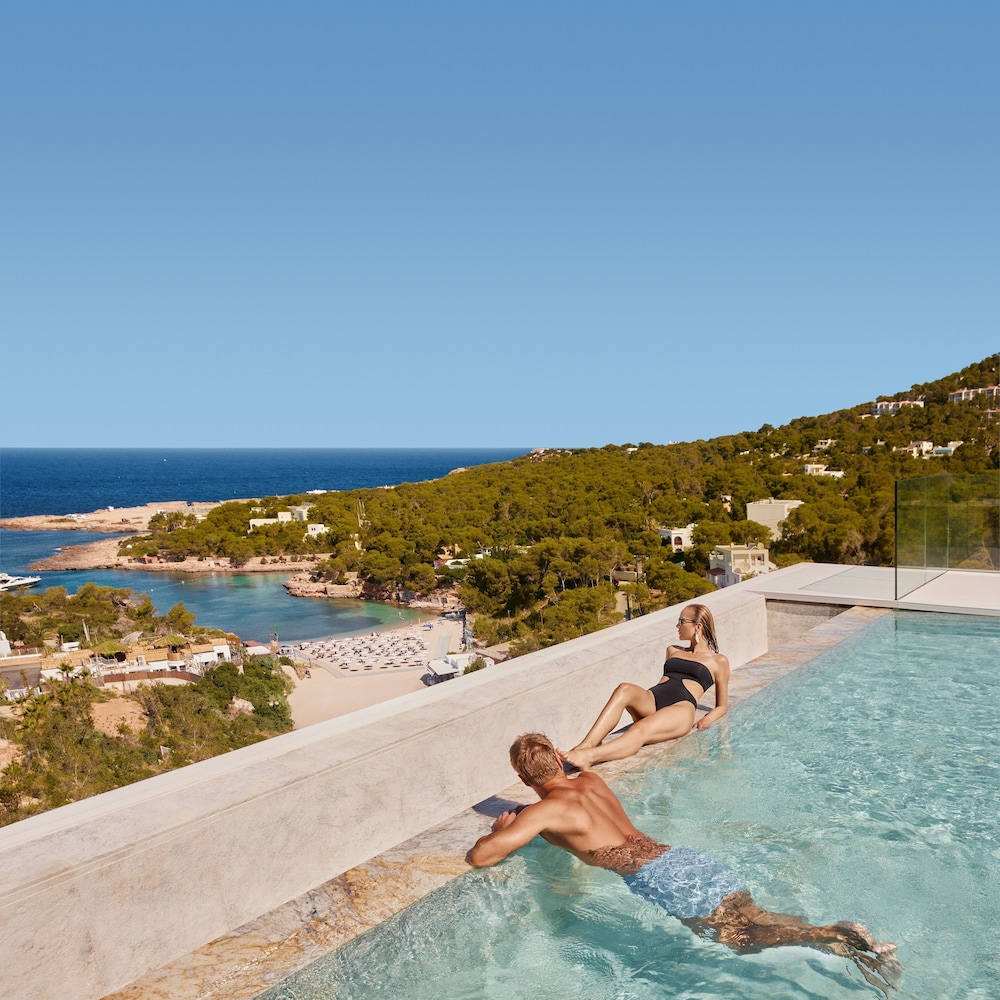
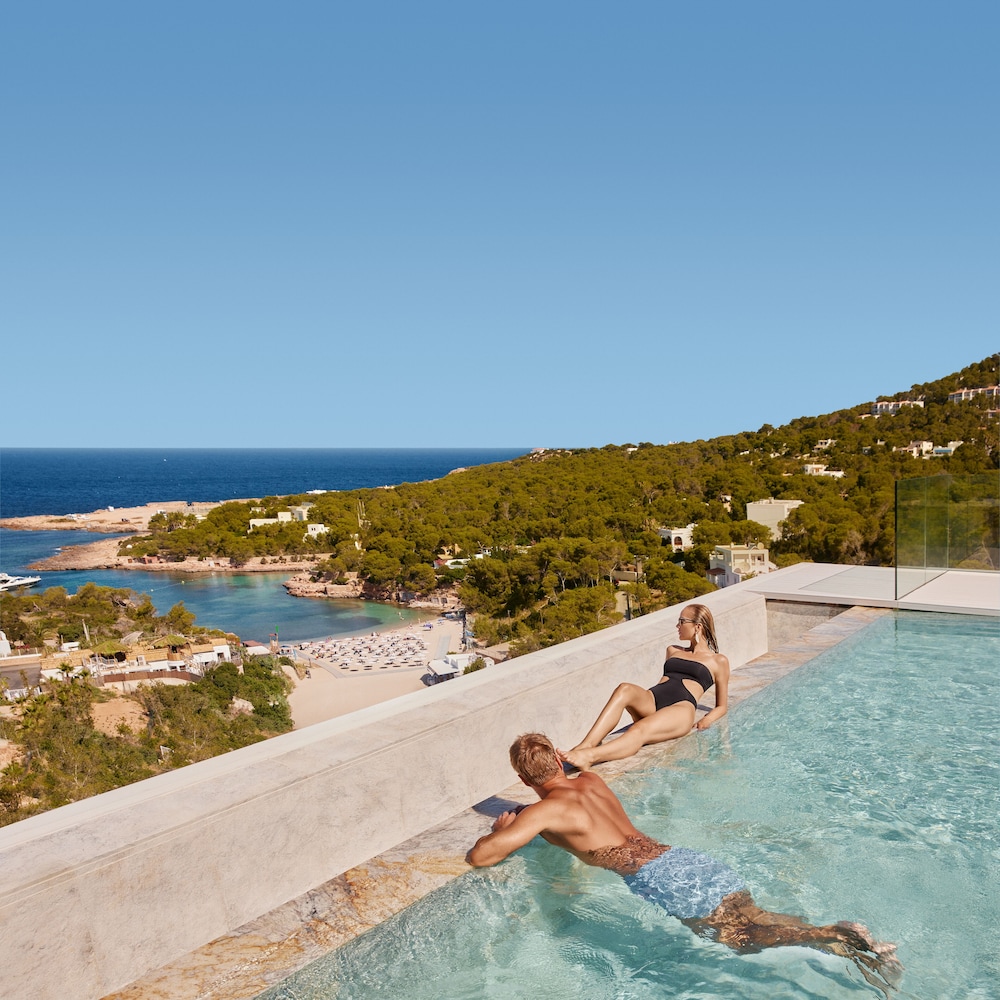
Cala Salada and its smaller neighbour Cala Saladeta sit north of Sant Antoni de Portmany, reached by one narrow road through pines. Clear shallow water, a pebbly shore and rock ledges either side.
Morningsbest time
Sant Antoninearest area to stay
16.5 kmfrom IBZ, straight line
Cala Salada is the beach north of Sant Antoni de Portmany that people mean when they say the water is clear. Cala Saladeta is the next inlet along, smaller and reached on foot. Both are small, both are in pines, and both repay an early start. This is how to get there, when to go, what to bring and what keeps the water looking the way it does.
01
Two coves behind the pines
Cala Salada is a small cove on the coast north of Sant Antoni de Portmany, where a narrow road drops through pine woods to a beach of sand and pebbles. The water stays shallow for some metres out and is unusually clear. Cala Saladeta is the next inlet along, smaller still and with no road of its own: you reach it over the rocks at the point or by swimming round. Both have pine slopes behind them.
The clarity is not an accident. Posidonia oceanica grows offshore, a seagrass that filters the water, holds the sand in place and shelters fish. Where the meadow begins, the colour changes from pale turquoise to a deeper green-brown, and the bottom turns from sand to leaves. Swimming over that edge, mask on, is the quietest thing to do in either cove. In summer the same clear water fills both beaches by mid-morning.
02
How to get there
By road, Cala Salada is a short drive from Sant Antoni de Portmany: a single narrow lane that leaves the coast road and winds down through the pines to a parking area above the beach. The lane is steep in places and used by cars, walkers and cyclists alike. There is no second road in. In July and August the parking fills early, so check the Consell d'Eivissa for any summer access restrictions before you set out.
Seasonal buses run from Sant Antoni de Portmany in summer. Days and times change, so check the island bus operator rather than trusting an old timetable. Outside the season the coves are reached by car, on foot or by bike, and the walk down is part of the visit. Boat trips along the north-west coast also call in during the summer months, anchoring outside the swimming area.
By carOne narrow road ends above the beach; the parking area is small and fills early in summer.
By busSeasonal services run from Sant Antoni de Portmany; check the island bus operator for current days.
On footThe lane climbs and twists and carries traffic, so walkers should start early and keep to the edge.
By boatCoastal trips call in through the summer and anchor outside the marked swimming area.
The coves of Cala Salada and Cala Saladeta among the pines, Ibiza03
The best time to go
Mornings are the best of it. The sun clears the ridge behind the coves later than it clears the sea, so early swimmers find flat water and shade in the pines. By midday in high summer the beach at Cala Salada is crowded, the path to Cala Saladeta becomes a slow file over the rocks, and the parking area is full. Arrive early or come in another month.
May, June, September and October are the kindest months. The sea is around 18–19 °C in May, 22–23 °C in June and 23–25 °C in September, the light is long, and the coves hold a fraction of the August crowd. Winter empties them completely. Between roughly November and April the seasonal buses stop and the facilities near the beach close, but the road stays open and the water is at its clearest and coldest, around 14–15 °C in February and March.
04
How to spend the day
Swim first. The bay at Cala Salada is shallow and calm in the morning, with rock ledges at either end where the bottom drops away and the fish gather. Then walk the few minutes over the point to Cala Saladeta, which is smaller and tighter, and often busier by afternoon because everyone arrives at once. The path is rocky; trainers or sandals with grip make it easy.
There is little shade on the sand at either cove once the sun is up, so the pines at the back are where people sit. Bring water and food, since what exists near the beach is seasonal and thin. Leave in the late afternoon when the light softens, or stay for the western sky, which is the reason many people drive out here in the first place.
The coves face west, so the sun goes down over the sea beyond the point and the water keeps its light after the beach has emptied. That is the second shift of the day: swimmers leaving, walkers arriving with a bottle and a towel. It is worth staying for, and worth carrying a light for the walk back up the road outside the long evenings.
The path between the coves takes minutes; the change of pace takes the whole day.
05
Rules on the water
Anchoring over posidonia is regulated by a Balearic decree, and mooring buoys have been installed in some bays in summer. If you arrive by boat, anchor on sand or take a buoy, and keep clear of the marked swimming area where people are in the water. A torn meadow does not recover in a season; the scar lasts for decades and the clear water goes with it.
On shore, the rules are the ordinary ones that keep a small cove usable: no fires, no camping, no leaving rubbish, no taking stones or plants. Bins are few and often full, so plan to carry everything back up the road. Access is by that single lane, which means whatever you bring down has to come back up with you.
AnchoringUse a mooring buoy where one is installed, or anchor on sand well clear of the seagrass.
Swimming areaStay inside the marked area when boats are moving past the point.
RubbishCarry it back up the road; bins at the coves are few and fill quickly in summer.
FiresNo fires or barbecues on the beach or among the pines behind it.
SoundKeep music low; a cove this small carries every note to the far side.
Sunset over the bay at Cala Salada, Ibiza
Protect itPosidonia is a plant, not weed. Its meadows clear the water and hold the sand, and an anchor tears them. Use a buoy or anchor on sand.
06
What to bring
Water first: more than you think you need in summer, in a bottle you can refill before leaving Sant Antoni de Portmany. Then shade, because the sand at both coves is in full sun for most of the day and the pines at the back are the only cover. Food as well, since what is available near the beach is seasonal and limited, and closes outside the summer months.
Footwear matters more than it sounds. The path between the coves is rock, not sand, and the ledges at the water's edge are worn smooth. A mask and snorkel turn a swim into something else entirely: the meadow edge, the pale sand patches between the leaves, small fish holding station in the shade of the rocks. A light layer helps when the wind comes up in the afternoon.
WaterBring a refillable bottle and fill it before you leave town.
FootwearTrainers or sandals with grip for the rocky path between the two coves.
ShadeA parasol or a light sheet; the beach itself has almost none.
MaskA mask and snorkel show the edge of the posidonia meadow a few metres out.
07
What is nearby
Sant Antoni de Portmany is the nearest place to stay and the nearest place to eat properly, and it stays open all year. North and west of the coves the coast turns rocky and the road climbs. South, the bay runs back to town. Cala Comte and Cala d'Hort, the second looking across to Es Vedrà, are a longer drive round the western side of the island.
The sunsets are the other reason people base themselves on this coast. The coves face west, and the rocks at the point give a clear line to the horizon. In town the sunset gathers a crowd along the waterfront through the season; out at Cala Salada it is quieter, a few people on the rocks and the water going flat. Bring something to sit on.
For a change of scale, the north coast beyond Sant Joan de Labritja has longer walks and smaller coves, and the south has the salt pans and dunes at Ses Salines. Both are half a day out rather than an afternoon. Staying in Sant Antoni keeps Cala Salada within a short drive in the morning, before the lane fills.
08
Practical notes
The coves are at their most usable from May to October, but they do not close. Outside roughly November to April the seasonal buses stop, the facilities near the beach shut and the lane is quiet. The towns stay open, flights and ferries are fewer, and the water sits around 14–15 °C in February and March. Treat the cold as part of the visit rather than a reason to skip it.
There is one road in and one road out, and it is narrow. Drive slowly, expect walkers and cyclists on the bends, and do not stop on the incline above the beach to look at the view. The emergency number is 112 across Spain. If you walk back up after sunset, take a light and something warm for the wind on the ridge.
Check before you goSummer bus services, parking and anchoring rules change. Check the Consell d'Eivissa and the Balearic government before you set out, especially with a car in July or August.
Where to wake up
Stays near Cala Salada and Cala Saladeta
Stays near Cala Salada and Cala Saladeta: the first 6 of 134 stays in the IMPT hotel database in or close to Sant Antoni de Portmany, the nearest area to Cala Salada and Cala Saladeta, five-star first, then four-star, then by guest score. Each button opens live prices for your dates in the IMPT app.
Both coves lie on the coast north of Sant Antoni de Portmany, on the west side of Ibiza. Cala Salada is the larger of the two and has the road. Cala Saladeta is the next inlet along and is reached on foot over the rocks at the point, or by swimming round from the first beach.
Can you get to Cala Salada without a car?
Yes, in summer. Seasonal buses run from Sant Antoni de Portmany to the coves, with days and times that change from year to year, so check the island bus operator. Outside the season the options are a walk or a bike ride down the same narrow lane, which is steep in places and shared with cars.
Is Cala Salada good for swimming?
Yes. The water at Cala Salada is shallow for some metres out, which suits children and less confident swimmers, and the bottom is sand and pebble rather than rock. The ledges at either end of the beach drop away more sharply. Mornings are calmest; by afternoon the bay can hold a chop and the beach is at its busiest.
How long is the walk from Cala Salada to Cala Saladeta?
A few minutes over the rocky point that separates them, or a short swim round it. The path is uneven and there is no handrail, so trainers or sandals with grip are better than flip-flops. Cala Saladeta is smaller, has no road and very little in the way of facilities, so take what you need from the first beach.
When is Cala Salada quietest?
Early morning, and any day in May, June, September or October. In July and August the beach fills by mid-morning and the small parking area at the end of the road is full not long after. Between roughly November and April the coves are close to empty, though the seasonal buses and facilities stop and the water is cold.
Is there parking at Cala Salada?
There is a small parking area at the end of the road above the beach, and it fills early in high summer. Stopping on the lane itself blocks everyone behind you and makes the descent worse. Check with the Consell d'Eivissa before driving down in July or August, since summer access arrangements can change.
Can boats anchor at Cala Salada?
Anchoring over posidonia is regulated by a Balearic decree, and mooring buoys are installed in some bays in summer. Anchor on sand or take a buoy, and keep clear of the marked swimming area where people are in the water. The meadows are what keep the water clear, and an anchor scar takes decades to close.
What facilities are there at Cala Salada?
Very few, and what exists is seasonal. Expect little beyond the beach itself outside the summer months, so bring water, food and shade. Much of the island's tourism business closes roughly from November to April and the coves are no exception. The nearest year-round shops and places to eat are in Sant Antoni de Portmany.
What else is near Cala Salada?
Sant Antoni de Portmany is the nearest town, with the waterfront sunset and places to eat all year. Further round the west coast are Cala Comte and Cala d'Hort, the second looking across to Es Vedrà. The salt pans and dunes at Ses Salines are a longer drive south, and the north coast villages are half a day out.
Photo credits: Coniferous, CC BY 3.0, via Wikimedia Commons; Enrique Ayesta Perojo, CC BY-SA 4.0, via Wikimedia Commons; Aabrilru, CC BY-SA 4.0, via Wikimedia Commons.
Watch
Ibiza
Half a minute of Ibiza, from the old town of Dalt Vila to the coves and headlands of the coast.
Captions are built in; the transcript is on the Ibiza page.
Video: JUAN CARLOS NAVALON SANCHEZ, Steven HAuse, Haseeb Ahmad, Josh Tavernier, Boris Ivas, Luca Musella on Pexels