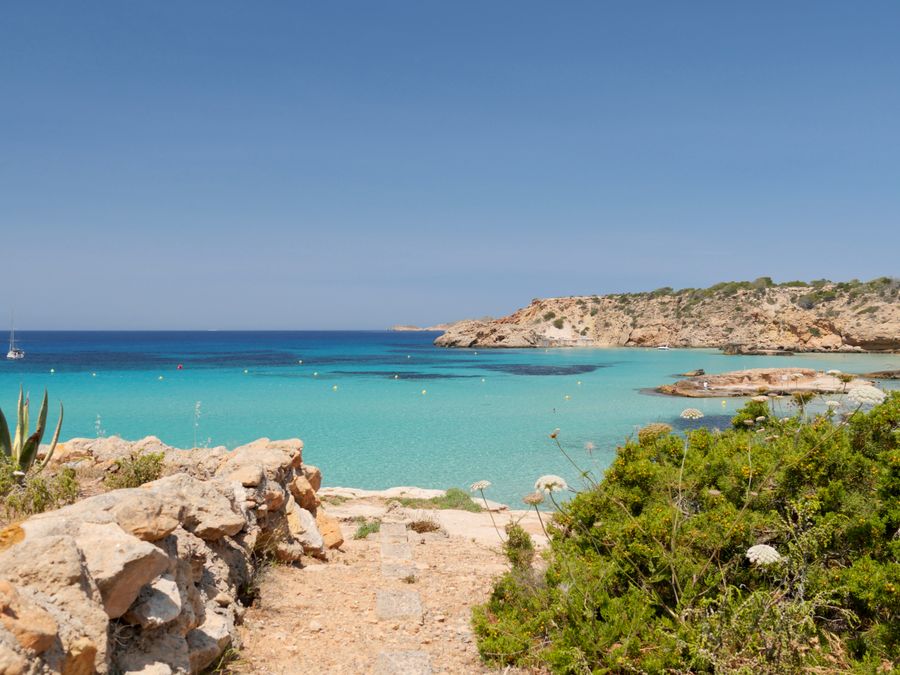
A narrow inlet on Ibiza's east coast where the water stays shallow and the headlands stay wooded. Cala Llonga suits families and anyone who wants a quiet base within easy reach of the island's busier corners.
15.3 kmfrom IBZ, straight line
22stays in the IMPT hotel database
Eastcoast
Cala Llonga is a small resort area on the east coast of Ibiza, about 15.3 km in a straight line from Ibiza Airport, set at the mouth of a valley between wooded headlands. The bay is long and narrow, the sand slopes gently and the water stays shallow well out from the shore. It works as a base rather than a destination in itself.
01
A valley that meets the sea
Cala Llonga sits at the bottom of a valley on Ibiza's east coast, in the municipality of Santa Eulària. The inlet is long and narrow, pinched between two headlands covered in pine, and the water inside it is sheltered from most of the swell that reaches the open coast. Buildings run along the sides of the bay and up the lower slopes, low enough that the pines still frame the view from the sand.
The bay faces roughly east, so mornings are bright and afternoons bring shade from the headland on the southern side. That shape is what makes the place calm: the sea inside the inlet stays flat when it is rough outside. It also means the beach is a place to swim and to sit rather than a place to test yourself against the water. The valley behind rises steadily, with lanes and paths climbing towards the main road.
The sea inside the inlet stays flat when it is rough outside.
02
Sand, shallows and swimming
The beach is a broad curve of sand at the head of the inlet, backed by a promenade and a line of pines. The seabed shelves so gently that the water is still at knee height a long way out, which is why families with small children gravitate here. Swimming is easy and unhurried. Beyond the mouth of the bay the coast opens and the water deepens quickly, so the sheltered zone is the sensible place to stay with children.
Because the inlet is sheltered, it is a reasonable place for a first paddle or a first snorkel. The shallow sand near the shore is not where the posidonia meadows lie; those are further out and deeper, and the seagrass is protected. Look and do not touch. To see the meadows properly, join a guided snorkel run by a licensed operator rather than striking out alone, and never anchor over the dark patches.
Shallow waterThe bay stays at knee height a long way out, which suits small children and nervous swimmers.
ShadePines and the southern headland give shade in the afternoon, so the sand stays usable.
SnorkellingThe rocky edges of the headlands show more fish than the open sand in the middle.
AnchoringMoor over sand and never over posidonia; the meadows are protected by a Balearic decree.
The beach promenade at Cala Llonga, Ibiza03
Sights near the inlet
Cala Llonga is small, so most of what there is to see lies a short drive or bus ride away. Santa Eulària, the nearest town of any size, has a promenade, a church on the hill and a working life that continues outside the season. North of it, Es Canar holds the Punta Arabí market on Wednesdays in season, and the lanes behind it lead to smaller coves. Check current market days before building a plan around one.
West along the coast, Dalt Vila, the walled upper town of Eivissa, is a UNESCO World Heritage Site, listed in 1999 along with the posidonia meadows and the Phoenician sites of Sa Caleta and Puig des Molins. The Renaissance walls, the cathedral at the top and the harbour below fill a morning. The Ses Salines Natural Park, with its salt pans and dunes, makes a longer half day. Both are best reached by car or bus rather than on foot from the inlet.
04
Who Cala Llonga suits
Families come first. The shallow water, the compact beach and the fact that everything sits within a few minutes' walk of the sand make it easy with children. Couples and older travellers who want a quiet base with a short transfer from the airport also do well here. Anyone looking for nightlife, a long list of restaurants or a sense of discovery will find the place thin on all three. That is the trade, and it suits most people who book here.
It is a resort area rather than a village, and it feels like one: a strip of buildings, a beach, a handful of places to eat. The compensations are the water, the pines and the position on the east coast, which puts Santa Eulària, Es Canar and the northern coves within reach while keeping the airport run short. For a car-free week built around sea and shade, it works well.
05
Evenings and eating
Evening here means a walk along the promenade, a meal within sight of the water and an early night. The choice is limited: a small spread of places along the bay and a few more up the valley, most of them seasonal. In July and August they fill early, and booking ahead is sensible. Out of season the choice narrows sharply, sometimes to almost nothing, and you may need to drive to Santa Eulària to eat.
Food on this coast is straightforward: fish, rice dishes, grilled vegetables, almond pastries and hierbas, the local herb liqueur, served cold at the end of a meal. Menus in the bay tend to be written for visitors, so it is worth walking one street back from the promenade. For a wider choice, Santa Eulària keeps restaurants open through the winter. Nothing here is worth queueing an hour for; eat earlier instead.
Book aheadIn July and August, tables in the bay fill early; reserve in the morning for the same evening.
WinterMany places close roughly November to April, so check before relying on a particular street.
Local drinksHierbas, the island's herb liqueur, is served cold or over ice to finish a meal.
FishLook for fish and rice cooked simply; bullit de peix is the island dish worth trying once.
The coast seen from Cap Llibrell, between Cala Llonga and Santa Eulària, Ibiza06
From the airport
Ibiza Airport lies about 15.3 km in a straight line from Cala Llonga, to the south-west, near the island's southern shore. The road route runs by way of the main east-coast road, and the drive is short outside peak hours. In July and August, and on summer weekends, the same journey can take much longer. Allow for that when meeting a flight or catching a ferry onwards. The airport sits in Sant Josep de sa Talaia, on the other side of Eivissa.
Buses link the airport with Ibiza Town and the larger east-coast towns, and from those points a local service reaches the bay. Timetables change with the season, with far fewer buses between November and April, so check the island bus operator for current lines and times before travelling. Taxis and pre-booked transfers are simpler with luggage or children, though supply is stretched in high summer and evening waits can be long.
Check before you goBus lines and timetables on the east coast change between summer and winter. Confirm the current route and times with the island bus operator before setting out.
07
Getting around the island
A car makes the east coast much easier: the island's sights are spread out and the coves to the north reward a drive. Roads are good, but parking near popular beaches fills early in summer. Bikes and scooters work for short hops along the coast road and are best kept off the main through routes. The bus network covers the larger towns and the airport, with more lines in summer and fewer in winter.
Within Cala Llonga itself, walking covers everything. The bay is compact, the beach and the few shops sit close together, and the lanes behind are steep enough to make a car unnecessary for daily needs. For anything beyond that, plan around the bus or the car rather than assuming the next resort can be reached on foot. The coast road north towards Es Canar and Santa Eulària is the axis for everything.
On footThe bay is small enough to cross in minutes, so daily needs do not require a vehicle.
By busServices connect the bay with Santa Eulària and the airport; check seasonal timetables.
By carUseful for the northern coves and Dalt Vila; parking near the beach fills early in summer.
By bikeThe coast road is short and mostly gentle, but the lanes up the valley climb.
08
Seasons, closures and visiting lightly
The season runs roughly from May to October. July and August are the busiest and the hottest, and the beach fills by mid-morning. June and September are the better months: the sea is warm, the light is long and the bay is quieter. Typical sea temperatures run around 18 to 19 °C in May, 22 to 23 °C in June and 25 to 26 °C in August, so swimming stays comfortable into autumn.
Outside the season much of the resort closes, roughly from November to April. Hotels, beach bars and boat trips shut, and many restaurants do too; the towns of Eivissa and Santa Eulària stay open all year. Winter is quiet, sometimes wet, and the bay belongs to residents. Plan around the towns for food and accept that some coastal paths and businesses will be unavailable. Check what is open before booking outside the summer.
The inlet sits within reach of the Posidonia oceanica meadows that keep this coast clear, and those meadows are protected by a Balearic decree. Anchor over sand, use a mooring buoy where one is installed in summer, and never drag a chain through seagrass. Take your litter off the beach and use the bins. Water is scarce on these islands, so keep showers short and ask before towels are changed.
Protect itThe Posidonia oceanica meadows between Ibiza and Formentera are a UNESCO-listed habitat, protected by a Balearic decree. Anchor over sand, never over seagrass.
Where to wake up
Stays in Cala Llonga
Stays in Cala Llonga: the first 12 of 22 stays in the IMPT hotel database in or close to Cala Llonga, five-star first, then four-star, then by guest score. Each button opens live prices for your dates in the IMPT app.
Cala Llonga is about 15.3 km in a straight line from Ibiza Airport, on the east coast. The drive follows the main east-coast road and is short outside peak hours, but summer traffic can stretch it. Buses run from the airport to the larger east-coast towns, with a local connection to the bay; check the island bus operator for current lines and times.
Is Cala Llonga good for families with young children?
Yes. The bay is long and sheltered and the seabed shelves gently, so the water stays shallow well out from the sand. The beach is compact and everything in the resort area sits within a short walk. It is one of the easier places on Ibiza for small children, though the summer sun is fierce and shade fills quickly.
Do you need a car to stay in Cala Llonga?
Not for daily needs. Cala Llonga is compact and walking covers everything within it. A car helps for the northern coves, Dalt Vila and Ses Salines, which are spread across the island. Buses connect the bay with Santa Eulària and the airport, with fewer services between November and April, so check timetables before relying on them.
When does Cala Llonga close for the season?
Much of Cala Llonga closes roughly from November to April. Many hotels, beach bars, boat trips and restaurants shut, and the bay becomes quiet. The towns of Eivissa and Santa Eulària stay open year round, so food and shops are still available there. Check what is open before booking a winter stay, and do not assume summer services will be running.
How busy is Cala Llonga in August?
August is the busiest month at Cala Llonga. The beach fills by mid-morning, parking near the bay is hard to find and restaurant tables go early in the evening. June and September are quieter and the sea is still warm, while May and October suit walkers more than swimmers. If August is the only option, start early and book ahead.
What can you do in the evening in Cala Llonga?
Evenings in Cala Llonga are quiet. There is a promenade to walk, a small choice of places to eat within sight of the water, and an early night. In July and August tables fill early, so reserve in the morning. Out of season the choice narrows sharply and a drive to Santa Eulària may be needed for a meal.
Is the seagrass at Cala Llonga protected?
The Posidonia oceanica meadows around Ibiza and Formentera are protected under a Balearic decree and form part of a UNESCO World Heritage listing. They lie further out and deeper than the bathing shallows at Cala Llonga. If arriving by boat, anchor over sand or use an installed mooring buoy, and never anchor over the seagrass itself.
How do you get from Cala Llonga to Formentera?
Formentera has no airport, so the route runs from Cala Llonga to Ibiza Town and then by ferry from the port to La Savina. Fast ferries take about 30 to 35 minutes and conventional ferries about an hour, with frequent sailings in season and fewer in winter. Check operators for current timetables and allow time for the drive.
Which months are best for swimming at Cala Llonga?
Sea temperatures around Ibiza are typically about 18 to 19 °C in May, 22 to 23 °C in June, 25 to 26 °C in August and 23 to 25 °C in September. Most people find June to September comfortable for long swims, and May and October fine for short ones. These are typical figures rather than a forecast.
Photo credits: Saoro, Public domain, via Wikimedia Commons; Dreizung, CC BY-SA 4.0, via Wikimedia Commons; Joan Gené, CC BY-SA 4.0, via Wikimedia Commons.
Watch
Ibiza
Half a minute of Ibiza, from the old town of Dalt Vila to the coves and headlands of the coast.
Captions are built in; the transcript is on the Ibiza page.
Video: JUAN CARLOS NAVALON SANCHEZ, Steven HAuse, Haseeb Ahmad, Josh Tavernier, Boris Ivas, Luca Musella on Pexels