The Far de la Mola marks the eastern end of Formentera, on a limestone plateau about 190 m above the water. Cliffs, pine and dry-stone walls lead to it, and morning is the time to go.
Morningbest time
La Molanearest area to stay
16.7 kmfrom La Savina port, straight line
La Mola lighthouse is the white tower at the eastern tip of Formentera, standing on the plateau of the same name at about 190 m. There is no village around it and no queue, only cliff, pine and the sea. The visit itself is short. Getting there is the point.
01
A light on the eastern tip
The Far de la Mola stands at the eastern end of Formentera, on the rim of the La Mola plateau, where the limestone gives way to the cliff. The plateau reaches about 190 m, the highest ground on the island, and the lighthouse marks the point where the land runs out. It is a working light, seen from far out at sea, and the reason a road crosses the plateau at all.
The tower is a navigation aid, not an attraction with a door to knock on. Whether anything inside is open changes from year to year, so ask the Consell de Formentera or the island tourist office before planning around it. What does not change is the setting: bare rock, wind-shaped pine, low dry-stone walls dividing plots that were once farmed, and the sea below on three sides.
02
Cliffs, pine and dry stone
The plateau is a slab of limestone laid over older rock, and the east coast shows the edge of it. The cliff is close to vertical in places, pale grey and yellow where the stone has broken away, with the water far below. On a clear morning the coast reads as a line of headlands, one after another, each with its own shelf of rock at the base.
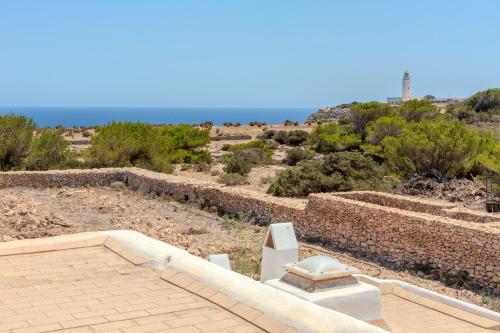
The vegetation is what survives the wind. Aleppo pine grows low and lean, bent away from the sea, and between the trees there is rosemary, rockrose and thrift, thicker in the sheltered hollows. Dry-stone walls, built without mortar, mark out small fields that were worked for grain and grass. Many are now given over to scrub, and the walls remain as the plainest record of how hard the ground was farmed.
Wildlife here is small and unhurried. The Pitiusan wall lizard, found only on Ibiza, Formentera and their islets, is common among the stones and will sit in the sun until you step close. Birds work the cliff face and the updraughts above it. There is nothing to fear on the plateau, but the edge is real: the rock crumbles and the wind can arrive without warning.
Scrub and sea seen from La Mola lighthouse, Formentera03
Getting to the plateau
The road to the lighthouse leaves the eastern main route and climbs across the plateau, past fields and walls, to a signed parking area near the tower. It is a straightforward drive with no difficult sections, but it is narrow in places and shared with cyclists. In high summer Formentera caps the number of visitor vehicles, so check the Consell de Formentera before bringing or hiring a car.
Without a car, the options are the seasonal bus, a bicycle or your own legs, and all three use the same few lanes. The signposted green routes, the circuits verds, link the villages and the coast for walking and cycling, and the plateau roads belong to that network. Distances are short but the sun is strong, so carry water and start early. Check the island bus operator for current lines and times.
By carFollow the signs from the eastern main road and park in the marked area.
By bikePlateau lanes and green routes reach the lighthouse; expect wind and little shade.
By busSeasonal services run in summer; check the island bus operator for lines and times.
On footQuiet lanes and tracks cross the plateau; the heat makes an early start worthwhile.
04
The best time of day
Morning is the reason to come. The lighthouse faces east, so the first light comes up out of the sea and hits the cliff face, and the plateau is at its coolest and quietest. In July and August that means very early: by mid-morning the rock is radiating heat and the wind has picked up. Outside summer the same hour is gentler and the light lasts longer.
Wind is the other variable. The east coast takes the full force of the tramuntana when it blows, and on those days the cliff edge is not a place to linger with a camera. The sea below turns white and the birds hang still in the air. Check the forecast, and if the wind is up, walk the sheltered lanes instead and come back another morning. Sunset, by contrast, belongs to the other end of the island.
Come at first light, when the cliff is still cool and the sea is doing all the work.
05
Walking the cliff paths
Paths run along the plateau rim, some of them old cart tracks worn into the rock, others marked trails between the walls. They are not fenced, and the edge is the edge: keep back from the lip, especially with children and in gusty weather. The ground is uneven, with loose stones and low walls to step over, and shoes with a grip are better than sandals.
The walking is easy in gradient and hard in exposure: little shade, steady wind and no water. A short loop from the parking area takes in the lighthouse and a stretch of cliff, and longer routes drop back through the plateau to El Pilar de la Mola. Use the signed green routes and do not improvise a descent to the water, because there is no easy way down from this stretch.
From the rim, the rest of Formentera lies behind you to the west: the two lagoons inside the natural park, the long beach of the Migjorn coast and the low ground toward Cap de Barbaria. It is the quickest way to understand the island's shape. Formentera is about 19 km long, and from this plateau most of that length is visible at once.
Wild thyme flowering beside La Mola lighthouse, Formentera06
Doing it lightly
The plateau is farmland and scrub, not a park with a fence, and it is easily damaged. Stay on tracks and paths, leave gates as you find them, and do not climb over the dry-stone walls, which are the most characteristic thing on the island and slow to rebuild. Take everything back with you, including fruit peel, and keep the noise down in the early morning, when the light brings people out.
Offshore, the meadows of Posidonia oceanica are what keep the water clear and the beaches in place. Anchoring over them is regulated across the Balearics and the rules are enforced. From the cliff you will see the darker patches of seagrass under the surface. Nothing you do at the lighthouse affects them directly, but the same principle holds for the whole island: take the pressure off and it looks after itself.
Stay on the pathTrampling breaks the plants that hold the thin soil on the plateau.
Leave the wallsDo not climb or dismantle dry-stone walls; they are not rebuilt quickly.
Take litter backThere are no bins at the cliff, so carry everything to the village.
Watch the wildlifeKeep a distance from lizards and birds, and never feed them.
Protect itThe walls, plants and lizards are why the walk is worth making. Keep to the paths and leave the stone where it stands.
07
What to bring
There is nothing at the cliff except the lighthouse and the view, so everything you need comes with you. Water first: the plateau is dry, shade is scarce and the nearest tap is back in the village. A hat and a long-sleeved layer deal with the sun and with wind that can feel cool even in summer. Binoculars turn the cliff into a different place.
Footwear matters more than it seems. The rock is sharp, the paths are stony and the wind moves loose gravel underfoot, so trainers with tread are enough and sandals are not. A light jacket is worth carrying out of season, when the plateau can be cold and the wind steady. Bring a bag for your own litter, and check the forecast before setting out.
WaterCarry more than you think; there is no supply on the plateau.
Sun and windHat, sunglasses and a layer that stops the wind.
FootwearTrainers with tread; the paths are stony and the rock is sharp.
BinocularsUseful for birds along the cliff and boats offshore.
08
Nearby and practical notes
El Pilar de la Mola is the village on the plateau, a short drive or walk back from the lighthouse, with the church, a few streets and a market that runs in season. Check the current days before you build a morning around it. Sant Francesc Xavier, the island's capital, has the services the plateau lacks. Es Caló de Sant Agustí, on the north-east coast, has boat houses and a small harbour.
The far end of the island is Cap de Barbaria, at the southern tip, with its own lighthouse and a different character: flat, exposed and best at sunset. Between the two, the land is low and quiet. La Savina is the port, where ferries from Ibiza Town arrive. A morning on the plateau fits well with a swim on the Migjorn coast or a ride on the green routes.
Practical points: the site is unsheltered, so plans change with the weather. Out of season, much of the island's tourism business closes roughly from November to April. The villages stay open, but do not count on the seasonal bus or the market in winter. Check the Consell de Formentera for the summer vehicle limits and the island bus operator for timetables at either end of the year.
Check before you goVehicle numbers are capped in high season, and seasonal buses and the market keep their own calendars. Confirm with the Consell de Formentera and the bus operator.
Where to wake up
Stays near La Mola lighthouse
Stays near La Mola lighthouse: 3 stays in the IMPT hotel database in or close to La Mola, the nearest area to La Mola lighthouse, five-star first, then four-star, then by guest score. Each button opens live prices for your dates in the IMPT app.
It stands at the eastern end of Formentera, on the La Mola plateau, at about 190 m, the highest ground on the island. The road crosses the plateau past El Pilar de la Mola and ends at a signed parking area near the tower. From there the lighthouse and the cliff are a short walk.
Can you go inside La Mola lighthouse?
The tower is a working navigation light and access inside is not guaranteed; it changes from year to year. Ask the Consell de Formentera or the island tourist office before planning around it. The cliffs, paths and plateau around the lighthouse are the reason most people come, and those stay open.
What is the best time of day for La Mola lighthouse?
Morning, because the tower faces east and the first light comes off the sea onto the cliff. In summer, go at first light to avoid the heat and the strengthening wind, when the plateau is at its quietest. Sunset belongs to the other end of the island, at Cap de Barbaria.
How do you reach La Mola lighthouse without a car?
Use the seasonal bus, a bicycle, or walk the lanes and green routes across the plateau. All three use the same small roads, so allow for traffic in summer. Check the island bus operator for current lines and times, because the service is thinner outside the main season.
Can you cycle to La Mola lighthouse?
Yes. The plateau lanes and the signposted green routes reach it, and the climb is gentle by island standards. Wind is the real obstacle rather than gradient, and there is little shade on the way. Take water, start early, and expect to share narrow lanes with cars in high summer.
Is there anywhere to swim near La Mola lighthouse?
Not directly below it: the cliff is close to vertical on this stretch and there is no easy way down to the water. Swimming belongs to the beaches on the south and north coasts. Treat the cliff edge as a viewpoint and keep back from the lip, particularly when the wind is up.
Is La Mola lighthouse worth visiting out of season?
Yes, if the weather is settled. The lighthouse and the plateau are open ground, and the light and the quiet are better in spring and autumn than in August. Much of the island's tourism business closes roughly from November to April, so check buses and the market before you go.
What else is close to La Mola lighthouse?
El Pilar de la Mola, the plateau village, with its market in season. Es Caló de Sant Agustí on the north-east coast, with its boat houses. Cap de Barbaria, at the other end of the island, for sunset. Sant Francesc Xavier has the services. The island is small, so these fit into a day.
Are there facilities at La Mola lighthouse?
There is no village at the lighthouse and very little shelter, so food and water come with you from El Pilar de la Mola or Sant Francesc Xavier. Carry your litter back to the village. The cliff is exposed in every season, so a hat and a windproof layer are worth having.
Photo credits: Formesar, CC BY-SA 4.0, via Wikimedia Commons; Montserrat Boix, CC BY-SA 4.0, via Wikimedia Commons; Joan Gené, CC0, via Wikimedia Commons.
Watch
Formentera
Formentera from a drone: white sand, shallow turquoise water and boats at anchor.
Captions are built in; the transcript is on the Formentera page.