A high plateau at the east end of Formentera, with a lighthouse on the cliff and a village that fills with stalls in the evening. Quiet, exposed and worth the drive.
16.6 kmfrom La Savina port, straight line
3stays in the IMPT hotel database
Eastcoast
La Mola is the limestone plateau that fills the east end of Formentera, rising to about 190 m above the coast, with the Far de la Mola lighthouse at its tip and the small village of El Pilar de la Mola in the middle. It is quiet, exposed and agricultural, and it makes a good base if you want nights that are dark and days that begin with a walk.
01
A plateau above the coast
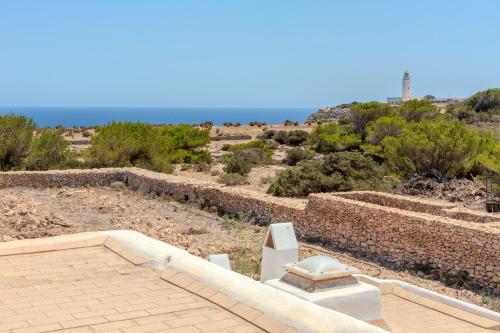
The eastern end of Formentera lifts into a flat-topped limestone plateau, about 190 m at its highest, edged with low cliffs and dry stone walls. The land is farmed in small fields, with fig trees, vines, capers and rough scrub between them. The roads are narrow, often single-track, and they tend to end at the lighthouse or at a cliff rather than loop back. From La Savina port the plateau is about 16.6 km away in a straight line.
Height changes the weather. La Mola catches more wind than the beaches below and loses heat at night, so a jacket earns its place even in summer. Shade is scarce away from the village and the pine edges, which makes walking at midday in July a poor plan. The reward is space: the plateau is large enough to absorb the summer traffic and still feel empty a few hundred metres from the road, which is rare on this island in August.
02
The lighthouse at the end
The Far de la Mola stands at the eastern tip, on the cliff line above the sea, and is the reason most people drive out this far. The white tower marks the end of the island and the start of open water, and the ground around it is bare rock and low scrub. A path follows the cliff edge, the horizon is unbroken to the east, and there is very little between you and the weather.
Early morning and the last hour before sunset are the best times, when the light comes in low across the fields and the cliffs warm up. Wind is constant: on a Tramuntana day the edge is not a comfortable place to stand. Parking near the tower is limited and fills quickly in high season, and turning a car round on the narrow approach takes patience. Stay back from the cliff edge, where the rock is undercut and unfenced.
The church of El Pilar de la Mola, Formentera
The road ends, the fields stop, and the light takes over.
03
El Pilar and the craft market
El Pilar de la Mola is a small village in the middle of the plateau, gathered around a whitewashed church with a broad porch. It has a handful of streets, a square and very little else, which is the point. In season the village hosts a craft market that draws people up from the beaches in the evening. Stalls sell jewellery, leather, textiles and food, much of it made on the island, and the mood is unhurried compared with the port.
The market is seasonal and its days change, so check with the Consell de Formentera or the island's tourist information before planning an evening around it. Arrive before the stalls open if you are driving, or come on foot or by bicycle along the green routes. Out of season the village returns to its ordinary self: a church, a couple of small bars, and the sound of wind across the square. That version of El Pilar is worth seeing too.
TimingThe market runs in season on set days; check the current schedule before you drive up.
ParkingSpace near the village is limited, so arrive early or come by bicycle.
ChurchThe village church is a calm stop, and its porch gives shade in the middle of the day.
Small purchasesSome stalls take cards and some do not, so go prepared.
04
Beaches below the plateau
The north coast below La Mola is rocky and little visited, with small inlets reached on foot. The south side is different: the long sand of Platja de Migjorn runs west from near Es Caló de Sant Agustí, and the water there is shallow and clear over posidonia meadows. Es Caló itself has a small harbour and boat houses built into the rock, and it is the easiest swim from the plateau. Nothing on this list is more than a short drive.
For a full beach day, Cala Saona on the west coast and Ses Illetes in the north are within reach by road, though both are busy in August and Ses Illetes sits inside the natural park with its own access rules. Many people based on La Mola walk to the plateau edge at sunrise and drive down to swim later. Beach etiquette matters here: posidonia is a living plant, not weed, and anchoring over it is regulated.
Es CalóA small harbour and shallow water at the foot of the plateau, good for an early swim.
MigjornLong sand to the west, with room to walk and posidonia offshore.
Cliff pathsTracks along the plateau edge lead to quiet rock platforms; take care on wet rock.
Ses IlletesFurther north inside the natural park, and best reached early in high season.
05
Who the plateau suits
La Mola suits people who want quiet. Nights are dark, the lanes empty early and the nearest noise is the wind. It is a good base for walkers and cyclists, since the green routes cross the plateau and connect it with Sant Ferran de ses Roques, Es Caló and the south coast. It also suits anyone who prefers a village church and a seasonal market to a strip of bars. It does not suit anyone who wants a different restaurant within walking distance every night.
Families with small children often prefer Es Pujols or the Migjorn coast, where the water is shallow and everything is closer together. Couples and solo travellers who value silence do well here. Staying on the plateau means committing to a car, a scooter or a bicycle for the length of the stay, because the distances look short on a map and feel longer in the heat. Visitor vehicles are capped in high season, so arrange yours before you arrive.
The cliffs of La Mola seen across the island from Cap de Barbaria, Formentera06
Evenings, food and darkness
Evening on La Mola is mostly about light and sky. The plateau has little light pollution, and the stars on a clear night are the main entertainment. Eating is simple: the village has a small number of places open in season, and they close early by coastal standards. Most people cook where they stay, or drive down to Sant Ferran, Es Pujols or Sant Francesc for a wider choice. Do not assume winter opening anywhere on the plateau.
Produce is the pleasure here. Late summer brings figs and tomatoes with flavour, and the island's dried fish is still made and sold in a small way, a reminder that this was a farming and fishing economy long before it was a holiday one. Shopping is done in Sant Francesc or at the market rather than up here. Wherever you eat, remember that many kitchens close from November to April and that hours are never fixed.
07
Getting there from the airport
Formentera has no airport. The route is a flight to Ibiza (IBZ), a transfer to Ibiza Town port, then a ferry to La Savina; fast ferries take about 30-35 minutes and conventional ones about an hour. Sailings are frequent in season and fewer in winter, so check the operators before fixing flights. From La Savina, La Mola is a drive east through Sant Francesc and Sant Ferran, with the lighthouse at the far end of the plateau road.
Buses run from the port and from Sant Francesc, but not to every corner of the plateau and not at every hour; check the island bus operator for current lines and times. A taxi from the port is a short ride but not always waiting when a ferry arrives, so booking ahead helps. With a car, the roads narrow past Sant Ferran and the last stretch to the lighthouse is slower than the map suggests.
Check before you goFerry timetables, visitor vehicle limits and bus times change with the season. Check the Consell de Formentera and the ferry operators before booking.
08
When to go, and going lightly
May, June, September and early October are the good months: warm sea, fewer people and enough open to eat and shop. July and August are hot and busy, and market evenings fill the plateau road. The island is at its quietest from November to April, when many businesses close and La Mola feels remote. That has its own appeal, but plan around fewer ferries and closed kitchens. Sea temperature runs from about 14-15 °C in February and March to about 25-26 °C in August.
Visiting lightly is straightforward here. Carry water, keep to tracks across the fields, and take no stones, plants or lizards. The posidonia meadows offshore are protected, anchoring over them is regulated, and mooring buoys are installed in some bays in summer. The tourist tax charged by accommodation supports some of this work; rates change, so check the Balearic government site. The plateau is farmland rather than a park, and gates should be left as you find them.
WaterThere are few shops on the plateau; carry more water than you think you need.
Sun and windShade is scarce and wind burns too, so cover up in the middle of the day.
LizardsThe Pitiusan wall lizard lives only here and on Ibiza; look, do not touch.
TracksStay on the green routes and field paths, and leave gates as you find them.
Protect itThe plateau is working farmland and the sea below is a protected meadow. Keep to paths, carry your rubbish out and never anchor over posidonia.
Where to wake up
Stays in La Mola
Stays in La Mola: 3 stays in the IMPT hotel database in or close to La Mola, five-star first, then four-star, then by guest score. Each button opens live prices for your dates in the IMPT app.
La Mola is the plateau that fills the east end of Formentera, roughly 16.6 km from La Savina port in a straight line. The village of El Pilar de la Mola sits in the middle and the Far de la Mola lighthouse marks the eastern tip. The land between is farmland, dry stone walls and narrow lanes.
How do you reach La Mola from Ibiza Airport?
Fly to Ibiza, take a bus or taxi to Ibiza Town port, then a ferry to La Savina: about 30-35 minutes on a fast ferry, about an hour on a conventional one. From La Savina, drive or take a bus east through Sant Francesc and Sant Ferran. Formentera has no airport, so the ferry is the only way across.
Is La Mola good for walking and cycling?
Yes. The signposted green routes cross the plateau and link it with Sant Ferran, Es Caló and the south coast, and the lanes carry little traffic. Wind and heat are the limits rather than distance. Carry water, start early, and remember that shade is scarce away from the village and the pine edges.
When does the craft market at El Pilar de la Mola take place?
The market is seasonal, running in the warmer months on set days, often into the evening. Days and dates change from year to year, so check with the Consell de Formentera or the island's tourist information before planning a trip around it. Out of season there is no market and the village is very quiet.
Can you stay on La Mola without a car?
It is possible but limiting. Buses connect the plateau with Sant Francesc and the port, with fewer services outside summer, and bicycles suit the green routes. A car or scooter makes beaches and evenings much easier. Check the island bus operator for current lines, and note that visitor vehicles are capped in high season.
Are there beaches on La Mola itself?
Not on the plateau: the coast below is mostly rock and low cliff. The nearest swimming is at Es Caló de Sant Agustí below the northern edge, or along Platja de Migjorn to the south-west. Both have shallow, clear water over posidonia. Allow a short drive or a longer bike ride, and take water.
Where can you eat in the evening on La Mola?
El Pilar de la Mola has a small number of places open in season, and they tend to close early. For more choice, drive down to Sant Ferran de ses Roques, Es Pujols or Sant Francesc, where kitchens stay open later in summer. Many places on the island close from November to April, so do not count on winter opening.
What is La Mola like out of season?
From November to April the plateau is very quiet. The market stops, many seasonal businesses close, ferries are fewer and the wind bites harder. The main towns stay open, so shopping and eating are possible in Sant Francesc. What remains is farmland, dark nights and empty lanes, which suits anyone who wants the island without the summer crowd.
Why is La Mola so windy?
The plateau rises to about 190 m and carries little tree cover, so wind crosses it uninterrupted, especially the Tramuntana from the north. That keeps summer temperatures bearable and the light clear, but it also means sunburn arrives without warning and a clifftop walk can be uncomfortable. Carry a layer and hold on to your hat.
Photo credits: MsLids, CC BY-SA 3.0 es, via Wikimedia Commons; Fabian Hurst, CC BY-SA 4.0, via Wikimedia Commons; Joan Gené, CC0, via Wikimedia Commons.
Watch
Formentera
Formentera from a drone: white sand, shallow turquoise water and boats at anchor.
Captions are built in; the transcript is on the Formentera page.