One village inland, one small settlement on the coast, and between them some of Menorca's wildest coves. Es Migjorn Gran is small, and much of it is walked rather than driven.
18stays in the IMPT hotel database
–area guides
Menorcaisland
Es Migjorn Gran is a small municipality in the south of Menorca, one of the island's youngest and least built-up. It has a single inland village, a small coastal settlement at Sant Tomàs, and a coast of ravines and coves that can only be reached on foot or by boat. This guide covers what is there, how to get around and when to come.
01
A municipality of its own
Es Migjorn Gran is one of Menorca's eight municipalities and one of the smallest, a block of land in the south of the island between Alaior and Ferreries. It is also one of the youngest: it ran its own affairs only from the 1980s, having previously been part of its neighbour. That history shows. There is no grand civic centre and no harbour, just a village with a council building and a long coast below it.
What separates Es Migjorn Gran from the rest of Menorca is the absence of things. No resort strip, no marina, no main road running through. The coast is reached on foot, the village is lived in all year, and the fields between them are still farmed and divided by dry stone walls. Visitors who want a base for walking and swimming rather than for going out at night tend to like it here.
02
The village and Sant Tomàs
The village of Es Migjorn Gran also carries the older name Sant Cristòfol, which is what you will see on some maps and hear from older residents. It sits on rising ground a few kilometres inland, with a church, a small square and narrow streets of two-storey houses that are occupied through the winter. Daily life is provided for: a grocery, a pharmacy, a school, somewhere to eat in the evening.
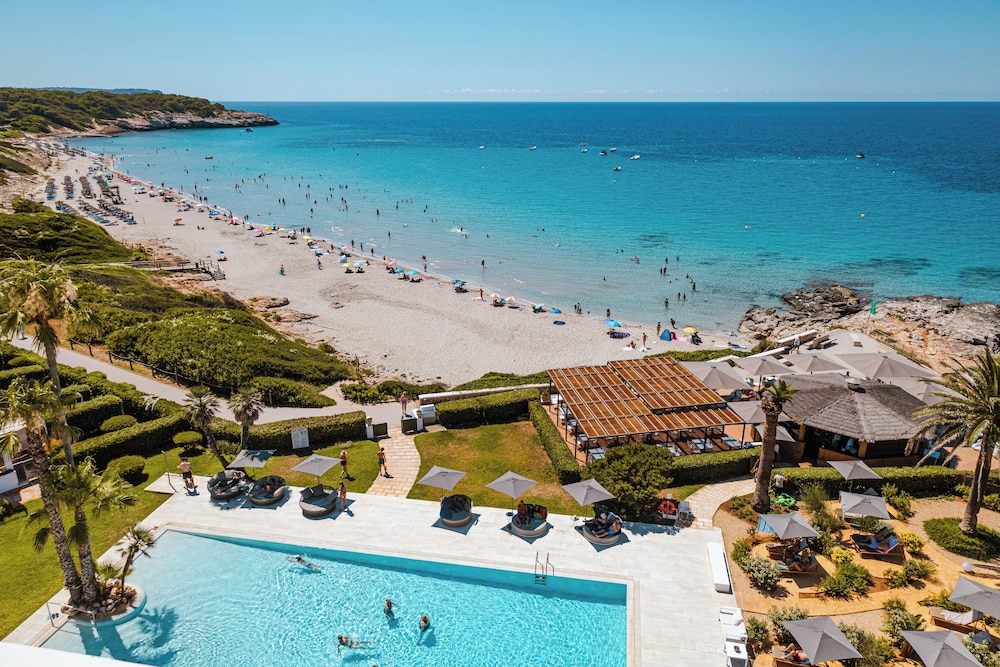
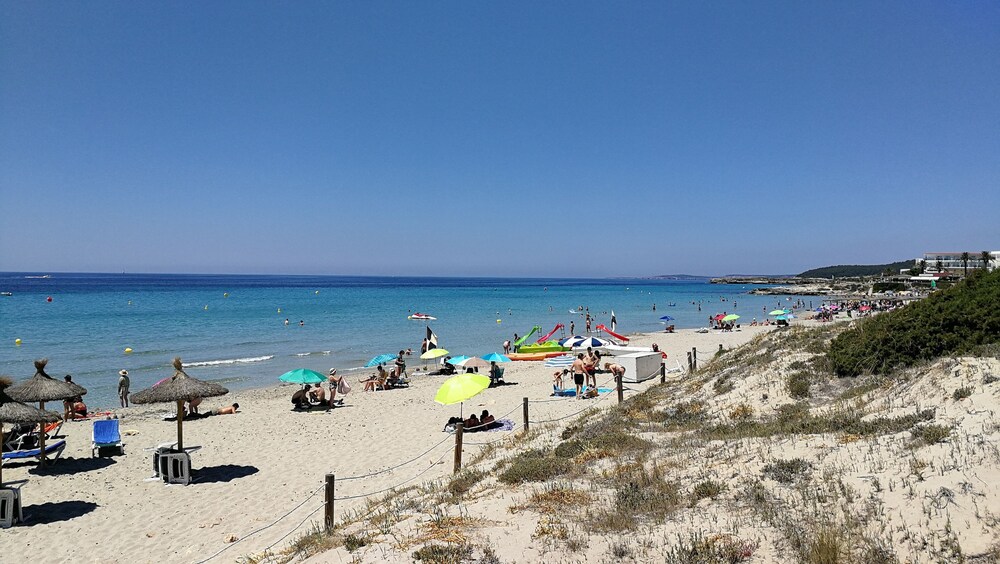
Sant Tomàs, the only settlement on the coast, is a summer place above a sandy bay, built low and close to the water. It has a small year-round core and a ring of holiday apartments and houses that fill in July and August. Out of season it is very quiet, which suits some people and not others. There is a beach, a short promenade and not much else, and that is the appeal.
Platja de Sant Adeodat, Es Migjorn Gran, Menorca03
Beaches and coves
The municipality's shoreline runs west from Sant Tomàs in a series of coves cut into the cliffs, each reached by a path down a ravine. None of them has a road, so even in August the sand stays quiet and the walk in becomes part of the day. Take water, wear shoes with grip and allow more time than the distance on the map suggests. The going is rough underfoot in places.
Swimming is easiest in the bigger bays, where the sand shelves gently. The smaller coves are rougher, can be cut off in swell and have no lifeguard cover. Offshore, posidonia meadows grow in the clear water, which is why anchoring is regulated around the island and why mooring buoys appear in some bays in summer. Check the current rules before you anchor, and never anchor over the seagrass.
Sant TomàsSandy and shallow, the easiest beach to reach and the one to choose with small children.
BinigausA wide sweep of sand below a ravine, a long but level walk south from Sant Tomàs.
TrebalúgerA deep inlet where a stream meets the sea, reached on the Camí de Cavalls from either side.
EscorxadaRemote sand and rock, the furthest cove for most day walkers, with no shade and no services.
FustamA small neighbouring cove on the same stretch, quiet even in season and best in calm weather.
Protect itThe clear water is the work of the posidonia meadows offshore. Use a mooring buoy where one is provided, never anchor over the seagrass, and carry everything back up the path.
04
Nature and protected land
The whole of Menorca has been a UNESCO Biosphere Reserve since 1993, and Es Migjorn Gran's share of it is the least developed part of the south coast. There is no natural park inside the municipality, but the ravines, cliffs and dune edges are protected, and the land is farmed rather than built on. Birds of prey work the cliff faces, and the scrub along the barrancs is thick with oleander and wild olive in spring.
Walkers should know that some paths cross private land, and that gates, crops and animals are part of the working landscape. Keep to the marked route, close what you open and give livestock room. Above the Binigaus ravine the limestone opens into large caves, and climbing and caving groups use them; if you go in, take a torch and tell someone where you are. Signal is patchy in the ravines.
05
Culture and history
The parish church of Sant Cristòfol stands at the top of the village, rebuilt over centuries and still the centre of local observance. The name Migjorn refers to the south, or to midday, a reminder that the village looks toward the sunny side of the island. Around it, the municipality is scattered with prehistoric remains: talayots, burial navetes and the dry stone walls that later farmers built from their stone. Some stand beside the road, others in fields.
'Talayotic Menorca' joined the World Heritage list in 2023, recognising the island's prehistoric monuments as a single group. Es Migjorn Gran contributes a modest share of them, and its sites are generally unstaffed and open to view. Treat them as you would a church: do not climb on the stones, do not move anything and leave gates as you find them. A few are signposted from the lanes, others need a map.
Menorca's prehistory is not fenced off here; it sits in the fields between the walls.
06
Food and markets
Eating here follows the island rather than the season. Menorcan cooking is plain and good: fish, rice, vegetables, pork and the lobster stew that the island is known for. Mahón-Menorca cheese, which has protected designation of origin status, appears on most tables, often with oil and pepper. In the village you will find everyday food served through the year; on the coast at Sant Tomàs, most kitchens open with the season and close with it.
The municipality has no large weekly market of its own. The nearest are in the surrounding towns, and days and locations change with the season, so ask at the council office or where you are staying. What the village does have is a summer festival around the feast of Sant Cristòfol, when the streets fill for a few days. Check the dates with the Consell Insular de Menorca or the local council before planning around it.
Horse and rider at the Sant Cristòfol festival in Es Migjorn Gran, Menorca07
Getting there and around
Menorca Airport (MAH) sits about four to five kilometres south-west of Maó. The straight-line distance from the airport to Es Migjorn Gran is shown on this page; the road route is longer and depends on the way you take, so no driving time is given here. By road you come off the main Maó to Ciutadella road and turn south, either for the village or, further west, for Sant Tomàs.
Buses run to the village and, in summer, to Sant Tomàs, but the network is thin and timetables change with the season. Check the island bus operator for the current lines. A car makes the coves and the villages of the south easier, though parking at Sant Tomàs fills quickly in high summer and the lanes down to the coast are for residents and farm traffic. Walkers arrive on the Camí de Cavalls.
By airFly into Menorca Airport (MAH), then continue south by bus, taxi or hire car.
By busSeasonal lines serve the village and Sant Tomàs; check the island operator for times.
By carThe village is easy to park in; Sant Tomàs is not, in July and August.
On footThe Camí de Cavalls, waymarked as the GR 223, follows the whole coast.
Check before you goBus timetables, cove parking and summer access rules change from year to year. Check the island bus operator and the Consell Insular de Menorca before you set out.
08
When to go
Late spring and early autumn are the best of it. In May the sea is around 18 or 19 °C, cool but swimmable for most people, and the paths are dry. June brings 22 or 23 °C water and long evenings. September holds 23 to 25 °C and quietens as the month goes on, which suits walkers and anyone who wants Sant Tomàs without the August crowd. July and August are hot and busy.
From roughly November to April much of the visitor economy closes. The apartments and seasonal restaurants at Sant Tomàs shut, boat trips stop and buses thin out. The village stays open, with its shop, school and council, and the coast is at its best for walking: cool, green and empty. Winter flights and ferries are fewer, so check schedules and do not assume that a place you saw in a photograph will be open.
09
Who it suits
Es Migjorn Gran suits people who want a quiet base with the sea within walking distance and no nightlife to speak of beyond a few summer bars. Walkers use it for the Camí de Cavalls and the coves; families settle at Sant Tomàs for the shallow beach; couples take the village for space and silence. A car helps, though not every day. Anyone looking for a lively resort town should look further east or west.
There are 18 stays in the IMPT database for this municipality, spread between the village and the Sant Tomàs coast, from small village houses to apartments above the bay. Book well ahead for July and August, when the coast fills, and confirm winter opening directly before booking outside the season, because much of the accommodation closes. The village side is the safer bet for a stay between November and April.
WalkersStay in the village for the Camí de Cavalls and the ravine paths to the coves.
FamiliesSant Tomàs has the shallow sand and the shortest walk to a beach.
CouplesThe village is quiet in the evening, with a handful of places to eat.
WinterChoose the village, confirm the booking and expect closed coastal businesses.
Where to wake up
Stays in Es Migjorn Gran
Stays in Es Migjorn Gran: the first 9 of 18 stays in the IMPT hotel database in or close to Es Migjorn Gran, five-star first, then four-star, then by guest score. Each button opens live prices for your dates in the IMPT app.
Is Es Migjorn Gran a good base for a beach holiday in Menorca?
Yes, if you want a small, quiet base rather than a resort. Sant Tomàs has a shallow sandy beach, and the wild coves of Binigaus, Trebalúger and Escorxada lie west of it along the coast path. There are few facilities and little nightlife, so families and walkers tend to be happier here than groups looking for bars.
How do you reach the coves of Es Migjorn Gran?
On foot, mostly. The coves west of Sant Tomàs have no roads; you walk in down ravines or along the Camí de Cavalls, the GR 223, which follows the whole coast. Allow more time than the distance suggests, carry water and wear shoes with grip. Some approaches cross private farm land, so keep to the marked path.
Is there a village in Es Migjorn Gran, or is it only coast?
There is a proper village, also called Sant Cristòfol, set inland a few kilometres from the sea, with a church, a square, a grocery and a school, and people living there all year. Sant Tomàs on the coast is the second, much smaller settlement and is largely seasonal. The village is where everyday life happens.
Can you walk the Camí de Cavalls through Es Migjorn Gran?
Yes. The Camí de Cavalls, waymarked as the GR 223, crosses the municipality along its whole coast, linking Sant Tomàs with Binigaus, Trebalúger, Escorxada and the boundaries with neighbouring municipalities. Stages are walkable in half a day and the path is well marked, though the ground is rough in places and there is little shade or water.
Does Es Migjorn Gran have prehistoric sites?
It has its share, though fewer and less famous than those elsewhere on the island. Talayots, navetes and sections of dry stone wall stand in fields and beside lanes, generally unstaffed and open to view. 'Talayotic Menorca' joined the World Heritage list in 2023. Do not climb on the stones or move anything, and leave gates as you find them.
What closes in Es Migjorn Gran out of season?
Most of the coast. From roughly November to April the apartments, seasonal restaurants and other visitor services at Sant Tomàs shut, boat trips stop and buses are fewer. The village stays open all year. Flights and ferries also thin out, so check timetables and confirm that your accommodation is open before booking.
Do you need a car in Es Migjorn Gran?
It helps. Buses reach the village and, in summer, Sant Tomàs, but services are thin and timetables change with the season, so check the island bus operator. A car makes shopping and the neighbouring towns easy, though parking at Sant Tomàs fills in high summer. Walkers can manage without one if they plan around the bus and the coast path.
Where do you swim in Es Migjorn Gran with children?
Sant Tomàs is the obvious choice: a sandy bay that shelves gently, with the shortest walk from a road. The wild coves to the west are beautiful but rougher, unguarded and reached by rough paths, so they suit older children and confident swimmers. Check conditions on the day and remember that lifeguard cover is seasonal at best.
When is the best time to visit Es Migjorn Gran?
Late spring and early autumn. In May the sea is around 18 or 19 °C and the paths are dry; June brings 22 or 23 °C water and long evenings; September holds 23 to 25 °C and quietens as the month goes on. July and August are hot and busy at Sant Tomàs, though the wilder coves stay quiet.