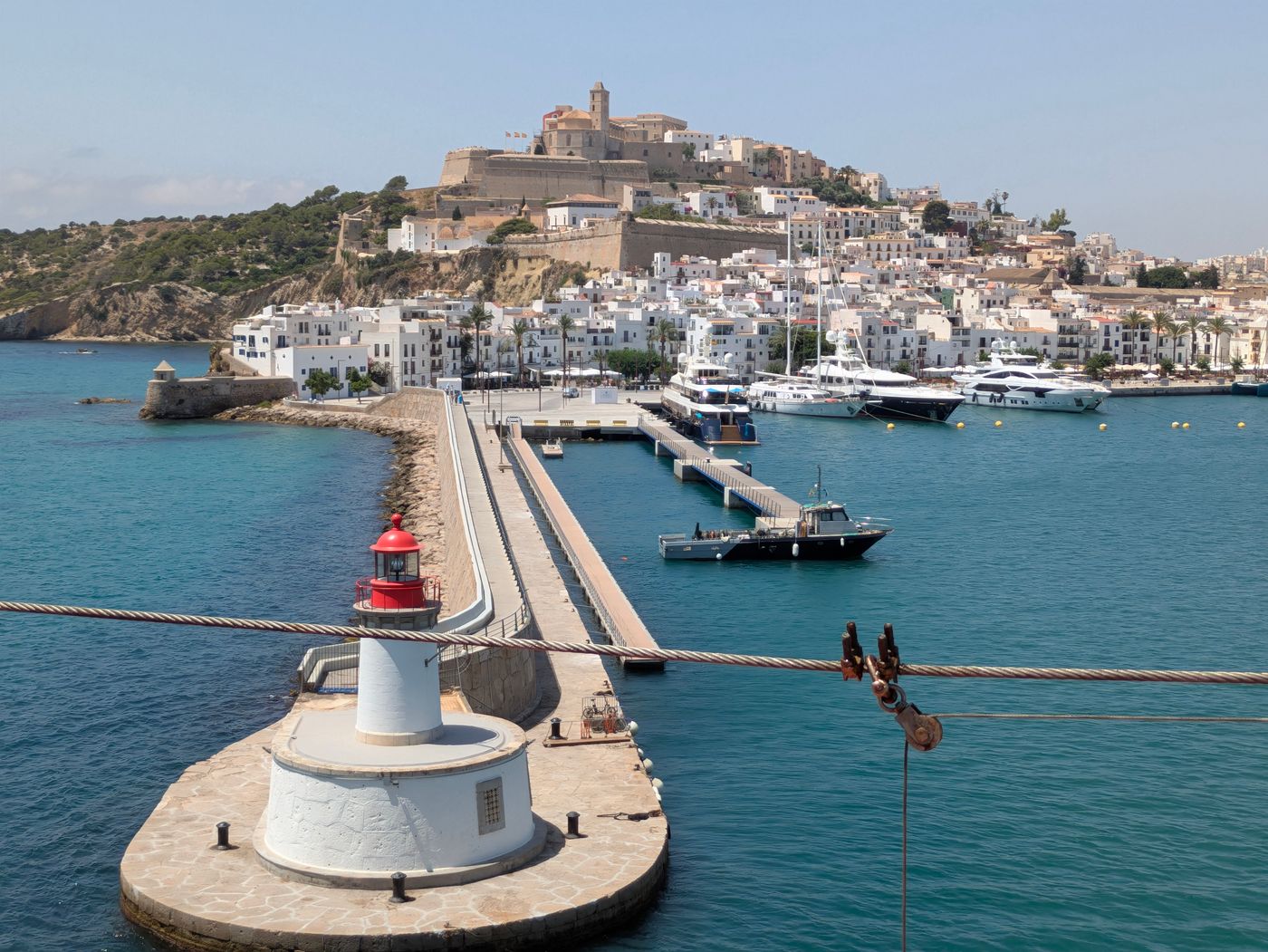
Most sea arrivals on Ibiza come into the port of Eivissa, below Dalt Vila. The same harbour handles the short crossing to Formentera, which has no airport of its own.
8 minread
Getting theretopic
Ibizaisland
Boats reach Ibiza at the port of Eivissa, with mainland crossings from Barcelona, Valencia and Dénia, a regular service from Palma in Mallorca, and seasonal routes into Sant Antoni de Portmany. Formentera is reached from the same Ibiza Town harbour rather than by air: a fast ferry to La Savina takes about 30 to 35 minutes, a conventional boat about an hour.
01
Where the boats arrive
Almost every sea arrival on Ibiza comes into the port of Eivissa, a harbour cut into the foot of the old town. The ferry terminals sit below Dalt Vila, so the Renaissance walls and the cathedral are the first things visible from the deck. Step off the boat and the walled town is a short climb from the quayside, which makes the port a sensible base for a first or last night on the island.
Sant Antoni de Portmany, on the west coast, has its own harbour and takes seasonal boats from the mainland. It is a working port as well as a resort, and the ferry berths are within walking distance of the town centre and the bus station. Outside the summer months the choice narrows sharply, and the mainland services concentrate on Eivissa. Both ports are on the island bus network, so a foot passenger can reach the rest of Ibiza without a car.
The walls of Dalt Vila are the first thing seen from the deck.
02
Crossings from the mainland
Barcelona, Valencia and Dénia all have direct sailings to the port of Eivissa. The Barcelona crossing is the longest and is often run overnight, which turns the passage into a night of sleep rather than a day at sea. Valencia and Dénia are closer, and their boats suit travellers driving down the Spanish coast with a car. Timetables change with the season, so compare the operators before fixing dates. Booking directly with the company that runs the route keeps you in touch with any change.
Cars, campervans and motorbikes travel on most of these boats, but space on a given sailing is finite and fills first in July and August. Foot passengers usually have more room and can book later. Cabins and reclining seats are sold separately on the longer crossings, and the better places go first. Weather can delay a sailing, so leave slack in the plan at either end of the trip. Summer storms in particular can hold a boat in port for hours.
BarcelonaThe longest mainland run, often sailed overnight.
ValenciaA mid-length crossing on the Spanish east coast.
DéniaBoats from this port suit drivers coming down the coast.
Sant AntoniSeasonal mainland services arrive on the west coast.
The Formentera ferry terminal in Ibiza Town port03
The Palma crossing
Palma in Mallorca has a regular service to the port of Eivissa, and the crossing is short enough to fit into a day. Mallorca works as a transit point rather than a destination here, but it matters for anyone flying into Palma and continuing by sea. The boat is also the way towards Menorca, since there is usually no regular direct ferry between Ibiza and Menorca; most travellers connect through Mallorca or fly.
Menorca is about 200 km from Ibiza, with Mallorca lying between, and the sea route reflects that: there is usually no direct boat. Fly between the two islands, or take a ferry to Palma and a second boat onward to Maó or Ciutadella. Both of those Menorca ports have their own mainland links, including overnight crossings to Barcelona, which is useful if the trip continues to Catalonia. Allow a full day for the combination, and check the two timetables against each other before booking.
04
On to Formentera
Formentera has no airport. The route is a flight to Ibiza, then a ferry from the port of Eivissa to La Savina, the island's only port. Fast boats take about 30 to 35 minutes; conventional boats take about an hour. Sailings are frequent in season and much fewer in winter, so the crossing is easy in July and needs planning in January. Tickets are sold at the harbour and through the operators, and the queue at the port in August is part of the trip.
Vehicles are the complication. The Consell de Formentera caps the number of visitor vehicles in high season, so bringing a car or van across needs checking well before the trip. Many travellers leave the car on Ibiza and walk, cycle or use the buses on Formentera, which suits an island about 19 km long with signposted green routes. Hire bikes and cars on Formentera instead of shipping one over. Parking at the Ibiza Town port fills early in summer.
No airportFly to Ibiza, then take a boat to La Savina.
Fast ferryAbout 30 to 35 minutes from the port of Eivissa.
Conventional ferryRoughly an hour, with more space for vehicles.
Vehicle limitsThe Consell de Formentera caps visitor vehicles in high season.
La SavinaThe port village, with the road to Sant Francesc Xavier.
Protect itThe meadows of Posidonia oceanica between Ibiza and Formentera are part of the UNESCO listing. Anchoring over them is regulated, so use the mooring buoys where they are installed.
05
When to book
For July and August, book the mainland crossing as soon as the dates are fixed. Those weeks carry the highest demand for cars and cabins, and the better places on a boat sell first. June and September are busy but calmer, and a booking a few weeks ahead is usually enough. For the Formentera crossing, tickets are generally available at the port, though a vehicle needs far more notice. Sailings at unsociable hours are usually the easiest to secure.
Winter is a different business. Sailings thin out, some seasonal routes stop altogether, and a crossing that runs daily in August may run twice a week in February. A flight plus a ferry can be rearranged by weather, so keep a day spare at each end of a winter trip. Check the operator's own timetable close to departure, and confirm with the port before travelling to it. Book flexible tickets where the option exists, since a delay at sea has a knock-on effect on everything after it.
The harbour light at the entrance to Ibiza Town port, Dalt Vila behind
Check before you goTimetables, operators and seasonal routes change, and the Formentera vehicle cap is set for each year. Confirm with the ferry company, and with the Consell de Formentera for a vehicle.
06
Arriving without a car
The port of Eivissa is close to the town, so a foot passenger can walk into the centre in minutes and reach the bus station for the rest of the island. Ibiza Airport sits about 7 km south-west of Ibiza Town, with buses linking it to Ibiza Town, Sant Antoni, Santa Eulària and the south beaches. More lines run in summer; the island bus operator publishes the current network. Taxis wait at the quay for the arrivals that come in on a timetable.
Luggage is the practical limit on a foot crossing. Cobbles in Dalt Vila and narrow pavements in the villages make a wheeled case awkward, and a bus at the end of the trip has limited space. A single bag that can be carried uphill is the easier choice for a week that mixes boats, buses and walking. Left luggage is limited at the port, so plan the arrival around the accommodation check-in time.
On footWalk from the quay into Eivissa in a few minutes.
By busIsland lines leave the town for the beaches and villages.
From the airportBuses link IBZ with Ibiza Town and the main coasts.
TaxisRanked at the port for boats that arrive on a timetable.
07
The water between the islands
The sea between Ibiza and Formentera holds meadows of Posidonia oceanica, a flowering seagrass found only in the Mediterranean. These meadows are part of the UNESCO World Heritage listing granted in 1999, together with Dalt Vila, the Phoenician settlement of Sa Caleta and the necropolis of Puig des Molins. They grow from the shallows to about 30 or 40 m and clear the water above them. From the deck of a ferry the effect is a band of turquoise where the bottom rises.
Anchoring over the meadows is regulated by a Balearic decree, and mooring buoys are installed in some bays in summer. The rules exist because a scar in the seagrass takes decades to close. Ferry passengers do not anchor, but anyone hiring a boat for the day should ask about the rules before leaving the harbour and use the buoys where they exist. The natural park offices and the harbour staff can explain what applies in a given bay.
08
Out of season
Much of the tourism business on Ibiza closes roughly from November to April, and that includes some seasonal boat services, beach bars and many restaurants. The main towns, Eivissa above all, stay open year-round, with ferries to the mainland continuing on reduced timetables. Winter is a good time to see Dalt Vila without crowds, provided the travel dates allow for a cancelled or delayed sailing. The sea is around 14 to 15 °C in February and March, which settles the question of swimming.
The Formentera crossing is the one to watch. Sailings are fewer, and the boats that do run can be full of residents and deliveries rather than day visitors. Sea temperature sits at about 18 to 19 °C in May, so late spring works well for walking and cycling on the smaller island without a vehicle. Check the operator's winter timetable before building a day around the crossing. A day trip in January may mean one boat out and one back, not a choice of times.
09
Making the port a base
The port of Eivissa makes a practical base for the first or last night of a trip. Dalt Vila rises directly above it: a walled town with Renaissance walls built in the 16th century and a cathedral at the top. From the harbour, the beaches of Playa d'en Bossa and Talamanca are close, and the south coast and Ses Salines are a short drive or bus ride away. Early boats and late arrivals both work better from here than from the far coasts.
A car is useful on Ibiza but not essential for a port-based stay. Buses cover the main routes, and the walled town, the museums and the port itself are all walkable. Puig des Molins, the Phoenician and Punic necropolis, is a short walk from the centre, and the museum at the site explains the island's long history as a landing place. Book a room near the harbour if the boat times are early or late.
FAQ
Questions people ask.
Where do ferries to Ibiza arrive?
At the port of Eivissa, below Dalt Vila, which handles the mainland crossings from Barcelona, Valencia and Dénia, the service from Palma and the boats to Formentera. Sant Antoni de Portmany also has a harbour with seasonal mainland routes. Both ports sit on the island bus network, so a foot passenger can continue without a car.
How long is the crossing from Barcelona to Ibiza by ferry?
The Barcelona boat is the longest of the mainland crossings and is often run overnight, so much of the passage happens while you sleep. Cabins and seats are sold separately, and the better places go first. Timetables and durations change with the season, so check the operator's own schedule before fixing dates.
How do you get from Ibiza to Formentera by ferry?
Boats leave the port of Eivissa for La Savina, the port of Formentera. Fast ferries take about 30 to 35 minutes and conventional ferries about an hour. Sailings are frequent in season and fewer in winter. Tickets are sold at the harbour and through the operators, and a vehicle needs booking well ahead.
Does Formentera have an airport?
No. Formentera has no airport, so the route is a flight to Ibiza Airport and then a ferry from the port of Eivissa to La Savina. The crossing is short, but allow time between the flight and the boat, since the airport is about 7 km from Ibiza Town and the transfer takes a while.
Can you take a car on the ferry to Formentera?
Sometimes, but the Consell de Formentera caps the number of visitor vehicles in high season, so space is limited and needs checking before booking. Many travellers leave the car on Ibiza and hire a bike or a small car on Formentera, or use the buses and the signposted green routes.
Is there a direct ferry from Ibiza to Menorca?
Usually not. There is normally no regular direct ferry between the two islands, so the route runs through Mallorca or by air. Take a boat from the port of Eivissa to Palma and a second one onward to Maó or Ciutadella, or fly. Allow a full day for the sea combination.
When should ferry tickets to Ibiza be booked?
For July and August, book as soon as the dates are fixed, especially with a car or a cabin, since space on a given sailing is finite. June and September are calmer and a few weeks ahead is usually enough. In winter, confirm the sailing is running before travelling to the port.
Do ferries to Ibiza run in winter?
They do, but on reduced timetables. Some seasonal routes stop altogether between roughly November and April, and a crossing that runs daily in August may run a couple of times a week in February. The main towns stay open year-round. Check the operator's winter schedule close to departure and keep a day spare.
How far is Ibiza Airport from the ferry port?
Ibiza Airport sits about 7 km south-west of Ibiza Town, in the municipality of Sant Josep de sa Talaia, so the transfer to the port of Eivissa is short. Buses link the airport with Ibiza Town, Sant Antoni, Santa Eulària and the south beaches, with more lines in summer. Check the island bus operator for current times.