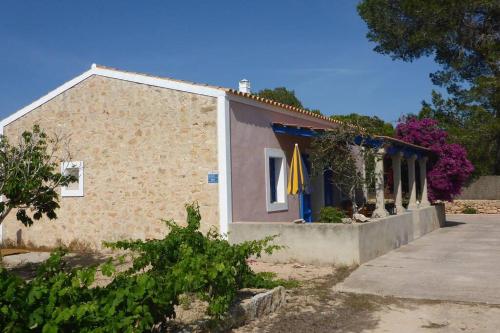
Formentera's capital is a village of white walls and one strong old church. The building was raised in the eighteenth century as a refuge, and the streets still arrange themselves around it.
All yearbest time
Sant Francescnearest area to stay
3.4 kmfrom La Savina port, straight line
Sant Francesc Xavier is Formentera's capital and its largest village, built around the church of the same name: an eighteenth-century fortified building with thick walls, a squat tower and a small square in front. It is where the island's history and its everyday life sit in the same street, and it makes an easy, useful stop on any day inland.
01
A church built as a refuge
The church of Sant Francesc Xavier stands at the centre of the village that grew around it, and its shape explains the history. It was built in the eighteenth century as a refuge as much as a place of worship: thick walls, small openings, a squat tower. When raiders came from the sea, islanders gathered inside and waited. The building is whitewashed like everything else here, and it looks plain rather than grand, which is part of why it still fits the village.
Inside, the scale is small, the light is dim and the air stays cool, which is welcome in August. The church is still in use for services, so treat it as a working building rather than a monument. Visit outside service times, keep voices low near the altar, and do not climb walls or sit on anything that looks fragile. The small square in front is where most visits to Sant Francesc begin and end.
It was built as a refuge as much as a place of worship: thick walls, small openings, a squat tower.
02
How to get there
Formentera has no airport, so the route is always the same: fly to Ibiza (IBZ), then take a ferry from Ibiza Town port to La Savina. Fast ferries cross in about 30-35 minutes; conventional ferries take about an hour. Sailings are frequent in season and fewer in winter, so check the operators before fixing a day. From La Savina, the village is a short trip inland, by bus, on a bike or in a taxi.
The green routes, the circuits verds, are signposted across the island and make the village an easy stop on foot or by bicycle. Buses run between the port, the village and the beaches, with more in summer and fewer out of season. Bringing a car in high season is the one thing to plan in advance, because the Consell de Formentera caps visitor vehicles in summer.
Driving in summer means arriving early and expecting the parking near the centre to be full. The village is small enough to cross on foot in a few minutes, so it is simpler to leave the car on the edge and walk in. Streets are narrow, some run one way, and pavements are thin, so a bicycle is often the calmest way to arrive.
FlyLand at Ibiza (IBZ); Formentera has no airport of its own.
FerryCross from Ibiza Town port to La Savina, then head inland.
BusCheck the island bus operator for times between the port, the village and the beaches.
BikeFollow the signposted green routes, which link the village with the coast.
Saints' figures in the church of Sant Francesc, Formentera03
The best time to come
Mornings are the calmest hours. The square fills slowly, the shops open, and the church can be seen without a crowd around the door. In July and August, come before the middle of the day or wait until the light softens, since the village is inland and the heat settles in the streets. Spring and autumn are the easiest seasons: the village is open, the ferries run, and the pace is closer to how the island normally lives.
Sant Francesc stays inhabited all year, one of the few places on Formentera that does. That matters between November and April, when many businesses elsewhere close and the ferries thin out. The village keeps its everyday rhythm: people shopping, children crossing the square, the island council at work. A winter visit gives you the church with almost nothing around it, though opening times are shorter and worth checking before travelling.
04
What to do in the village
Start in the square in front of the church, which is the centre of everything, then walk outward through the grid of white streets. There is no single sight to tick off. The pleasure is in the ordinary: a village that has long served as the island's capital and still works as one, with small shops, cafés, a pharmacy and the offices of the island council. Allow an hour, more if you stop.
The village is also where Formentera's everyday life is most visible. Shops sell practical things as well as beach things, bakeries and cafés open early, and the pace picks up around midday and quietens in the afternoon. Look at how the buildings are made: thick white walls, small windows, flat roofs, all designed for heat and for rain that arrives in a few heavy days.
Take time over the church itself. The interior is small, cool and dim, with a nave that fits the population it was built for. Look at the thickness of the walls and the height of the windows, and the defensive purpose becomes obvious. Outside, the tower is the tallest thing in the village. If a service is beginning, step out and come back, because the building serves the parish first.
05
Rules and quiet courtesy
This is a working church and a lived-in village, not a museum. Come outside service times, keep voices low inside, and dress as you would for a church anywhere else. Do not touch the altar, the images or anything hanging on the walls. Photographs are usually fine without a flash; if a sign says otherwise, follow the sign. The square belongs to the people who live here, so leave the middle of it to them.
The wider rules are the island's rules. Water is scarce, so use it sparingly. Litter goes with you, including anything small. Do not feed the lizards, which are endemic to these islands and do better without snacks. Dogs stay outside the church. If you are here during a festival or a service, keep to the edge and let the village get on with it. Common sense covers almost everything.
The fortified church of Sant Francesc Xavier on the town square, Formentera
Protect itThe church is a parish building first and a sight second. Quiet, modest dress and no flash are what the village asks of visitors.
06
What to bring
Nothing specialised is needed for a village visit. Water is the main thing, since the square is hot by midday. A hat, sun protection and a light layer for the church, which stays cool whatever the street temperature is. Shoes that cope with cobbles and a little uneven paving. A bag for anything you buy, because small shops may not have one to give.
If you arrive by bicycle, bring a lock and lights, because the roads towards Cap de Barbaria and La Mola are unlit and the return is longer than a small map suggests. A refillable bottle is worth carrying everywhere on Formentera. A paper map still works when a phone does not, and the green routes are signposted well enough to follow without one.
WaterCarry more than you think; the square is hot by midday.
Sun hatThe streets are white and the shade is thin in the middle of the day.
Light layerThe church interior stays cool whatever the temperature outside.
Lock and lightsUseful if you arrive by bicycle and ride back after dark.
07
What is nearby
La Savina, the port, is close enough to reach on foot or by bike, and the two lagoons beside it, Estany des Peix and Estany Pudent, sit inside the Ses Salines Natural Park. The salt pans and the shallow water bring birds, and the light at the end of the day is the reason many people walk that way. The village makes a natural start or finish for that circuit.
To the north, the beaches of Ses Illetes and the sand at Es Pujols are a short ride away, and Es Pujols has the Ca na Costa megalithic tomb, about 4,000 years old, the oldest known monument on the Pitiusas. South, the road runs to Cap de Barbaria and its lighthouse; east, to La Mola and the lighthouse on the plateau. Each is a ride rather than a walk.
The circuits verds are the thread that ties the village to the coast, and they are signposted for walking and cycling. The Consell de Formentera publishes the routes, including the stretches that stay on quiet tracks away from the main road. Pick one that ends near water, and the day has a shape without needing a plan.
La SavinaThe port is a short ride away, with ferries back to Ibiza.
Estany des PeixA shallow lagoon beside the port, good for birds and evening light.
Ses IlletesSand and clear water to the north, reached by bike or bus.
Cap de BarbariaThe southern cape and its lighthouse, at the end of an unlit road.
08
Practical notes
The village is the island's capital and stays open all year, though individual businesses keep their own hours and many on Formentera close roughly from November to April. Check bus times with the island operator, church times with the parish, and crossings with the ferry operators. The tourist tax, the Balearic sustainable tourism tax, is charged by the accommodation per person per night; the rate depends on the type and category of the place and the season, so check the Govern de les Illes Balears.
In summer the Consell de Formentera limits visitor vehicles, so check the rules before bringing or hiring a car. The emergency number is 112. Parking in the village is limited, and the edge of the centre is the sensible place to leave a car. Sant Francesc is small, and the best way to see it is still to arrive on foot, with the square as the place to start.
Check before you goBus timetables, church opening and summer vehicle limits all change. Confirm with the island bus operator, the parish and the Consell de Formentera.
Where to wake up
Stays near Sant Francesc and its fortified church
Stays near Sant Francesc and its fortified church: the first 6 of 25 stays in the IMPT hotel database in or close to Sant Francesc Xavier, the nearest area to Sant Francesc and its fortified church, five-star first, then four-star, then by guest score. Each button opens live prices for your dates in the IMPT app.
Why was the church of Sant Francesc Xavier fortified?
It was built in the eighteenth century as a refuge as much as a place of worship. The thick walls, small openings and squat tower gave islanders somewhere to gather when raiders came from the sea. The building reads as defensive rather than decorative, and that shape is the clearest surviving record of how exposed Formentera once was.
Is the church of Sant Francesc Xavier open to visitors?
It is a working parish church, so opening depends on services and on the time of year. Look at the door when you arrive, and ask in the village if it is shut. Visits are usually possible outside service times, and any change to that is a local matter worth confirming on the day rather than assuming.
How do you get to Sant Francesc Xavier from Ibiza?
Fly to Ibiza (IBZ), then take a ferry from Ibiza Town port to La Savina, which takes about 30-35 minutes on a fast crossing and about an hour on a conventional one. From La Savina the village is a short trip inland by bus, bicycle or taxi. Sailings are fewer in winter, so check the operators first.
Do you need a car to visit Sant Francesc Xavier?
No. The village is small and flat enough to cross on foot, and buses connect it with the port and the beaches. Bicycles work well on the signposted green routes. A car helps for the far ends of the island, but in high season the Consell de Formentera limits visitor vehicles, so check before bringing or hiring one.
What is the best time of day to visit Sant Francesc Xavier?
Morning, before the heat settles and while the square is still quiet. In July and August, either arrive early or wait until the light softens in the late afternoon. Spring and autumn are the easiest seasons overall, when the village is fully open and the ferries run to a fuller timetable.
How long does a visit to Sant Francesc Xavier take?
About an hour for the church, the square and a walk through the surrounding streets. Add time if you stop for coffee, shop, or use the village as the start of a longer ride to the lagoons or the coast. Many people pass through twice in a day, once on the way out and once on the way back.
What is there to see near Sant Francesc Xavier?
La Savina and the lagoons of Estany des Peix and Estany Pudent are close, inside the Ses Salines Natural Park. The beaches of Ses Illetes lie to the north, Es Pujols and the Ca na Costa megalithic tomb are a short ride away, and the lighthouses at Cap de Barbaria and La Mola sit at opposite ends of the island.
How should you behave inside the church at Sant Francesc Xavier?
As you would in any working church. Keep voices low, dress modestly, do not touch the altar or anything on the walls, and avoid photography during a service. If a sign asks for something specific, follow it. The building serves the parish first, and visitors are welcome around that rather than instead of it.
Is Sant Francesc Xavier open in winter?
The village stays inhabited all year and is one of the few places on Formentera that does. Individual shops and cafés keep their own hours, and many businesses on the island close roughly from November to April, so expect a quieter visit with shorter opening times. Ferries are also fewer, so check crossings before planning a winter day.
Photo credits: EvaLuengo1, CC BY-SA 4.0, via Wikimedia Commons; Joan Gené, CC BY-SA 4.0, via Wikimedia Commons; Marcin Janeczek, CC BY 3.0, via Wikimedia Commons.
Watch
Formentera
Formentera from a drone: white sand, shallow turquoise water and boats at anchor.
Captions are built in; the transcript is on the Formentera page.